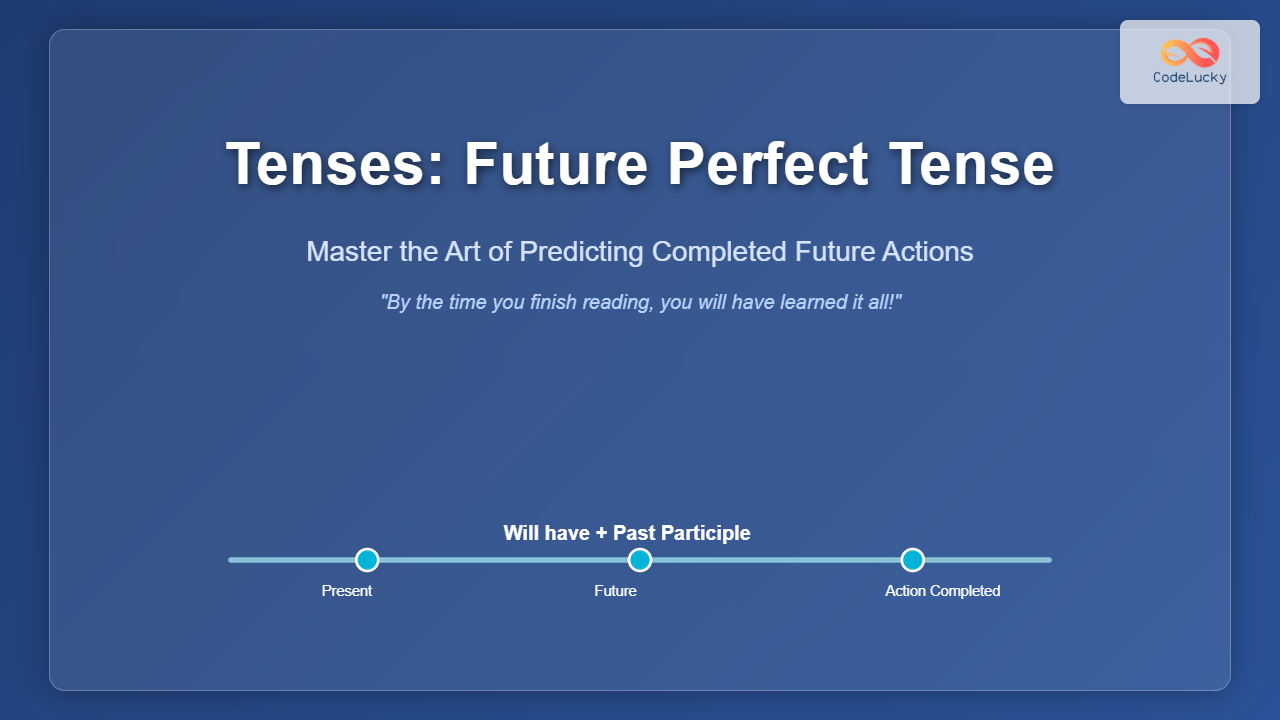
Future Perfect Tense is one of the most fascinating English tenses that helps describe actions that will be completed before a specific time or event in the future. For advanced beginners, understanding this tense is vital for fluency and accurate sentence formation.
What is the Future Perfect Tense?
The Future Perfect Tense is used to talk about an action that will have been completed before another time or event in the future.
Structure:
Subject + will have + past participle (V3)
Examples:
- By 10 PM, I will have finished my homework.
- She will have completed the project by next Monday.
- They will have left before the party starts.
Understanding with a Timeline
To visualize how the Future Perfect Tense fits into time, look at the diagram below:
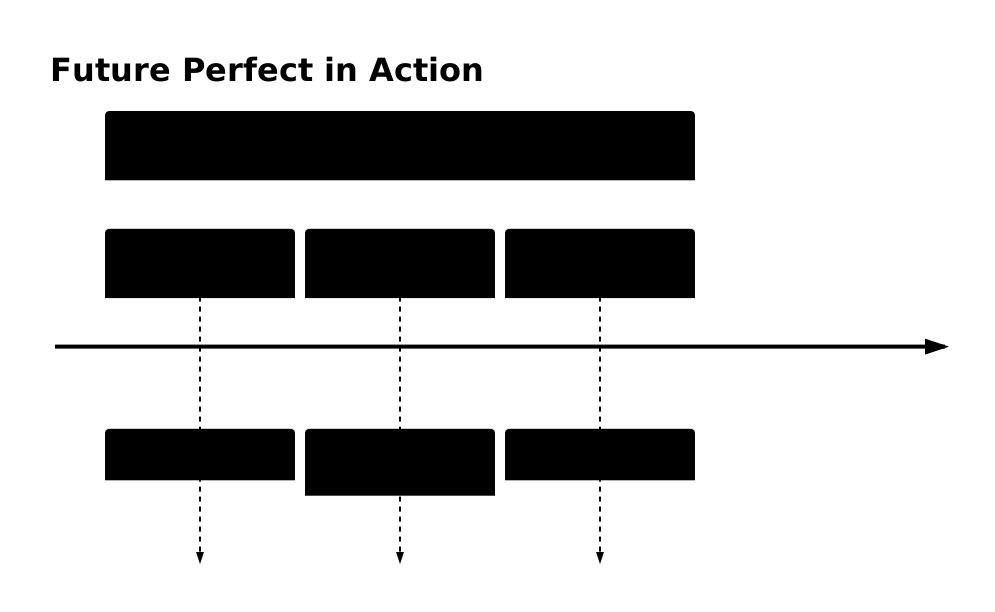
In the above timeline, the action “finish homework” will be completed before the future event “go to bed.” That’s the core logic of Future Perfect Tense.
When to Use Future Perfect Tense
Use the Future Perfect Tense when you want to show that an action will be finished before another event or a specific time in the future. Common scenarios include:
- Deadlines: By this time next week, we will have completed the website.
- Predictions: In five years, people will have adopted more sustainable habits.
- Expectations: She will have reached home by now.
Forming the Future Perfect Tense
Let’s break it down step-by-step:
- Start with the subject – the person or thing doing the action.
- Add “will have”.
- Use the past participle (V3) of the main verb.
Example Breakdown:

Future Perfect with Time Expressions
Certain time expressions often accompany this tense to indicate deadlines or future points in time:
- By tomorrow
- By next week/month/year
- Before + specific future event
- In + time duration (e.g., in two hours, in ten days)
Examples with Time Expressions:
- By 8 PM, the team will have arrived at the stadium.
- Before the sun sets, we will have completed our hike.
- In one hour, she will have cooked dinner.
Interactive Practice: Test Yourself
Complete the blanks using the Future Perfect form of verbs in parentheses:
- By next month, they __________ (finish) painting the house.
- Before we arrive, he __________ (leave) for the airport.
- In two hours, the movie __________ (start).
Think of the correct forms, then check below:
Show Answers
- will have finished
- will have left
- will have started
Negative and Question Forms
Negative Form
Structure: Subject + will not have + past participle
Examples:
- She will not have completed the training by then.
- They will not have reached home before midnight.
Question Form
Structure: Will + subject + have + past participle?
Examples:
- Will you have finished your project by tomorrow?
- Will they have left before the rain starts?
Common Mistakes and Quick Fixes
- Wrong: I will have finish my work.
Correct: I will have finished my work. - Wrong: She will has done it.
Correct: She will have done it. - Wrong: They will have go.
Correct: They will have gone.
How Future Perfect Differs from Similar Tenses

Each tense expresses a different relationship with time and completion:
- Future Simple: Action will happen.
- Future Perfect: Action will be completed before another future event.
- Future Perfect Continuous: Action will have been continuing for some time before a future point.
Mini Quiz
Select the correct future perfect form:
- By 2030, India __________ (achieve) major space milestones.
- Before the guests arrive, we __________ (prepare) everything.
- By the end of this year, you __________ (learn) English tenses perfectly.
Show Answers
- will have achieved
- will have prepared
- will have learned
Summary Table
| Form | Example |
|---|---|
| Affirmative | She will have completed the work. |
| Negative | She will not have completed the work. |
| Question | Will she have completed the work? |
Key Takeaways
- Future Perfect = will have + past participle.
- Used to describe actions completed before a future moment.
- Common with phrases like by the time or before.
- Helps sound precise and fluent in English communication.
Mastering the Future Perfect Tense is a wonderful step forward in expressing complex future ideas clearly. Practice with real-life contexts — deadlines, plans, or predictions — and you’ll soon use it naturally!