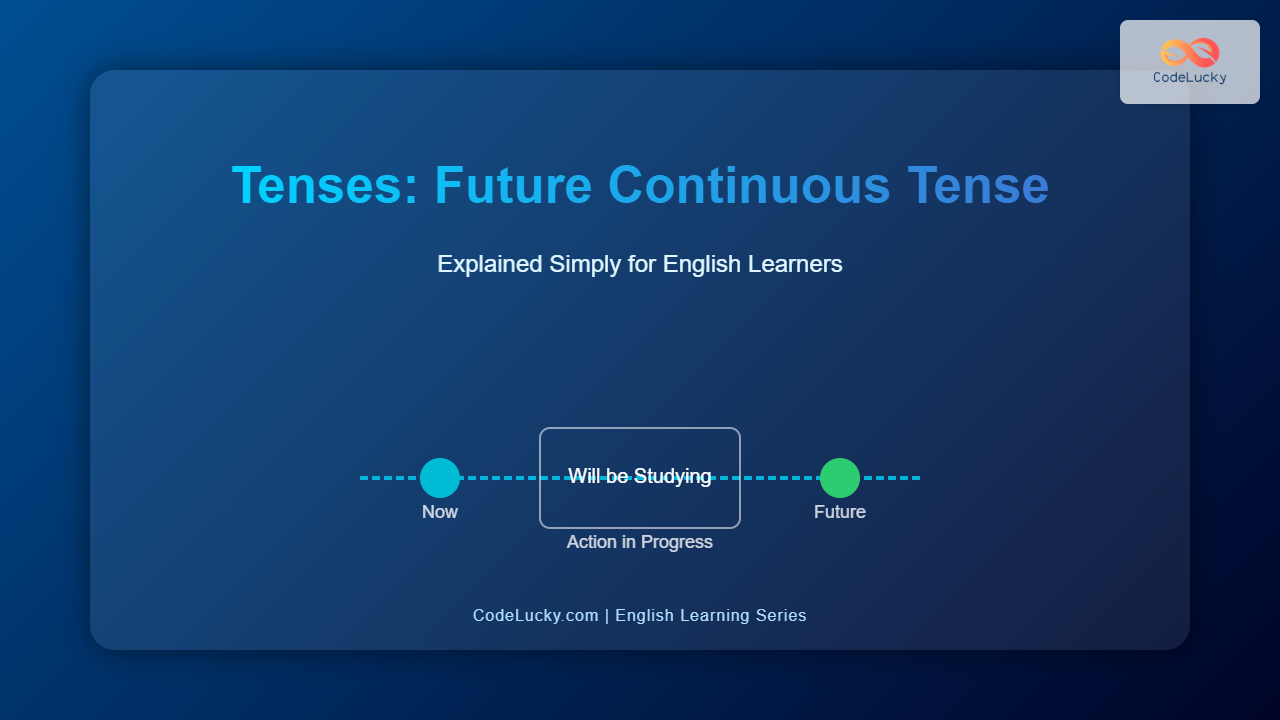
The Future Continuous Tense is one of the most practical and easy-to-understand tenses in English grammar. It describes an action that will be happening at a specific moment in the future. This article from CodeLucky.com breaks down the tense in simple terms, with examples, sentence structures, and visual diagrams to help you master it naturally.
What is the Future Continuous Tense?
The Future Continuous Tense (also known as Future Progressive Tense) expresses an ongoing action that will occur in the future. It focuses on the process or duration of that action rather than just its completion.
Example: “I will be studying at 8 PM tonight.”
This means that at 8 PM, the action of studying will be in progress.

Formula of the Future Continuous Tense
The Future Continuous Tense is formed using the following structure:
Subject + will be + Verb(-ing) + Object
| Sentence Type | Formula | Example |
|---|---|---|
| Affirmative | Subject + will be + Verb(-ing) | She will be reading a novel. |
| Negative | Subject + will not be + Verb(-ing) | She will not be reading a novel. |
| Interrogative | Will + Subject + be + Verb(-ing)? | Will she be reading a novel? |
When to Use the Future Continuous Tense
Use the Future Continuous Tense in the following situations:
- To describe an action happening at a specific time in the future: “They will be sleeping at midnight.”
- To express parallel or simultaneous future actions: “I will be driving while you will be talking to the client.”
- To politely inquire about future plans: “Will you be joining us for dinner?”
- To predict an ongoing situation in the future: “He will be staying with his parents next month.”

Examples of Future Continuous Tense in Different Contexts
Let’s see how the tense works in daily-life examples.
- Personal Action: “I will be traveling to Delhi next week.”
- Work Context: “Our team will be presenting the report tomorrow.”
- Education: “Students will be preparing for their final exams.”
- Predictions: “The weather will be getting colder soon.”
- Courtesy: “Will you be using your car tomorrow?”

Interactive Practice: Try It Yourself
You can actively practice by filling in the blanks. Hover or click to reveal answers (in supported editors or CodeLucky interactive lesson modules).
1. At this time tomorrow, I __________ to Goa.
2. She __________ the meeting next Friday.
3. __________ when you call them?
Future Continuous vs Future Simple
It’s easy to confuse these two tenses. Here’s a table to help you compare them:
| Aspect | Future Simple | Future Continuous |
|---|---|---|
| Focus | Completion of action | Ongoing nature of action |
| Example | I will start the project tomorrow. | I will be working on the project tomorrow evening. |
| Usage | Quick decision or single event | Activity in progress during a period |

Common Mistakes to Avoid
- ❌ Saying “I will studying” instead of ✅ “I will be studying.”
- ❌ Using base verb instead of -ing form.
- ❌ Adding extra helping verbs like “will shall be.”
- ✅ Always keep the structure “will be + verb-ing.”
Quick Recap
Conclusion
The Future Continuous Tense helps express plans and actions in progress at a particular future time. By practicing with simple sentences and visualizing the ongoing nature of the action, you can use this tense confidently in daily communication and writing.
Key takeaway: Use “will be + verb-ing” to describe continuous actions in the future and make your conversations sound natural and fluent.
Written for CodeLucky.com English Learning Series — helping you learn English grammar step by step.