Choosing between free and paid web hosting is one of the most crucial decisions you’ll make when launching your website. With countless options available, understanding the fundamental differences can save you time, money, and potential headaches down the road.
In this comprehensive guide, we’ll examine every aspect of free versus paid hosting, helping you make an informed decision based on your specific needs and goals.
What is Free Web Hosting?
Free web hosting services provide basic website hosting without upfront costs. These providers typically monetize through advertisements displayed on your site, premium upgrades, or by collecting user data.
Popular free hosting providers include:
- 000webhost
- InfinityFree
- AwardSpace
- Freehostia
- GitHub Pages (for static sites)

What is Paid Web Hosting?
Paid web hosting involves monthly or annual fees in exchange for dedicated resources, professional support, and advanced features. These services range from shared hosting to dedicated servers.
Common paid hosting types:
- Shared Hosting: $2-15/month
- VPS Hosting: $10-80/month
- Dedicated Hosting: $80-300+/month
- Cloud Hosting: $5-100+/month
- Managed WordPress: $15-50/month
Free vs Paid Hosting: Detailed Comparison
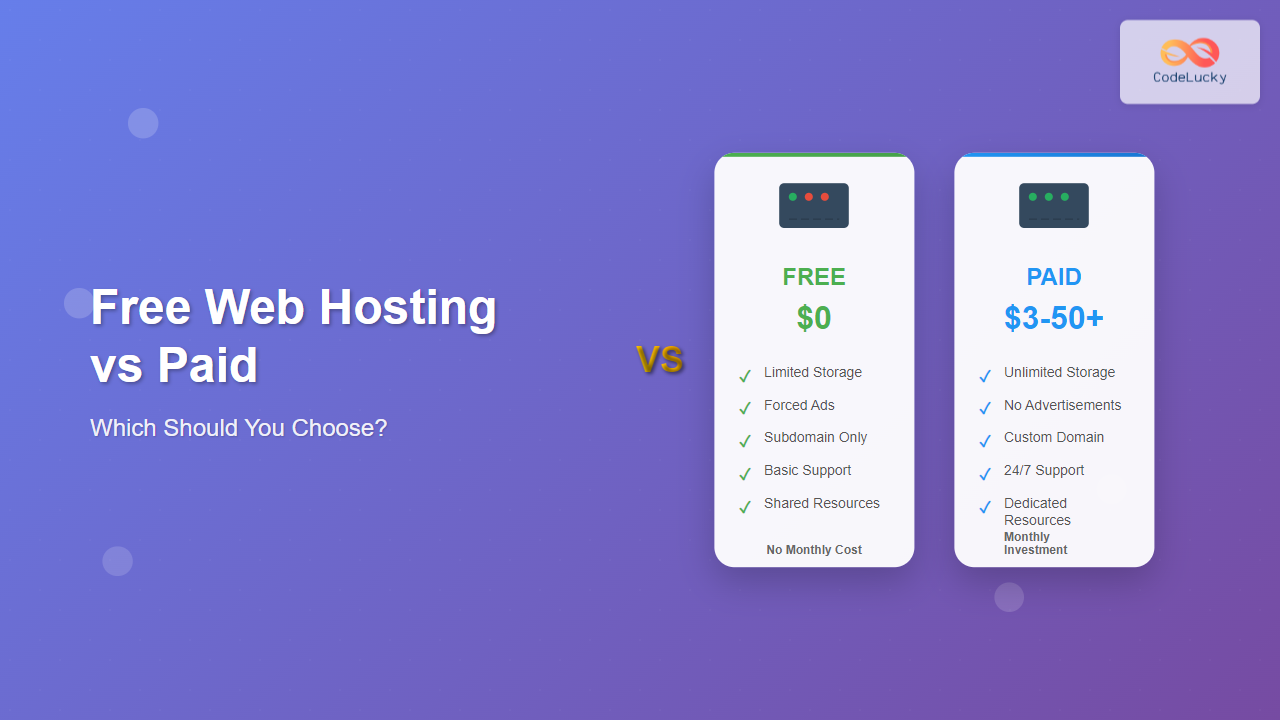
| Feature | Free Hosting | Paid Hosting |
|---|---|---|
| Cost | $0 | $2-300+/month |
| Storage Space | 100MB – 5GB | 10GB – Unlimited |
| Bandwidth | 1-10GB/month | Unlimited or high limits |
| Domain | Subdomain only | Custom domain included |
| Advertisements | Forced ads | No ads |
| Support | Limited/Community | 24/7 Professional |
| Uptime | 90-98% | 99.9%+ |
| Email Hosting | Usually not included | Professional email included |
Advantages of Free Web Hosting
1. Zero Financial Investment
The most obvious benefit is cost savings. Free hosting allows you to experiment with web development without financial commitment, making it perfect for beginners learning HTML, CSS, and basic web design.
2. Quick Start
Most free hosting providers offer instant setup with simple registration processes. You can have a basic website running within minutes.
3. Learning Environment
Free hosting provides an excellent sandbox for students, hobbyists, and developers testing new technologies without risking money on failed experiments.
4. Perfect for Static Sites
Services like GitHub Pages excel at hosting static websites, documentation, and portfolios with impressive performance and reliability.

Disadvantages of Free Web Hosting
1. Limited Resources
Free hosting typically offers minimal storage (100MB-5GB) and bandwidth restrictions that can cause your site to become inaccessible if you exceed limits.
Example resource limitations:
- Storage: Only enough for 50-200 basic web pages
- Bandwidth: 1,000-5,000 visitors per month maximum
- Processing Power: Shared among thousands of users
2. Forced Advertisements
Most free hosts display ads on your website, which you cannot control or remove. These ads can appear as banners, pop-ups, or embedded content that may not align with your brand.
3. No Custom Domain
Free hosting usually provides subdomains like yoursite.freehostname.com, which appears unprofessional and affects SEO rankings and user trust.
4. Poor Performance and Reliability
Free services often experience:
- Frequent downtime (10-20 hours per month)
- Slow loading speeds due to oversold servers
- Limited server locations affecting global performance
5. Minimal Support
Customer support is typically limited to community forums or knowledge bases, with no direct technical assistance when problems arise.

Advantages of Paid Web Hosting
1. Superior Performance
Paid hosting provides dedicated resources, faster servers, and better infrastructure resulting in:
- Load times: 1-3 seconds vs 5-15 seconds on free hosting
- Uptime: 99.9% vs 90-98% on free platforms
- Concurrent users: Handle thousands vs hundreds
2. Professional Features
Paid hosting includes essential business features:
- Custom domain names
- Professional email addresses ([email protected])
- SSL certificates for security
- Daily backups and restore options
- Advanced analytics and monitoring tools
3. Scalability
As your website grows, paid hosting allows seamless upgrades to handle increased traffic, storage needs, and functionality requirements without migration headaches.
4. Security and Compliance
Professional hosting providers offer:
- Regular security updates and patches
- Malware scanning and removal
- DDoS protection
- Compliance with privacy regulations (GDPR, CCPA)
5. Professional Support
24/7 technical support through multiple channels including live chat, phone, and email with guaranteed response times.
Disadvantages of Paid Web Hosting
1. Ongoing Costs
Monthly or annual fees can add up, especially for premium hosting solutions. Budget considerations include:
- Hosting fees: $24-3600+ annually
- Domain registration: $10-50/year
- SSL certificates: $0-200/year (often included)
- Premium themes/plugins: $50-500/year
2. Overwhelming Options
The variety of hosting plans, features, and providers can be confusing for beginners, potentially leading to poor decisions or overspending.
3. Technical Complexity
Some paid hosting options require technical knowledge for server management, security configuration, and performance optimization.

When to Choose Free Web Hosting
Free hosting makes sense in specific scenarios:
1. Personal Projects and Learning
If you’re building a personal blog, portfolio, or learning web development, free hosting provides a risk-free environment to experiment and grow your skills.
2. Static Websites
Simple websites with HTML/CSS/JavaScript that don’t require databases or server-side processing work well on platforms like GitHub Pages or Netlify.
3. Temporary or Testing Sites
When developing prototypes, testing new designs, or creating temporary landing pages, free hosting offers quick deployment without financial commitment.
4. Very Limited Budget
If you absolutely cannot afford hosting costs but need an online presence, free hosting can serve as a temporary solution while you save for paid alternatives.
Example Use Case: A graphic designer creating their first portfolio website might use GitHub Pages to showcase their work while learning web development basics, then upgrade to paid hosting when ready to accept clients.
When to Choose Paid Web Hosting
Paid hosting becomes necessary when your needs exceed free hosting limitations:
1. Business Websites
Any commercial venture requires the reliability, professionalism, and features that only paid hosting can provide. This includes:
- E-commerce stores
- Corporate websites
- Service provider sites
- Membership platforms
2. High-Traffic Sites
Websites expecting more than 1,000 monthly visitors need the bandwidth and performance capabilities of paid hosting to ensure good user experience.
3. Database-Driven Applications
WordPress sites, custom web applications, and content management systems require server-side processing and database access typically unavailable on free platforms.
4. Professional Email Requirements
Business communications demand professional email addresses matching your domain ([email protected]) rather than generic email providers.
5. SEO and Marketing Goals
Serious SEO efforts require custom domains, fast loading speeds, and reliable uptime that free hosting cannot consistently provide.
Example Use Case: A small business launching an online store would choose paid hosting to ensure reliable transactions, professional appearance, and the ability to handle customer inquiries through branded email addresses.
Real-World Performance Comparison
To illustrate the practical differences, let’s examine typical performance metrics:
Loading Speed Test Results
| Hosting Type | Average Load Time | Time to First Byte | Global Performance |
|---|---|---|---|
| Free Hosting | 5-15 seconds | 2-8 seconds | Poor in distant regions |
| Budget Paid ($3-5/month) | 2-4 seconds | 0.5-2 seconds | Good in primary region |
| Premium Paid ($15-30/month) | 1-2 seconds | 0.2-0.8 seconds | Excellent globally |
Traffic Handling Capacity
- Free Hosting: 100-1,000 concurrent users before slowdown
- Shared Paid: 1,000-5,000 concurrent users
- VPS/Cloud: 5,000-50,000+ concurrent users
Migration Considerations
Many users start with free hosting and later migrate to paid solutions. Understanding the migration process helps in long-term planning:
Common Migration Challenges
- Domain Changes: Moving from subdomain to custom domain affects SEO rankings
- File Transfers: Manual copying of files and databases
- Email Setup: Configuring professional email addresses
- Feature Differences: Adapting to new hosting environment capabilities
Migration Best Practices
- Plan Timing: Migrate during low-traffic periods
- Backup Everything: Create complete backups before starting
- Test Thoroughly: Verify all functionality on new hosting
- Update DNS: Point domain to new hosting provider
- Monitor Performance: Check site speed and functionality post-migration

Cost-Benefit Analysis
Understanding the true cost difference helps in making informed decisions:
Free Hosting Hidden Costs
- Time Investment: 5-10 hours dealing with limitations and issues
- Lost Opportunities: Poor user experience affecting conversions
- Migration Costs: Eventually moving to paid hosting anyway
- SEO Impact: Lower rankings due to performance issues
Paid Hosting Value Proposition
- Professional Image: Custom domain and no ads
- Time Savings: Reliable performance and support
- Growth Potential: Ability to scale with your needs
- Security Benefits: Protected from malware and attacks
Hosting Recommendations by Use Case
For Beginners Learning Web Development
Recommendation: Start with GitHub Pages for static sites or 000webhost for PHP/MySQL learning
- Zero cost for experimentation
- Good documentation and community support
- Easy upgrade path to paid hosting
For Small Business Websites
Recommendation: Shared hosting ($3-8/month) from reputable providers
- Professional appearance with custom domain
- Reliable performance for moderate traffic
- Email hosting and basic security features
For E-commerce Sites
Recommendation: Managed hosting or VPS ($15-50/month)
- Enhanced security for transactions
- Better performance for shopping cart functionality
- 24/7 support for critical business operations
For High-Traffic Blogs
Recommendation: Cloud hosting or managed WordPress hosting
- Auto-scaling for traffic spikes
- Content delivery network integration
- Advanced caching and optimization
Making Your Decision
To choose between free and paid hosting, ask yourself these key questions:
- What’s my primary goal? Learning/experimenting vs. business/professional use
- How much traffic do I expect? Under 1,000 vs. thousands of monthly visitors
- Do I need a professional image? Personal project vs. business representation
- What’s my budget? Zero cost vs. $3-50+ monthly investment
- How important is reliability? Occasional downtime acceptable vs. 99.9% uptime required
- Do I need support? Self-sufficient vs. requiring technical assistance
Quick Decision Matrix:
- Choose Free Hosting If: Learning, personal projects, static sites, zero budget, temporary use
- Choose Paid Hosting If: Business use, high traffic expected, professional image required, need reliability and support
Conclusion
The choice between free and paid web hosting ultimately depends on your specific needs, goals, and circumstances. Free hosting serves as an excellent starting point for learning and experimentation, while paid hosting becomes essential for serious websites requiring reliability, performance, and professional features.
Many successful websites begin with free hosting and migrate to paid solutions as their needs grow. This progression is natural and expected in web development. The key is honestly assessing your current requirements while planning for future growth.
Remember that web hosting is the foundation of your online presence. Investing in quality hosting often pays dividends through better user experience, improved SEO rankings, and reduced technical headaches. Whether you start free or go directly to paid hosting, make sure your choice aligns with your long-term objectives and provides room for growth.
Consider starting with free hosting for learning and experimentation, but be prepared to upgrade to paid hosting when your website becomes a serious project or business venture. The small monthly investment in quality hosting is often one of the best decisions you’ll make for your online success.
- What is Free Web Hosting?
- What is Paid Web Hosting?
- Free vs Paid Hosting: Detailed Comparison
- Advantages of Free Web Hosting
- Disadvantages of Free Web Hosting
- Advantages of Paid Web Hosting
- Disadvantages of Paid Web Hosting
- When to Choose Free Web Hosting
- When to Choose Paid Web Hosting
- Real-World Performance Comparison
- Migration Considerations
- Cost-Benefit Analysis
- Hosting Recommendations by Use Case
- Making Your Decision
- Conclusion