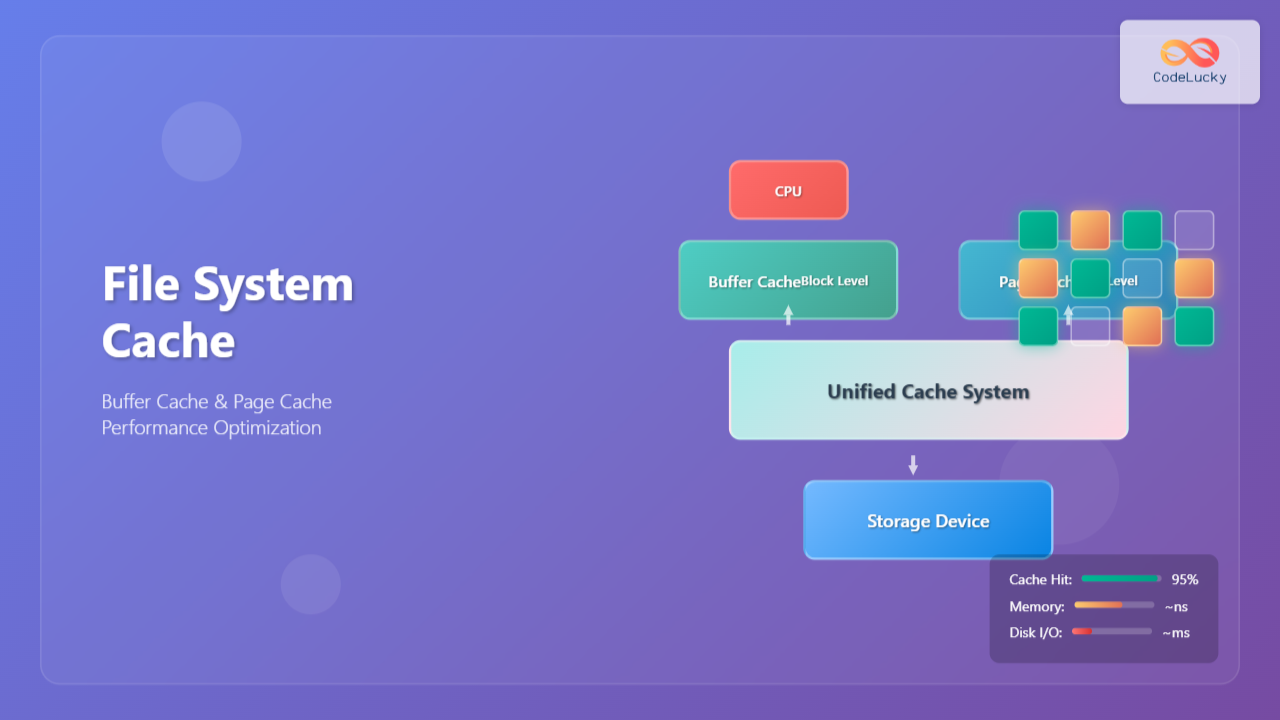
File system caching is a fundamental performance optimization technique in modern operating systems that dramatically reduces disk I/O operations by storing frequently accessed data in memory. This comprehensive guide explores the two primary caching mechanisms: buffer cache and page cache, their differences, implementation details, and real-world applications.
Understanding File System Cache Fundamentals
File system cache acts as an intermediary layer between applications and storage devices, leveraging the principle of locality of reference. When applications request data, the operating system first checks if the data exists in cache memory before accessing slower storage devices.

Key Benefits of File System Caching
- Reduced Latency: Memory access (nanoseconds) vs disk access (milliseconds)
- Improved Throughput: Multiple requests served from cache simultaneously
- Lower CPU Utilization: Fewer context switches for I/O operations
- Enhanced User Experience: Faster application response times
Buffer Cache: Block-Level Caching Mechanism
Buffer cache operates at the block level, managing fixed-size blocks of data typically ranging from 512 bytes to 8KB. This caching layer sits between the file system and block device drivers, providing efficient storage and retrieval of disk blocks.
Buffer Cache Architecture

Buffer Cache Implementation Example
// Simplified buffer cache structure in C
struct buffer_head {
    unsigned long b_blocknr;     // Block number
    char *b_data;                // Pointer to data
    struct buffer_head *b_next;  // Hash chain pointer
    struct buffer_head *b_prev;  // LRU chain pointer
    int b_count;                 // Reference count
    int b_state;                 // Buffer state flags
};

// Buffer states
#define BH_Uptodate  0  // Buffer contains valid data
#define BH_Dirty     1  // Buffer needs writing to disk
#define BH_Lock      2  // Buffer is locked
#define BH_Req       3  // Buffer has pending request
Buffer Cache Operations
The buffer cache implements several key operations for efficient data management:
1. Buffer Allocation and Lookup
// Example of buffer lookup function
struct buffer_head *getblk(dev_t device, int block, int size) {
    struct buffer_head *bh;

    // Hash lookup for existing buffer
    bh = get_hash_table(device, block, size);
    if (bh) {
        bh->b_count++;  // Increment reference count
        return bh;
    }

    // Allocate new buffer if not found
    bh = get_unused_buffer_head();
    bh->b_blocknr = block;
    bh->b_size = size;
    bh->b_dev = device;

    // Add to hash table
    insert_into_hash_queue(bh);
    return bh;
}
2. Write-Back Strategy
Buffer cache implements write-back caching where dirty buffers are written to disk asynchronously:
// Periodic sync operation
void sync_buffers(void) {
    struct buffer_head *bh;

    for (bh = lru_list; bh; bh = bh->b_next_lru) {
        if (buffer_dirty(bh) && !buffer_locked(bh)) {
            ll_rw_block(WRITE, 1, &bh);
        }
    }
}
Page Cache: File-Level Caching System
Page cache operates at the file level, managing entire pages of file data (typically 4KB on most systems). It’s more sophisticated than buffer cache, supporting memory-mapped files and providing better integration with virtual memory systems.

Page Cache Data Structures
// Linux page cache structures
struct address_space {
    struct inode *host;              // Associated inode
    struct radix_tree_root page_tree; // Pages indexed by offset
    spinlock_t tree_lock;            // Protects page_tree
    unsigned int i_mmap_writable;    // VM_SHARED mappings
    struct rb_root i_mmap;           // VM areas mapped to this file
    atomic_t i_mmap_writable;        // Number of writable mappings
    unsigned long nrpages;           // Number of pages
};

struct page {
    unsigned long flags;         // Page flags (dirty, locked, etc.)
    atomic_t _count;            // Reference count
    struct address_space *mapping; // Associated address space
    pgoff_t index;              // Page offset in file
    struct list_head lru;       // LRU list linkage
    void *private;              // Filesystem private data
};
Page Cache Lookup and Allocation
// Find or create a page in the page cache
struct page *find_or_create_page(struct address_space *mapping,
                                 pgoff_t index, gfp_t gfp_mask) {
    struct page *page;

    // Look for existing page
    page = find_get_page(mapping, index);
    if (page)
        return page;

    // Allocate new page
    page = __page_cache_alloc(gfp_mask);
    if (!page)
        return NULL;

    // Add to page cache
    if (add_to_page_cache_lru(page, mapping, index, gfp_mask)) {
        put_page(page);
        return NULL;
    }

    return page;
}
Key Differences Between Buffer Cache and Page Cache

| Aspect | Buffer Cache | Page Cache |
|---|---|---|
| Granularity | Block-level (512B – 8KB) | Page-level (4KB typical) |
| Primary Use | Metadata and raw device access | File content caching |
| Integration | Block layer integration | Virtual memory integration |
| Memory Mapping | Not supported | Fully supported |
| Indexing | Hash tables | Radix trees |
Modern Unified Cache Implementation
Contemporary operating systems like Linux have largely unified buffer cache and page cache into a single coherent system. This unified approach eliminates redundancy and provides better memory utilization.
Unified Cache Benefits
- Memory Efficiency: No duplicate caching of the same data
- Coherency: Single source of truth for cached data
- Simplified Management: Unified replacement policies
- Better Performance: Reduced memory fragmentation
Example: Linux Unified Cache Operation
// Reading from a file through unified cache
ssize_t generic_file_read_iter(struct kiocb *iocb, struct iov_iter *iter) {
    struct file *file = iocb->ki_filp;
    struct address_space *mapping = file->f_mapping;
    struct page *page;
    loff_t pos = iocb->ki_pos;

    while (iov_iter_count(iter)) {
        pgoff_t index = pos >> PAGE_SHIFT;

        // Find page in cache
        page = find_get_page(mapping, index);
        if (!page) {
            // Page fault - read from storage
            page = page_cache_read(file, index);
        }

        // Copy data to user space
        copy_page_to_iter(page, offset, bytes, iter);
        put_page(page);

        pos += bytes;
    }

    return bytes_copied;
}
Cache Replacement Algorithms
Both buffer cache and page cache implement sophisticated replacement algorithms to manage limited memory resources efficiently.

LRU (Least Recently Used) Implementation
// Simplified LRU implementation for page cache
struct lru_cache {
    struct list_head active_list;    // Recently accessed pages
    struct list_head inactive_list;  // Less recently accessed pages
    spinlock_t lru_lock;            // Protects LRU lists
    unsigned long nr_active;         // Count of active pages
    unsigned long nr_inactive;       // Count of inactive pages
};

// Move page to front of active list
void mark_page_accessed(struct page *page) {
    if (PageActive(page)) {
        // Already active, move to front
        list_move(&page->lru, &active_list);
    } else if (PageReferenced(page)) {
        // Promote from inactive to active
        SetPageActive(page);
        ClearPageReferenced(page);
        list_move(&page->lru, &active_list);
        nr_active++;
        nr_inactive--;
    } else {
        // First access, mark as referenced
        SetPageReferenced(page);
    }
}
Performance Monitoring and Optimization
Understanding cache performance is crucial for system optimization. Here are key metrics and monitoring techniques:
Cache Performance Metrics
# Monitor cache hit rates and memory usage
cat /proc/meminfo | grep -E "(Cached|Buffers|Dirty|Writeback)"
Buffers:        1048576 kB
Cached:         8388608 kB
SwapCached:           0 kB
Dirty:            12345 kB
Writeback:            0 kB

# Monitor I/O statistics
iostat -x 1
Device    r/s     w/s    rkB/s    wkB/s   await  %util
sda      10.2     5.1   512.4    204.8    2.1    1.2
Optimization Techniques
- Prefetching: Anticipatory loading of data
- Write Coalescing: Combining multiple small writes
- Readahead: Sequential read optimization
- Memory Pressure Management: Dynamic cache size adjustment
Example: Implementing Read-ahead
// Simplified readahead implementation
void page_cache_readahead(struct address_space *mapping,
                         struct file_ra_state *ra,
                         struct file *file,
                         pgoff_t offset,
                         unsigned long size) {
    unsigned long max_ahead = ra->ra_pages;
    pgoff_t start = offset;
    pgoff_t end = offset + size;

    // Determine readahead window
    if (ra->prev_pos + 1 == offset) {
        // Sequential access - increase readahead
        ra->size = min(ra->size * 2, max_ahead);
    } else {
        // Random access - reset readahead
        ra->size = get_init_ra_size(size, max_ahead);
    }

    // Trigger asynchronous reads
    for (pgoff_t page_offset = start;
         page_offset < end;
         page_offset++) {
        if (!find_get_page(mapping, page_offset)) {
            __do_page_cache_readahead(mapping, file,
                                    page_offset, 1, 0);
        }
    }

    ra->prev_pos = offset;
}
Real-World Applications and Use Cases
File system caching plays critical roles in various scenarios:
Database Systems
Database management systems rely heavily on caching for performance:
// Database buffer pool management
struct buffer_pool {
    struct hash_table *page_hash;    // Quick page lookup
    struct lru_list *replacement;    // Replacement policy
    struct page_frame *frames;       // Physical page frames
    size_t pool_size;               // Total buffer pool size
    atomic_t hit_count;             // Cache hit statistics
    atomic_t miss_count;            // Cache miss statistics
};

// Buffer pool hit ratio calculation
double get_hit_ratio(struct buffer_pool *pool) {
    long hits = atomic_read(&pool->hit_count);
    long misses = atomic_read(&pool->miss_count);
    return (double)hits / (hits + misses) * 100.0;
}
Web Servers
Web servers benefit from caching static content:
// Web server file caching example
struct file_cache_entry {
    char *filename;
    char *content;
    size_t content_length;
    time_t last_modified;
    time_t cached_time;
    int reference_count;
};

// Serve file with caching
int serve_cached_file(const char *filename, int client_socket) {
    struct file_cache_entry *entry = find_cached_file(filename);

    if (entry && is_cache_valid(entry)) {
        // Cache hit - serve from memory
        send(client_socket, entry->content,
             entry->content_length, 0);
        entry->reference_count++;
        return 0;
    }

    // Cache miss - read from disk and cache
    entry = load_and_cache_file(filename);
    if (entry) {
        send(client_socket, entry->content,
             entry->content_length, 0);
        return 0;
    }

    return -1; // File not found
}
Advanced Cache Synchronization
Maintaining cache coherency across multiple processes and systems requires sophisticated synchronization mechanisms:
// Cache coherency protocol implementation
enum cache_state {
    CACHE_INVALID = 0,
    CACHE_SHARED = 1,
    CACHE_MODIFIED = 2,
    CACHE_EXCLUSIVE = 3
};

struct cache_line {
    void *data;
    size_t size;
    enum cache_state state;
    atomic_t reference_count;
    spinlock_t state_lock;
};

// Invalidate cache entry across all caches
void invalidate_cache_entry(struct cache_line *line) {
    spin_lock(&line->state_lock);

    if (line->state == CACHE_MODIFIED) {
        // Write back dirty data
        write_back_to_storage(line->data, line->size);
    }

    line->state = CACHE_INVALID;
    spin_unlock(&line->state_lock);

    // Notify other cache instances
    broadcast_invalidation(line);
}
Troubleshooting Common Cache Issues
Understanding and resolving cache-related problems is essential for system administrators:
Cache Thrashing
# Detect cache thrashing patterns
vmstat 1 10 | awk '
/procs/ { print; next }
/r b/ { print; next }
{
    if ($9 > 1000) { # High wait I/O
        print $0 " <- High I/O Wait"
    } else {
        print
    }
}'

# Monitor page fault rates
sar -B 1 5
02:30:01 PM  pgpgin/s pgpgout/s   fault/s  majflt/s  pgfree/s
02:30:02 PM    245.50      12.87   1234.65      45.21    987.34
Memory Pressure Debugging
# Check memory allocation failures
dmesg | grep -i "out of memory\|killed process"

# Monitor slab allocator for cache objects
cat /proc/slabinfo | head -20
slabinfo - version: 2.1
# name
buffer_head     15234    15240      104       39
dentry          45678    45720       192       21
inode_cache     12345    12360       608        6
Future Trends in File System Caching
Emerging technologies and trends shaping the future of file system caching include:
- NVMe and Persistent Memory: Blurring lines between storage and memory
- Machine Learning: Intelligent prefetching and replacement policies
- Distributed Caching: Cache coherency across network-attached storage
- Container-Aware Caching: Optimizations for containerized workloads
Conclusion
File system caching through buffer cache and page cache mechanisms represents one of the most critical performance optimizations in modern operating systems. Understanding these systems enables developers and system administrators to build more efficient applications and optimize system performance effectively.
The evolution from separate buffer and page caches to unified caching systems demonstrates the continuous refinement of operating system design. As storage technologies advance and workload patterns evolve, caching strategies will continue to adapt, ensuring optimal balance between performance, resource utilization, and data consistency.
Mastering these concepts provides a solid foundation for tackling complex system performance challenges and designing scalable applications that effectively leverage system resources.
Related Posts

PHP Caching: Improving Application Performance
In the world of web development, performance is king. As your PHP applications grow in complexity and user base, the...

Buffering in Operating System: Complete Guide to Single, Double and Circular Buffer Implementation
What is Buffering in Operating System? Buffering in operating systems is a fundamental technique used to temporarily store data in...

MySQL Query Cache: Speeding Up Data Retrieval
The MySQL query cache is like a high-speed shortcut for your database. Instead of re-executing the same query multiple times,...

Demand Paging: Loading Pages on Demand for Efficiency
Introduction to Demand Paging Demand paging is a sophisticated memory management technique used by modern operating systems to optimize memory...

memcached Linux: Complete Guide to High-Performance Caching System
Memcached is a high-performance, distributed memory object caching system that dramatically improves application performance by storing frequently accessed data in...

CSS Caching: Complete Guide to Browser Cache and CDN Optimization Strategies
CSS caching is a fundamental performance optimization technique that dramatically reduces page load times and improves user experience. By implementing...
tmpfs Linux: Complete Guide to Temporary Filesystem in Memory for Better Performance
tmpfs (temporary file system) is a powerful Linux feature that creates a virtual filesystem stored entirely in RAM and swap...
Memory Management in Operating System: Virtual and Physical Memory Fundamentals
Introduction to Memory Management Memory management is one of the most critical functions of an operating system, responsible for efficiently...
File System in Operating System: Complete Guide to Structure and Organization
Introduction to File Systems A file system is a fundamental component of any operating system that provides a structured way...

Log-structured File System: Sequential Write Optimization for High-Performance Storage
Log-structured File Systems (LFS) represent a revolutionary approach to data storage that fundamentally changes how operating systems handle file operations....
Paging in Operating System: Complete Guide to Memory Management and Page Tables
What is Paging in Operating Systems? Paging is a memory management scheme that allows the operating system to store and...

File Locking Mechanisms: Complete Guide to Advisory and Mandatory Locking in Operating Systems
File locking mechanisms are essential components of modern operating systems that prevent data corruption and ensure data integrity when multiple...