Introduction to Fault Tolerance
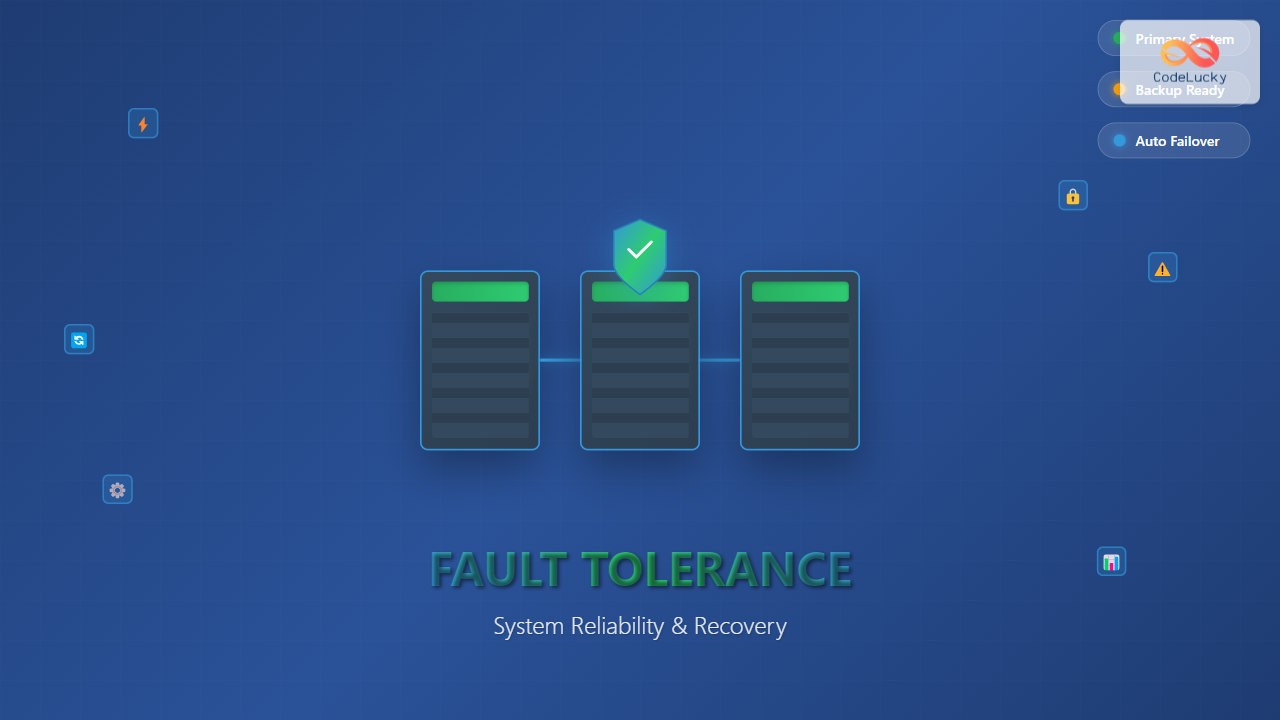
Fault tolerance is a critical aspect of system design that ensures continued operation despite hardware failures, software bugs, or environmental disruptions. In today’s interconnected world, system downtime can cost businesses thousands of dollars per minute, making fault tolerance not just desirable but essential.
A fault-tolerant system is designed to continue operating correctly even when one or more of its components fail. This capability is achieved through various techniques including redundancy, error detection, isolation, and recovery mechanisms.
Understanding Faults, Errors, and Failures
Before diving into fault tolerance techniques, it’s crucial to understand the distinction between faults, errors, and failures:
- Fault: The underlying cause of a problem (hardware malfunction, software bug)
- Error: The manifestation of a fault in the system state
- Failure: When the system deviates from its specified behavior

Types of Faults
Transient Faults
Transient faults occur temporarily and disappear without intervention. These are often caused by:
- Electromagnetic interference
- Power fluctuations
- Cosmic rays affecting memory
- Network congestion
Example: A single bit flip in memory due to radiation that corrects itself during the next memory refresh cycle.
Intermittent Faults
Intermittent faults appear and disappear repeatedly, making them difficult to diagnose. Common causes include:
- Loose connections
- Temperature-sensitive components
- Race conditions in software
Permanent Faults
Permanent faults persist until the faulty component is repaired or replaced. Examples include:
- Hard disk failures
- Burned-out processors
- Software bugs that always trigger under specific conditions
Fault Tolerance Techniques
1. Redundancy
Redundancy is the most fundamental fault tolerance technique, involving the use of multiple identical components to perform the same function.
Hardware Redundancy
Hardware redundancy can be implemented at various levels:
- Component Level: Duplicate processors, memory modules, or storage devices
- System Level: Multiple servers performing the same task
- Site Level: Geographically distributed data centers

Software Redundancy
Software redundancy involves running multiple versions of software:
- N-Version Programming: Multiple teams develop independent implementations
- Recovery Blocks: Sequential execution of alternative algorithms
- Checkpointing: Periodic saving of system state
Information Redundancy
Information redundancy adds extra bits to detect and correct errors:
- Parity Bits: Simple error detection
- Hamming Codes: Single error correction
- Reed-Solomon Codes: Multiple error correction
Time Redundancy
Time redundancy involves repeating operations to detect transient faults:
def fault_tolerant_operation(data):
    attempts = 0
    max_attempts = 3

    while attempts < max_attempts:
        try:
            result1 = process_data(data)
            result2 = process_data(data)  # Repeat operation

            if result1 == result2:
                return result1  # Results match, likely correct
            else:
                attempts += 1  # Mismatch detected, retry

        except Exception as e:
            attempts += 1
            if attempts >= max_attempts:
                raise e

    raise Exception("Operation failed after maximum attempts")
2. Error Detection Mechanisms
Watchdog Timers
Watchdog timers monitor system activity and trigger recovery actions if the system becomes unresponsive:
#include
#include

volatile int watchdog_counter = 0;

void watchdog_handler(int sig) {
    if (watchdog_counter == 0) {
        // System appears hung, initiate recovery
        printf("System hang detected, initiating recovery...\n");
        system_recovery();
    }
    watchdog_counter = 0;  // Reset counter
    alarm(5);  // Set next watchdog timeout
}

void main_loop() {
    signal(SIGALRM, watchdog_handler);
    alarm(5);  // Initial watchdog setup

    while (1) {
        // Main system work
        perform_critical_operations();

        // Pet the watchdog
        watchdog_counter++;
    }
}
Heartbeat Monitoring
Heartbeat mechanisms involve periodic signals between system components to verify their operational status:
import time
import threading
from datetime import datetime, timedelta

class HeartbeatMonitor:
    def __init__(self, timeout_seconds=10):
        self.timeout = timeout_seconds
        self.last_heartbeat = {}
        self.monitoring = True

    def register_component(self, component_id):
        self.last_heartbeat[component_id] = datetime.now()

    def heartbeat(self, component_id):
        self.last_heartbeat[component_id] = datetime.now()

    def check_components(self):
        current_time = datetime.now()
        failed_components = []

        for component_id, last_beat in self.last_heartbeat.items():
            if current_time - last_beat > timedelta(seconds=self.timeout):
                failed_components.append(component_id)

        return failed_components

    def monitor_loop(self):
        while self.monitoring:
            failed = self.check_components()
            if failed:
                print(f"Failed components detected: {failed}")
                self.handle_failures(failed)
            time.sleep(1)
3. Recovery Mechanisms
Rollback Recovery
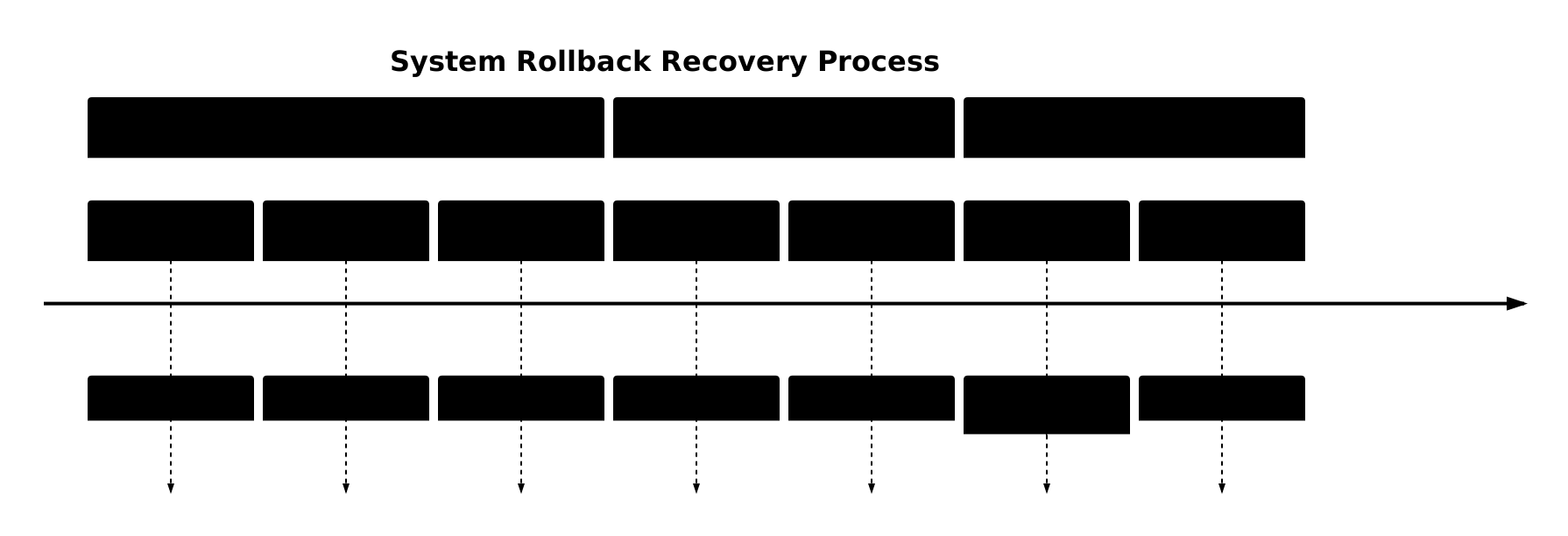
Rollback recovery restores the system to a previous known-good state when an error is detected:
Forward Recovery
Forward recovery attempts to continue operation by correcting the error or working around it:
class ForwardRecoverySystem:
    def __init__(self):
        self.error_handlers = {}
        self.fallback_strategies = []

    def register_error_handler(self, error_type, handler_func):
        self.error_handlers[error_type] = handler_func

    def add_fallback_strategy(self, strategy_func):
        self.fallback_strategies.append(strategy_func)

    def execute_with_recovery(self, operation, *args, **kwargs):
        try:
            return operation(*args, **kwargs)
        except Exception as e:
            error_type = type(e).__name__

            # Try specific error handler
            if error_type in self.error_handlers:
                try:
                    return self.error_handlers[error_type](e, *args, **kwargs)
                except:
                    pass

            # Try fallback strategies
            for strategy in self.fallback_strategies:
                try:
                    return strategy(*args, **kwargs)
                except:
                    continue

            # All recovery attempts failed
            raise e

# Usage example
recovery_system = ForwardRecoverySystem()

def handle_network_error(error, url, **kwargs):
    # Try alternative server
    backup_url = url.replace('primary', 'backup')
    return fetch_data(backup_url)

recovery_system.register_error_handler('ConnectionError', handle_network_error)
Fault Tolerance Patterns in Distributed Systems
Circuit Breaker Pattern
The circuit breaker pattern prevents cascading failures by temporarily disabling calls to a failing service:
import time
from enum import Enum

class CircuitState(Enum):
    CLOSED = 1
    OPEN = 2
    HALF_OPEN = 3

class CircuitBreaker:
    def __init__(self, failure_threshold=5, timeout=60):
        self.failure_threshold = failure_threshold
        self.timeout = timeout
        self.failure_count = 0
        self.last_failure_time = None
        self.state = CircuitState.CLOSED

    def call(self, func, *args, **kwargs):
        if self.state == CircuitState.OPEN:
            if self._should_attempt_reset():
                self.state = CircuitState.HALF_OPEN
            else:
                raise Exception("Circuit breaker is OPEN")

        try:
            result = func(*args, **kwargs)
            self._on_success()
            return result
        except Exception as e:
            self._on_failure()
            raise e

    def _should_attempt_reset(self):
        return (time.time() - self.last_failure_time) >= self.timeout

    def _on_success(self):
        self.failure_count = 0
        self.state = CircuitState.CLOSED

    def _on_failure(self):
        self.failure_count += 1
        self.last_failure_time = time.time()

        if self.failure_count >= self.failure_threshold:
            self.state = CircuitState.OPEN
Bulkhead Pattern
The bulkhead pattern isolates critical resources to prevent failures from spreading:

Measuring System Reliability
Key Metrics
Several metrics help quantify system reliability:
- MTBF (Mean Time Between Failures): Average time between system failures
- MTTR (Mean Time To Repair): Average time to restore service after failure
- Availability: Percentage of time system is operational
- Reliability: Probability system performs correctly during a specific time period
Availability calculation:
Availability = MTBF / (MTBF + MTTR)The Nine’s of Availability
| Availability % | Downtime per Year | Downtime per Month | Common Description |
|---|---|---|---|
| 90% | 36.53 days | 73 hours | One nine |
| 99% | 3.65 days | 7.3 hours | Two nines |
| 99.9% | 8.77 hours | 44 minutes | Three nines |
| 99.99% | 52.6 minutes | 4.4 minutes | Four nines |
| 99.999% | 5.26 minutes | 26 seconds | Five nines |
Implementing Fault Tolerance in Practice
Database Fault Tolerance
Database systems implement fault tolerance through various mechanisms:
- RAID Arrays: Redundant storage with automatic failover
- Master-Slave Replication: Real-time data synchronization
- Clustering: Multiple database instances sharing load
- Point-in-Time Recovery: Transaction log-based recovery
Network Fault Tolerance
Network resilience strategies include:
- Redundant Paths: Multiple network routes
- Load Balancing: Distributing traffic across multiple servers
- Failover Protocols: Automatic switching to backup connections
- Quality of Service (QoS): Prioritizing critical traffic
Application-Level Fault Tolerance
Applications can implement fault tolerance through:
import functools
import time
import random

def retry_with_backoff(max_retries=3, base_delay=1, backoff_factor=2):
    def decorator(func):
        @functools.wraps(func)
        def wrapper(*args, **kwargs):
            for attempt in range(max_retries):
                try:
                    return func(*args, **kwargs)
                except Exception as e:
                    if attempt == max_retries - 1:
                        raise e

                    # Exponential backoff with jitter
                    delay = base_delay * (backoff_factor ** attempt)
                    jitter = random.uniform(0.1, 0.5)
                    time.sleep(delay + jitter)

                    print(f"Attempt {attempt + 1} failed, retrying in {delay:.2f}s...")

        return wrapper
    return decorator

@retry_with_backoff(max_retries=5, base_delay=0.5)
def unreliable_api_call():
    # Simulate an unreliable external API
    if random.random() < 0.7:  # 70% failure rate
        raise ConnectionError("Network timeout")
    return "Success!"
Best Practices for Fault-Tolerant System Design
Design Principles
- Fail Fast: Detect errors quickly and fail predictably
- Isolation: Contain failures to prevent cascading effects
- Graceful Degradation: Reduce functionality rather than complete failure
- Monitoring and Alerting: Implement comprehensive system monitoring
- Testing: Regularly test failure scenarios and recovery procedures
Implementation Guidelines
- Use timeouts for all external calls and operations
- Implement health checks for all system components
- Design for idempotency to safely retry operations
- Use asynchronous processing to prevent blocking failures
- Implement proper logging for failure analysis and debugging
Chaos Engineering: Testing Fault Tolerance
Chaos engineering involves intentionally introducing failures to test system resilience:
import random
import time
import threading

class ChaosMonkey:
    def __init__(self, services):
        self.services = services
        self.active = False

    def start_chaos(self, failure_rate=0.1, max_downtime=30):
        self.active = True
        threading.Thread(target=self._chaos_loop,
                        args=(failure_rate, max_downtime)).start()

    def _chaos_loop(self, failure_rate, max_downtime):
        while self.active:
            if random.random() < failure_rate:
                target_service = random.choice(self.services)
                downtime = random.uniform(5, max_downtime)

                print(f"Chaos Monkey: Attacking {target_service} for {downtime:.1f}s")
                self._attack_service(target_service, downtime)

            time.sleep(60)  # Check every minute

    def _attack_service(self, service_name, duration):
        # Simulate various failure modes
        failure_modes = [
            self._simulate_high_latency,
            self._simulate_service_down,
            self._simulate_resource_exhaustion
        ]

        failure_mode = random.choice(failure_modes)
        failure_mode(service_name, duration)

    def stop_chaos(self):
        self.active = False
Future Trends in Fault Tolerance
Emerging trends in fault tolerance include:
- AI-Driven Recovery: Machine learning algorithms for predictive failure detection
- Self-Healing Systems: Automated diagnosis and recovery without human intervention
- Edge Computing Resilience: Fault tolerance in distributed edge environments
- Quantum Error Correction: New techniques for quantum computing systems
- Microservices Resilience: Specialized patterns for containerized architectures
Conclusion
Fault tolerance is essential for building reliable systems in today’s interconnected world. By implementing proper redundancy, error detection, and recovery mechanisms, systems can maintain operation even when components fail. The key to successful fault tolerance lies in proactive design, comprehensive testing, and continuous monitoring.
Remember that fault tolerance is not a one-size-fits-all solution. The appropriate techniques depend on system requirements, cost constraints, and acceptable risk levels. Start with identifying critical components and failure modes, then implement layered defenses to create truly resilient systems.
As systems become more complex and distributed, fault tolerance techniques continue to evolve. Staying current with best practices and emerging patterns ensures that your systems can withstand the challenges of an increasingly connected digital landscape.
- Introduction to Fault Tolerance
- Understanding Faults, Errors, and Failures
- Types of Faults
- Fault Tolerance Techniques
- Fault Tolerance Patterns in Distributed Systems
- Measuring System Reliability
- Implementing Fault Tolerance in Practice
- Best Practices for Fault-Tolerant System Design
- Chaos Engineering: Testing Fault Tolerance
- Future Trends in Fault Tolerance
- Conclusion