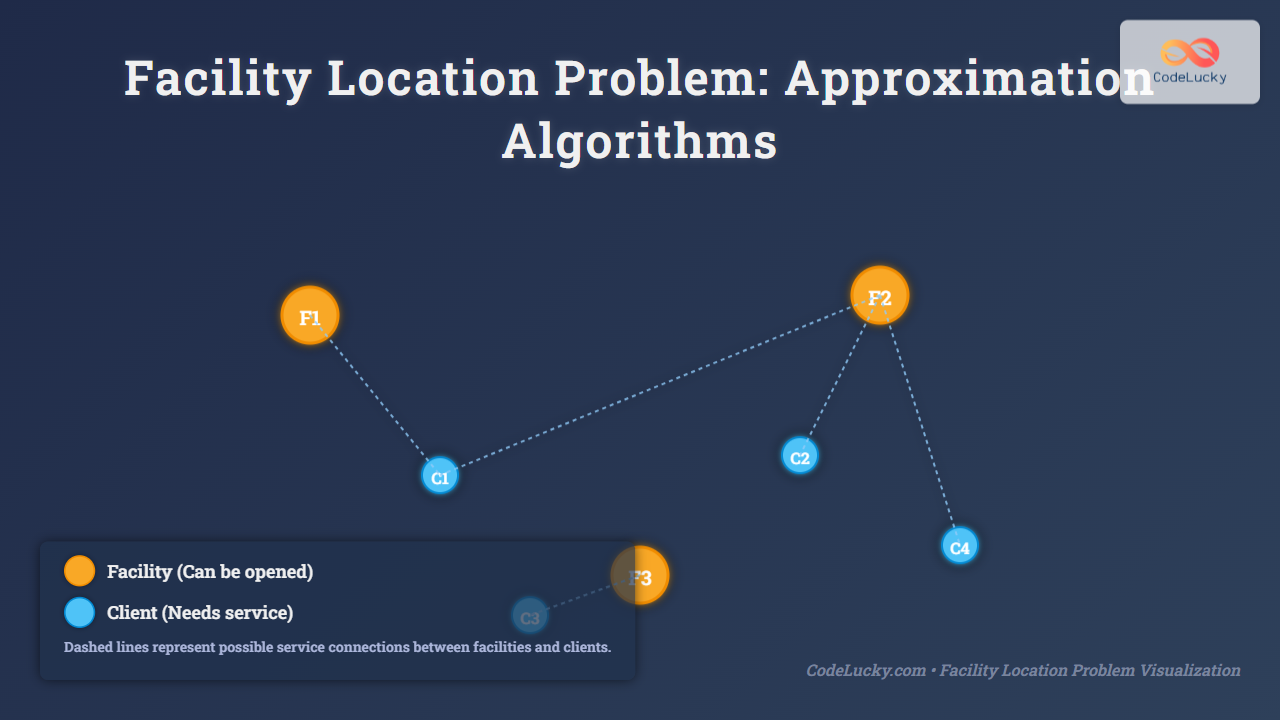
The Facility Location Problem is a fundamental combinatorial optimization challenge with broad applications in logistics, supply chain management, telecommunications, and data clustering. This problem focuses on choosing which facilities to open and assigning clients to them to minimize the total cost. In practice, this problem is computationally hard, thus efficient approximation algorithms play a crucial role in finding near-optimal solutions within reasonable time.
Understanding the Facility Location Problem
The problem is typically defined as follows: given a set of candidate facility locations and a set of clients, each facility has an opening cost, and serving a client from a facility incurs a serving cost. The goal is to select a subset of facilities to open and assign each client to an open facility such that the total sum of opening and serving costs is minimized.

This problem is NP-hard, so finding exact solutions for large instances is impractical. Approximation algorithms help by guaranteeing solutions within a provable factor of the optimum.
Key Formulations of the Problem
- Uncapacitated Facility Location: No limit on the number of clients a facility can serve.
- Capacitated Facility Location: Facilities have capacity constraints limiting client assignments.
This article focuses on the uncapacitated version, more common in theoretical algorithmic studies.
Approximation Algorithms Overview
Several approximation approaches exist:
1. Greedy Algorithm Approach
A simple heuristic iteratively opens facilities that yield the highest cost saving per unit cost increase, assigning clients as the algorithm progresses. Though intuitive, this method often yields solutions far from optimal with no strong theoretical guarantee.
2. Primal-Dual Approximation Algorithm
This technique uses primal-dual linear programming relaxations and incrementally constructs a feasible dual solution guiding facility opening decisions.

Notably, the algorithm by Jain and Vazirani achieves a 3-approximation—the total cost of its solution is at most three times the optimal cost.
3. Local Search Algorithms
This heuristic iteratively improves a candidate solution by considering moves like opening, closing, or swapping facilities if these changes reduce cost. Local search can provide constant-factor approximations and works well in practice.

Detailed Example of Primal-Dual Algorithm
Consider 3 facilities (F1, F2, F3) and 4 clients (C1, C2, C3, C4). Facility opening costs and client-facility serving costs are given.
| Facility | Opening Cost | Serving Costs to Clients | |||
|---|---|---|---|---|---|
| C1 | C2 | C3 | C4 | ||
| F1 | 10 | 4 | 6 | 8 | 5 |
| F2 | 15 | 2 | 5 | 7 | 4 |
| F3 | 7 | 9 | 3 | 6 | 7 |
The primal-dual approach starts with zero dual variables associated with clients and increases them uniformly until an open facility is justified by the payments. For instance, clients gradually “pay” towards opening a facility as their dual variables grow.
Stepwise payment collection example:
- Clients C1 and C2 increase dual variables until F2 can be opened since it has a relatively low opening cost and clients have low serving cost to F2.
- F2 is opened, C1, C2 assigned there.
- Then increase contributions from C3 and C4 until F1 or F3 becomes optimal to open.
- Facilities opened and clients assigned accordingly minimizing total cost.
Interactive Visual Example
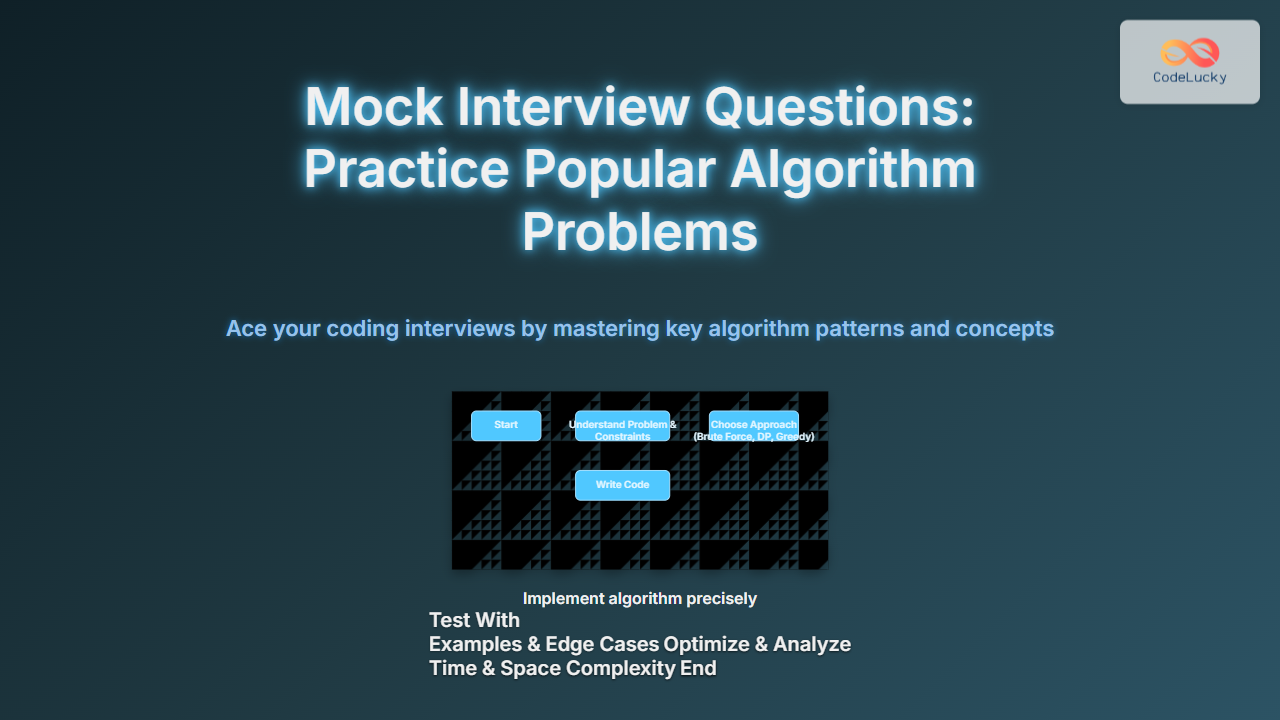
This interactive flowchart conceptualizes primal-dual steps for clarity.

Summary of Approximation Guarantees
| Algorithm | Approximation Ratio | Comments |
|---|---|---|
| Greedy Heuristic | No guarantee | Simple but potentially bad worst-case |
| Primal-Dual (Jain-Vazirani) | 3-approximation | Strong theoretical foundation |
| Local Search | Constant factor (often 3 or 4) | Good practical performance |
Conclusion
The Facility Location Problem is a rich area blending theoretical and practical algorithm design. Approximation algorithms like the primal-dual method provide potent tools to tackle NP-hardness with performance guarantees. Understanding these algorithms and their application context empowers researchers and practitioners to address complex, real-world allocation problems efficiently.
For deeper study, exploring capacitated versions, metric assumptions, and hybrid heuristics can expand solution capabilities.