In Python programming, exception handling plays a vital role in creating robust and error-resilient applications. Two often-confused constructs in exception handling are except and except BaseException. Understanding their differences helps developers write safer, more predictable error management in Python scripts and applications.
Overview of Exception Handling in Python
Python implements exception handling using try and except blocks. When an error occurs within a try block, Python looks to capture it via the matching except clause. Proper use of these clauses ensures that programs don’t crash and can handle unexpected situations gracefully.
What Does except Mean?
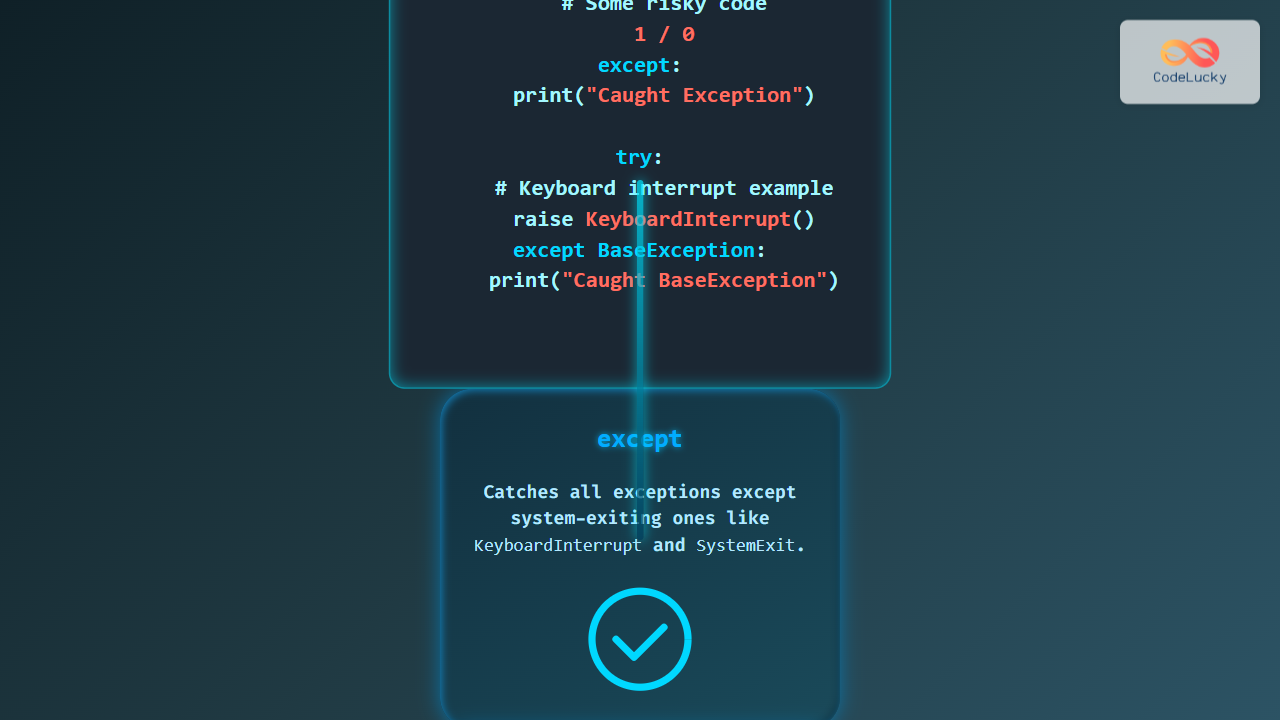
When used alone without specifying an exception type, the except clause acts as a catch-all for all exceptions that derive from the Exception base class. This excludes certain system-exiting exceptions like SystemExit, KeyboardInterrupt, and GeneratorExit.
Concisely, except: is equivalent to except Exception:.

Example of except (without specifying BaseException)
try:
    print(10 / 0)
except:
    print("Caught an exception that derives from Exception.")
Output:
Caught an exception that derives from Exception.Here, the ZeroDivisionError is caught because it inherits from Exception.
What is BaseException in Python?
BaseException is the root of the exception hierarchy in Python. All built-in, user-defined, and system-exiting exceptions inherit from it. However, most exceptions programmers catch inherit from the subclass Exception. System-exiting exceptions inherit directly from BaseException.
Exception— standard runtime errors.SystemExit,KeyboardInterrupt,GeneratorExit— inherit directly fromBaseException, bypassingException.
What Does except BaseException Mean?
Using except BaseException: will intercept all exceptions, including system-exiting exceptions like KeyboardInterrupt (Ctrl+C), SystemExit (exit calls), and GeneratorExit. This can be dangerous because it prevents cleanup or orderly shutdown in some cases and should be used with caution.

Example of except BaseException
try:
    raise KeyboardInterrupt
except BaseException:
    print("Caught all exceptions, including KeyboardInterrupt.")
Output:
Caught all exceptions, including KeyboardInterrupt.Key Differences Between except and except BaseException
| Aspect | except or except Exception |
except BaseException |
|---|---|---|
| Exception coverage | Catches all exceptions derived from Exception. Excludes system-exiting exceptions. |
Catches all exceptions including system-exiting: SystemExit, KeyboardInterrupt, GeneratorExit. |
| Use Cases | General error handling in most user-level code. | Rarely used; useful in global error handlers or where all exceptions, including interrupts, must be caught. |
| Risk | Does not interfere with system exit or keyboard interrupt by default. | May suppress critical system exit and interrupt signals, causing program hang or preventing exit. |
| Code simplicity | More idiomatic and safer for exception handling. | Less usual; requires careful design to avoid unintended behavior. |
When to Use Each?
- Use
exceptorexcept Exception: For typical error handling to catch runtime errors but allow user interrupts and system exits. - Use
except BaseException: Sparingly and only when absolutely necessary to catch every possible exception, including interrupts and exits — e.g., in top-level frameworks or cleanup code that must run no matter what.
Interactive Code Sample
Run this sample in your own Python environment to see difference in behavior when pressing Ctrl+C (KeyboardInterrupt):
import time

try:
    print("Press Ctrl+C to interrupt the first block.")
    while True:
        time.sleep(1)
except:
    print("Caught generic exception (Exception subclasses).")

try:
    print("Press Ctrl+C to interrupt the second block.")
    while True:
        time.sleep(1)
except BaseException:
    print("Caught all exceptions, including KeyboardInterrupt.")
Summary
The except clause without specifying BaseException targets typical exceptions derived from Exception, thus allowing natural system-exiting exceptions to propagate. In contrast, except BaseException captures all exceptions inheriting from Python’s root exception class, including system-exiting signals, which can disrupt normal program termination and user interrupts if used improperly.
In most Python programming, prefer the idiomatic except or except Exception, reserving except BaseException for very specialized cases where handling every possible exception is required.