Mastering English error correction is one of the most effective ways to improve fluency and confidence in writing or speaking. Beginners often repeat typical mistakes related to grammar, sentence structure, and vocabulary usage. In this detailed guide from CodeLucky.com, we break down the most frequent English learner errors and show how to correct them effectively—using examples, patterns, and visual diagrams where useful.
Why Error Correction Matters
Error correction isn’t about perfection—it’s about clarity. Every mistake corrected brings your English closer to being natural and understandable. It improves comprehension, shows professionalism, and builds long-term language awareness.
1. Subject–Verb Agreement Errors
One of the most common grammar mistakes is mismatching a subject with the correct verb form. The subject and verb must agree in number (singular/plural).
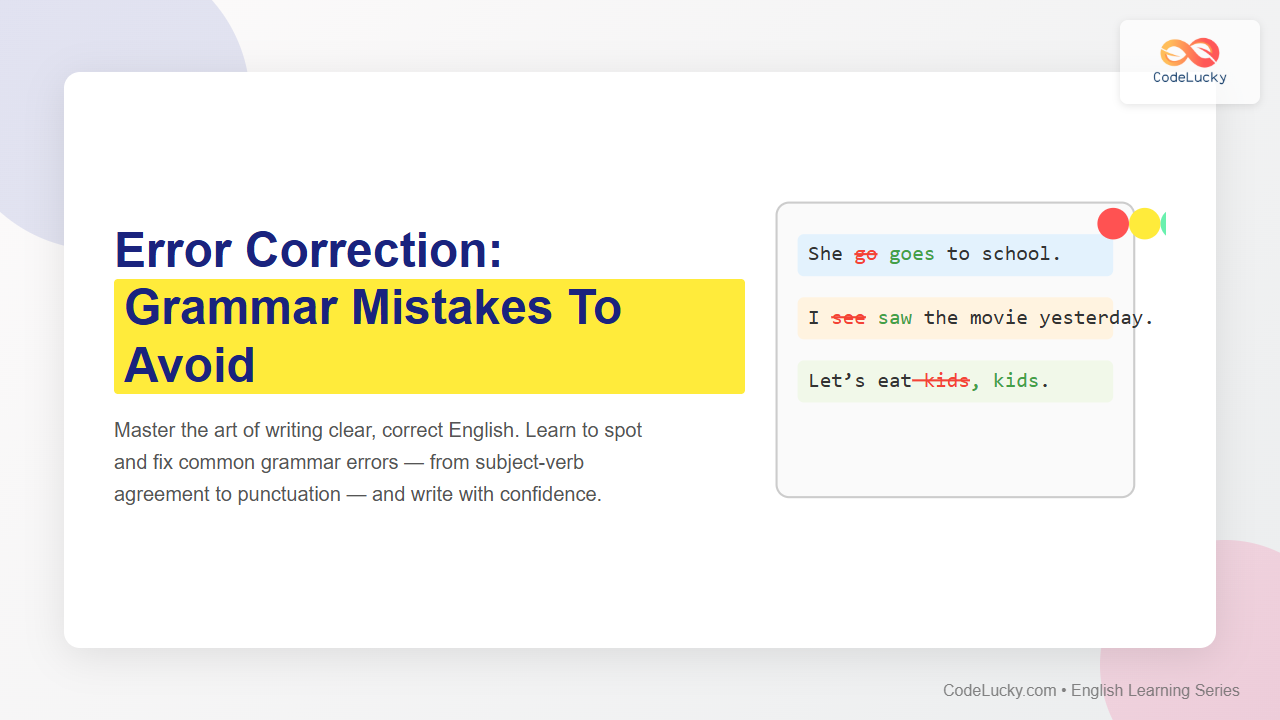
Incorrect: She go to school every day.
Correct: She goes to school every day.
Explanation: Since “she” is singular, the verb requires an –s ending in the present tense.

This simple logic can instantly fix half of the typical English learner mistakes. For example:
- He plays football. ✅
- They play football. ✅
2. Incorrect Tense Usage
English learners often confuse past, present, and future tenses. The key is consistency—one event must stay within one timeframe.
Incorrect: Yesterday, I go to the market.
Correct: Yesterday, I went to the market.
“Yesterday” signals the past, so the past form “went” must be used.

Common Tip: Watch out for time indicators (like yesterday, now, tomorrow)—they guide which tense is correct.
3. Articles: “a”, “an”, and “the”
Articles in English are small words that cause big confusion for beginners. They define whether you’re speaking generally or specifically.
General rules:
- Use a before consonant sounds (a cat, a book).
- Use an before vowel sounds (an apple, an hour).
- Use the for specific things both you and your listener know about (the sun, the teacher).
Incorrect: I saw an dog in the park.
Correct: I saw a dog in the park.

4. Preposition Mistakes
Prepositions (in, on, at, to, from, with, etc.) describe relationships between words. But they often confuse learners because they don’t always translate directly into other languages.
Incorrect: I am good in English.
Correct: I am good at English.
Incorrect: We arrived to the office at 9.
Correct: We arrived at the office at 9.
Notice how “arrive at” and “good at” are fixed expressions—not logic-based, but usage-based. When in doubt, learn collocations (word pairings that sound right together).

5. Confusing Countable and Uncountable Nouns
Some nouns can be counted (apples), while others cannot (information). Understanding which is which changes which quantifiers you can use.
Incorrect: She gave me many informations.
Correct: She gave me a lot of information.

To remember quickly:
- If you can add “s,” it’s countable: books, cars, pens.
- If you cannot, it’s uncountable: water, advice, information.
6. Word Order and Sentence Structure
In English, the word order (Subject + Verb + Object) is strict. Mixing it up leads to confusion.
Incorrect: Always he comes late.
Correct: He always comes late.
Typical English sentence pattern:

Interactive Correction Exercise
Try this simple task. Identify the error and rewrite correctly:
- I can playing piano.
- He don’t like coffee.
- I am agree with you.
Answers:
- I can play piano.
- He doesn’t like coffee.
- I agree with you.
Final Thoughts
Correcting your mistakes regularly is like debugging your English. The more often you do it, the faster you recognize the right patterns. Always read aloud, review feedback, and focus on patterns, not memorization.
Use these examples as a mini reference whenever you write or speak in English. With consistent practice, your confidence and accuracy will both grow quickly.
Written by CodeLucky.com — Your trusted source for practical English learning and grammar improvement.