The concept of Network Connectivity plays a pivotal role in computer science, particularly in applications involving graphs, networks, and dynamic connectivity queries. This article dives deep into the Dynamic Connectivity problem and how it can be efficiently solved using the Union-Find algorithm, also known as the Disjoint Set Union (DSU) data structure. The Union-Find algorithm is a classic and powerful tool for managing dynamic connectivity in networks.
Understanding Dynamic Connectivity
Dynamic connectivity is the problem of managing a network or graph while it changes over time. Specifically, it involves answering queries of the form: Are two nodes connected? even as edges are added or removed (with emphasis often on edge additions). This problem is common in networking, social networks, and cluster detection.
Imagine a network of computers or a social network where connections can be added dynamically. The challenge is to quickly determine if a path exists between any two nodes, without recomputing connectivity from scratch after every update.
The Naive Approach
A brute force method would be to run a graph traversal (DFS or BFS) after each update to check if two nodes are connected. However, this approach is inefficient and slow, with a time complexity reaching O(n) per query in large networks, making it impractical for real-time applications.
The Union-Find Data Structure
The Union-Find or Disjoint Set data structure offers a highly efficient way to keep track of elements partitioned into a set of disjoint subsets. It efficiently supports two primary operations:
- Find: Determine which subset a particular element belongs to.
- Union: Merge two subsets into a single subset.
This makes Union-Find an ideal fit for dynamically maintaining connectivity information in a network.
How Union-Find Works
The data structure represents each set as a tree, with a single root node called the representative or parent. Each element points to its parent, and a call to Find climbs the tree until reaching this root.
To optimize performance, two key enhancements are applied:
- Path Compression: During a Find operation, nodes visited on the path are directly connected to the root, flattening the tree and speeding up future operations.
- Union by Rank/Size: When merging two sets, the root of the smaller tree is made to point to the root of the larger, preventing trees from becoming too tall.
As a result, Union-Find operations run almost in constant time, practically O(α(n)) where α is the inverse Ackermann function – very slow growing and almost constant for all practical input sizes.
Implementing Union-Find: Step-by-Step
Let’s see the Union-Find algorithm in action with Python code snippets along with clear explanation:
class UnionFind:
    def __init__(self, n):
        self.parent = list(range(n))
        self.rank = [0] * n

    def find(self, x):
        if self.parent[x] != x:
            self.parent[x] = self.find(self.parent[x])  # Path Compression
        return self.parent[x]

    def union(self, x, y):
        rootX = self.find(x)
        rootY = self.find(y)
        if rootX != rootY:
            if self.rank[rootX] > self.rank[rootY]:
                self.parent[rootY] = rootX
            elif self.rank[rootX] < self.rank[rootY]:
                self.parent[rootX] = rootY
            else:
                self.parent[rootY] = rootX
                self.rank[rootX] += 1
This class initializes each element as its own parent (separate set). The find operation includes path compression and union merges two sets by rank to maintain balance.
Example: Dynamic Network Connectivity
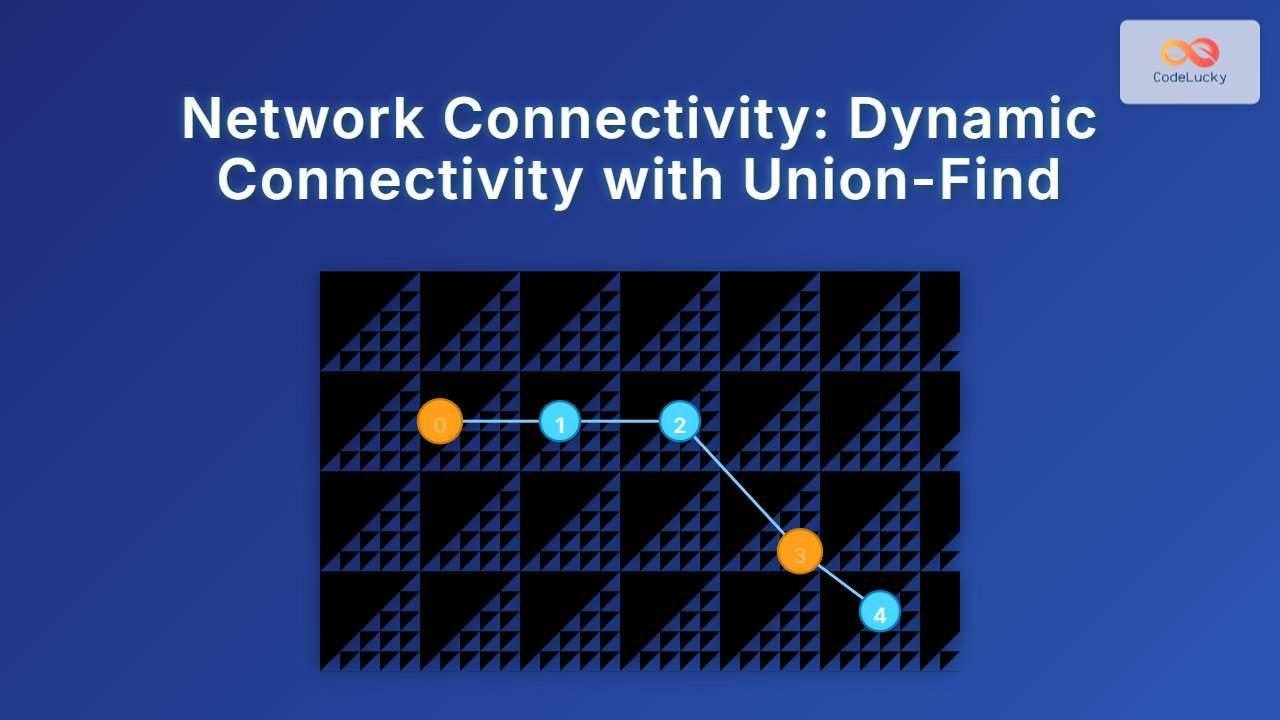
Consider a network of 5 nodes where edges are added dynamically. Initially, no nodes are connected.
uf = UnionFind(5)

uf.union(0, 1)  # Connect node 0 and 1
uf.union(1, 2)  # Connect node 1 and 2 (thus 0,1,2 connected)

print(uf.find(0) == uf.find(2))  # True, they are connected
print(uf.find(0) == uf.find(3))  # False, no connection to 3 yet

uf.union(3, 4)  # Connect node 3 and 4

print(uf.find(3) == uf.find(4))  # True, connected
print(uf.find(2) == uf.find(4))  # False, different sets
uf.union(2, 3)  # Connect sets {0,1,2} and {3,4}

print(uf.find(0) == uf.find(4))  # True, all connected now
Visual Representation of Connectivity

This example demonstrates how Union-Find seamlessly merges and queries sets, enabling fast answers to connectivity questions even as the network evolves.
Use Cases and Advantages of Union-Find in Dynamic Connectivity
- Networked Systems: Quickly determine if two computers or devices are in the same network segment.
- Social Networks: Manage friendships or group membership dynamically.
- Clustering and Image Processing: Identify connected components efficiently.
- Graph Algorithms: Used in Kruskal’s Minimum Spanning Tree algorithm to check cycles.
The key advantage is the ability to handle large numbers of union and find operations with near constant time, making it scalable for big data problems involving dynamic connectivity.
Interactive Example Concept
An interactive tool can illustrate the dynamic merging of sets: users can click to connect pairs of nodes and instantly see the connectivity results updated via Union-Find. While full interactivity code is beyond this article, the essential logic revolves around calling union(x, y) for new edges and find(x) == find(y) to check connectivity.
Summary
The Union-Find algorithm solves the dynamic connectivity problem in networks efficiently by representing connected components with disjoint sets and supporting fast union and find operations enhanced with path compression and union by rank.
This elegant, well-optimized data structure underpins many algorithms and real-world applications requiring rapid connectivity queries as networks evolve.
Understanding and implementing Union-Find is a foundational skill for computer scientists and software engineers working with graphs, networks, and dynamic datasets.