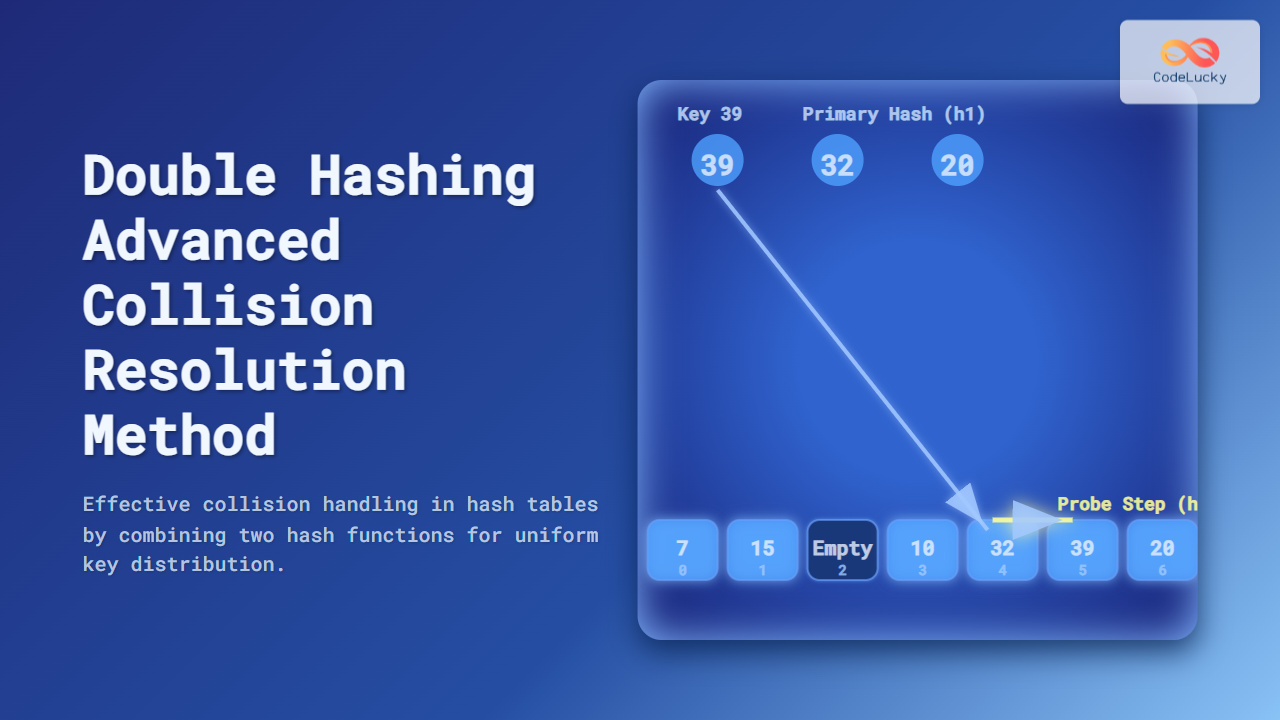
In the world of hash tables, a fundamental issue that often arises is the problem of collisions—when two keys map to the same slot in the table. Several techniques are used to handle collisions, such as separate chaining, linear probing, and quadratic probing. However, one of the most effective and advanced methods is Double Hashing. In this article, we will explore what double hashing is, how it works, its advantages, performance considerations, and detailed Python examples with visual explanations.
What is Double Hashing?
Double Hashing is a collision resolution strategy in open addressing hashing. When a collision occurs, instead of probing the table sequentially (like linear probing) or quadratically (like quadratic probing), double hashing uses a second hash function to calculate a step size for the probe. This makes it more efficient in distributing entries uniformly and reduces clustering.
The general formula for probing in double hashing is:
h(key, i) = (h1(key) + i * h2(key)) mod mh1(key): The primary hash function.h2(key): The secondary hash function (must not evaluate to 0).i: The probe number (0, 1, 2, …).m: Size of the hash table (preferably prime).
Why Double Hashing?
- Reduces Clustering: Unlike linear probing, it doesn’t create long chains of occupied slots.
- Uniform Distribution: The second hash function ensures scattered probing across the table.
- Performance: Offers near O(1) average time complexity for successful searches and insertions.
Visual Representation of Double Hashing
Consider a hash table of size 7, primary hash function h1(k) = k mod 7, and secondary hash function h2(k) = 5 - (k mod 5). Let’s insert a few numbers: 10, 20, 15, 7, 32.

Now consider inserting 39. We find:
h1(39) = 39 mod 7 = 4
h2(39) = 5 - (39 mod 5) = 1
But slot 4 is already occupied by 32, so we probe:
(4 + 1×1) mod 7 = 5→ Slot 5 is free → Place 39 at slot 5.
Step-by-step Visualization of Double Hashing
Python Implementation of Double Hashing
class DoubleHashTable:
    def __init__(self, size=7):
        self.size = size
        self.table = [None] * size

    def h1(self, key):
        return key % self.size

    def h2(self, key):
        return 5 - (key % 5)

    def insert(self, key):
        index = self.h1(key)
        step = self.h2(key)

        for i in range(self.size):
            new_index = (index + i * step) % self.size
            if self.table[new_index] is None:
                self.table[new_index] = key
                return
        print("Hash Table Overflow, could not insert")

    def search(self, key):
        index = self.h1(key)
        step = self.h2(key)

        for i in range(self.size):
            new_index = (index + i * step) % self.size
            if self.table[new_index] == key:
                return new_index
            if self.table[new_index] is None:
                return None
        return None

# Example Usage
ht = DoubleHashTable()
for num in [10, 20, 15, 7, 32, 39]:
    ht.insert(num)

print("Hash Table:", ht.table)
print("Search for 39 at index:", ht.search(39))
Output:
Hash Table: [7, 15, None, 10, 32, 39, 20]
Search for 39 at index: 5
Advantages of Double Hashing
- Minimizes clustering problems.
- Provides better utilization of table space.
- Can achieve close to O(1) performance in average cases.
Disadvantages of Double Hashing
- Requires careful design of secondary hash function to avoid infinite loops.
- Slightly more complex to implement than linear or quadratic probing.
- Performance degrades when load factor approaches 1.
Best Practices for Double Hashing
- Choose table size as a prime number for better distribution.
- Ensure secondary hash function never evaluates to 0.
- Keep load factor below 0.7 for optimal performance.
Real-world Applications
- Symbol tables in compilers.
- Dictionary implementations in programming languages.
- Cache indexing in operating systems.
- Database indexing for fast key lookups.
Conclusion
Double Hashing provides a reliable and highly effective way to resolve collisions in hash tables. By using two independent hash functions, it distributes keys more uniformly and minimizes clustering, offering significant performance improvements over simpler collision resolution strategies. Whether you’re designing a compiler’s symbol table, building efficient caches, or working on high-performance indexing, double hashing is a powerful technique to master.