Distributed system design represents one of the most critical aspects of modern computing, where multiple independent computers work together to achieve common goals. As applications scale beyond single machines, understanding how to coordinate multiple computers becomes essential for building robust, scalable, and fault-tolerant systems.
What is a Distributed System?
A distributed system is a collection of independent computers that appears to users as a single coherent system. These computers communicate through message passing over a network and coordinate their actions to provide services that would be impossible or impractical on a single machine.
Key characteristics of distributed systems include:
- Concurrency: Multiple processes execute simultaneously across different nodes
- No global clock: Each node maintains its own clock, leading to timing challenges
- Independent failures: Individual components can fail without bringing down the entire system
- Network communication: All coordination happens through message passing

Core Coordination Challenges
The CAP Theorem
The CAP theorem, formulated by Eric Brewer, states that any distributed system can guarantee at most two of these three properties:
- Consistency: All nodes see the same data simultaneously
- Availability: System remains operational and responsive
- Partition tolerance: System continues despite network failures
This fundamental limitation shapes all distributed system design decisions. Real-world systems typically choose between CP (consistency + partition tolerance) or AP (availability + partition tolerance) based on business requirements.
Consensus Problems
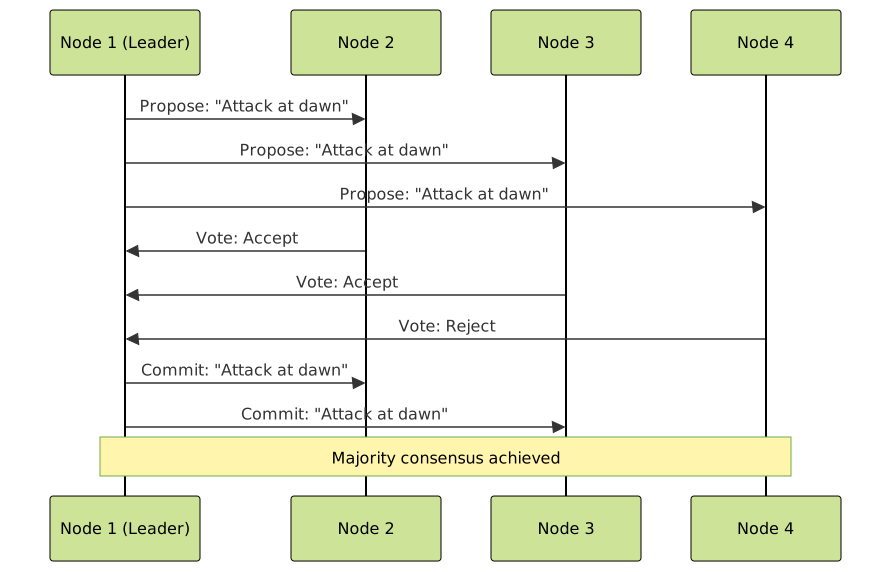
Achieving consensus among distributed nodes is crucial for coordination. The Byzantine Generals Problem illustrates the challenge: how can distributed nodes agree on a course of action when some nodes might be faulty or malicious?
Coordination Mechanisms
Leader Election
Leader election algorithms ensure exactly one node acts as coordinator at any time. Popular algorithms include:
Bully Algorithm:
- Nodes have unique IDs
- Higher ID nodes “bully” lower ID nodes
- Highest available ID becomes leader
Ring Algorithm:
- Nodes arranged in logical ring
- Election message passes around ring
- Node with highest ID becomes leader
Mutual Exclusion
Ensuring only one process accesses shared resources prevents race conditions and data corruption:
Centralized Approach:
class DistributedLock:
    def __init__(self, coordinator):
        self.coordinator = coordinator
        self.queue = []

    def request_lock(self, process_id):
        if self.is_locked():
            self.queue.append(process_id)
            return "QUEUED"
        else:
            self.grant_lock(process_id)
            return "GRANTED"

    def release_lock(self, process_id):
        if self.queue:
            next_process = self.queue.pop(0)
            self.grant_lock(next_process)
Token Ring Approach:
- Single token circulates among nodes
- Only token holder can access critical section
- Fault tolerance through token regeneration
Distributed Consensus Algorithms
Raft Consensus Algorithm provides a practical approach to distributed consensus:

Raft divides consensus into three sub-problems:
- Leader election: Choose new leader when current fails
- Log replication: Leader accepts client requests and replicates to followers
- Safety: Ensure consistency if leaders change
Consistency Models
Strong Consistency
Strong consistency guarantees that all nodes see the same data simultaneously. This is achieved through:
Two-Phase Commit (2PC):
- Prepare phase: Coordinator asks all participants to prepare for commit
- Commit phase: If all agree, coordinator tells everyone to commit
class TwoPhaseCommit:
    def __init__(self, coordinator, participants):
        self.coordinator = coordinator
        self.participants = participants

    def execute_transaction(self, transaction):
        # Phase 1: Prepare
        prepare_responses = []
        for participant in self.participants:
            response = participant.prepare(transaction)
            prepare_responses.append(response)

        # Phase 2: Commit or Abort
        if all(response == "YES" for response in prepare_responses):
            for participant in self.participants:
                participant.commit(transaction)
            return "COMMITTED"
        else:
            for participant in self.participants:
                participant.abort(transaction)
            return "ABORTED"
Eventual Consistency
Eventual consistency allows temporary inconsistencies but guarantees convergence over time. This model powers many large-scale systems like Amazon DynamoDB and Cassandra.
Vector Clocks help track causality in eventually consistent systems:
class VectorClock:
    def __init__(self, node_id, nodes):
        self.node_id = node_id
        self.clock = {node: 0 for node in nodes}

    def tick(self):
        self.clock[self.node_id] += 1

    def update(self, other_clock):
        for node in self.clock:
            self.clock[node] = max(self.clock[node], other_clock[node])
        self.tick()

    def happens_before(self, other_clock):
        return (all(self.clock[node] <= other_clock[node] for node in self.clock)
                and self.clock != other_clock)
Fault Tolerance Strategies
Replication
Replication maintains multiple copies of data across different nodes to survive failures:
Active Replication:
- All replicas process requests simultaneously
- Requires deterministic operations
- Higher resource usage but better fault tolerance
Passive Replication:
- Primary processes requests, backups receive state updates
- Lower resource usage
- Failover required when primary fails

Failure Detection
Reliable failure detection prevents system degradation:
Heartbeat Mechanism:
class FailureDetector:
    def __init__(self, timeout=5.0):
        self.timeout = timeout
        self.last_heartbeat = {}
        self.suspected_failures = set()

    def receive_heartbeat(self, node_id):
        self.last_heartbeat[node_id] = time.time()
        if node_id in self.suspected_failures:
            self.suspected_failures.remove(node_id)

    def check_failures(self):
        current_time = time.time()
        for node_id, last_time in self.last_heartbeat.items():
            if current_time - last_time > self.timeout:
                self.suspected_failures.add(node_id)

        return self.suspected_failures
Real-World Implementation Patterns
Microservices Architecture
Microservices represent a distributed system pattern where applications are decomposed into small, independent services:
- Service discovery: Services find and communicate with each other
- Load balancing: Distribute requests across service instances
- Circuit breakers: Prevent cascade failures
- Distributed tracing: Monitor requests across services
Distributed Databases
Modern distributed databases implement sophisticated coordination mechanisms:
Sharding strategies:
- Range-based: Partition data by key ranges
- Hash-based: Use hash function to distribute data
- Directory-based: Lookup service maps keys to nodes
Consistency protocols:
- Paxos: Complex but proven consensus algorithm
- Raft: Simpler alternative to Paxos
- PBFT: Byzantine fault-tolerant consensus

Performance Optimization
Caching Strategies
Distributed caching reduces latency and improves system performance:
Cache coherence protocols:
- Write-through: Updates propagate immediately to all caches
- Write-behind: Updates queued and applied asynchronously
- Cache invalidation: Remove stale data from caches
Load Distribution
Effective load distribution prevents bottlenecks:
Load balancing algorithms:
- Round-robin: Requests distributed sequentially
- Weighted round-robin: Accounts for server capacity differences
- Least connections: Routes to server with fewest active connections
- Consistent hashing: Minimizes redistribution when nodes change
Security Considerations
Distributed systems face unique security challenges:
Authentication and authorization:
- Distributed identity management
- Token-based authentication (JWT, OAuth)
- Role-based access control (RBAC)
Communication security:
- TLS/SSL encryption for network traffic
- Message authentication codes (MAC)
- Digital signatures for non-repudiation
Byzantine fault tolerance:
- Handling malicious nodes
- Cryptographic proofs
- Consensus despite adversarial behavior
Monitoring and Observability
Effective monitoring is crucial for distributed system health:
Key metrics:
- Latency: Request processing time
- Throughput: Requests processed per second
- Error rate: Percentage of failed requests
- Availability: System uptime percentage
Distributed tracing:
class DistributedTracer:
    def __init__(self):
        self.traces = {}

    def start_span(self, operation_name, parent_context=None):
        span_id = self.generate_span_id()
        trace_id = parent_context.trace_id if parent_context else self.generate_trace_id()

        span = {
            'span_id': span_id,
            'trace_id': trace_id,
            'operation_name': operation_name,
            'start_time': time.time(),
            'parent_span_id': parent_context.span_id if parent_context else None
        }

        return span

    def finish_span(self, span):
        span['end_time'] = time.time()
        span['duration'] = span['end_time'] - span['start_time']
        self.traces[span['trace_id']] = span
Future Trends and Technologies
The field of distributed systems continues evolving with emerging technologies:
Edge computing:
- Processing closer to data sources
- Reduced latency for IoT applications
- Challenges in coordination across edge nodes
Serverless architectures:
- Function-as-a-Service (FaaS) platforms
- Event-driven coordination
- Automatic scaling and resource management
Blockchain and distributed ledgers:
- Decentralized consensus mechanisms
- Immutable transaction logs
- Smart contracts for automated coordination
Best Practices for Implementation
Successful distributed system implementation requires following proven practices:
Design principles:
- Fail fast: Detect and handle failures quickly
- Idempotency: Operations produce same result when repeated
- Loose coupling: Minimize dependencies between components
- Graceful degradation: Maintain partial functionality during failures
Testing strategies:
- Chaos engineering: Intentionally inject failures
- Load testing: Verify performance under high demand
- Network partition testing: Ensure partition tolerance
- Time synchronization testing: Handle clock skew scenarios
Operational considerations:
- Comprehensive logging and monitoring
- Automated deployment and rollback procedures
- Disaster recovery planning
- Performance tuning and capacity planning
Mastering distributed system design requires understanding these coordination mechanisms and their trade-offs. As systems scale and complexity increases, the ability to design robust distributed architectures becomes increasingly valuable. The principles and patterns covered in this guide provide a solid foundation for building reliable, scalable distributed systems that can handle real-world challenges while maintaining performance and consistency requirements.