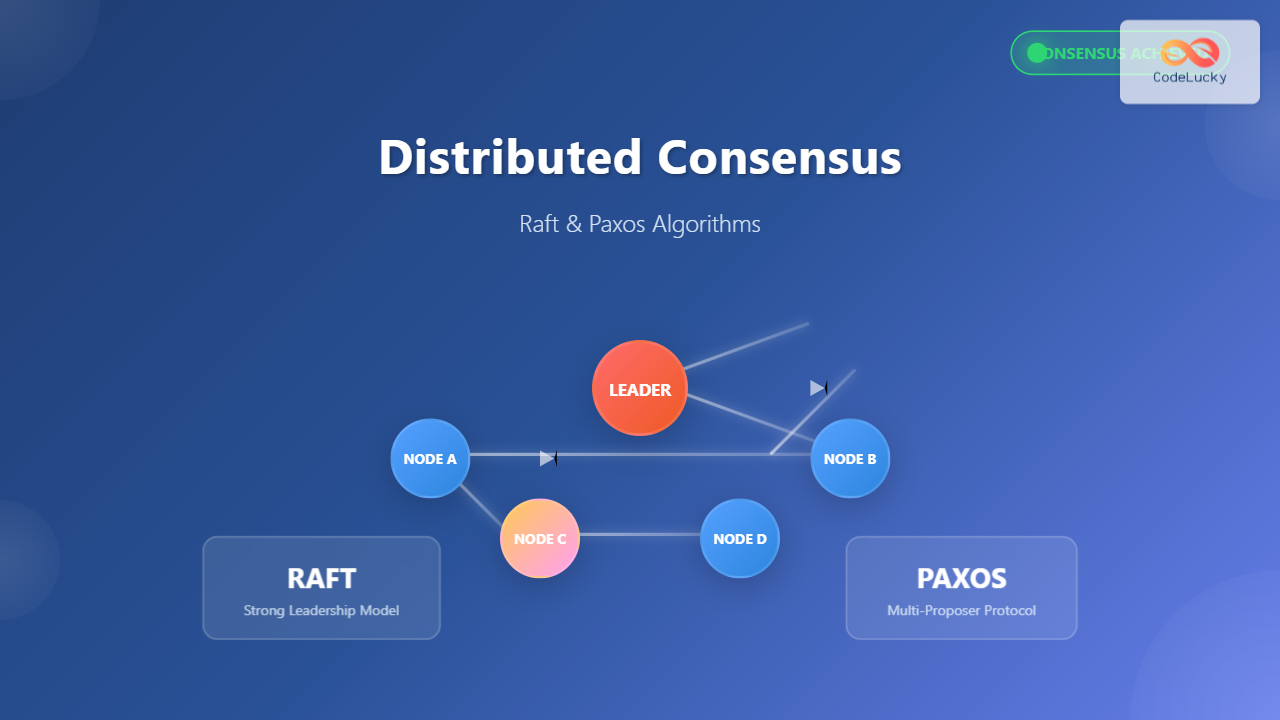
Distributed consensus is one of the most challenging problems in computer science, requiring multiple nodes in a distributed system to agree on a single value despite failures, network partitions, and varying message delays. This comprehensive guide explores two fundamental consensus algorithms: Raft and Paxos, providing detailed explanations, visual representations, and practical examples.
What is Distributed Consensus?
Distributed consensus ensures that all nodes in a distributed system agree on a common state or value, even when some nodes fail or become unreachable. This is crucial for maintaining data consistency across replicated databases, distributed file systems, and blockchain networks.
The consensus problem becomes complex due to:
- Network partitions: Communication between nodes may be interrupted
- Node failures: Servers can crash or become unresponsive
- Message delays: Network latency can vary significantly
- Byzantine failures: Nodes may behave maliciously or send conflicting information
The CAP Theorem and Consensus
Before diving into specific algorithms, it’s essential to understand the CAP theorem, which states that a distributed system can only guarantee two of the following three properties:
- Consistency: All nodes see the same data simultaneously
- Availability: The system remains operational even during failures
- Partition tolerance: The system continues to function despite network partitions
Both Raft and Paxos prioritize consistency and partition tolerance, temporarily sacrificing availability during network splits to maintain data integrity.
Raft Consensus Algorithm
Raft, introduced by Diego Ongaro and John Ousterhout in 2014, was designed to be more understandable than Paxos while providing equivalent fault tolerance guarantees. Raft divides the consensus problem into three key subproblems:
Raft Core Components
1. Leader Election
Raft uses a strong leader approach where one node acts as the leader, handling all client requests and log replication. When the system starts or the current leader fails, nodes elect a new leader through a voting process.

2. Log Replication
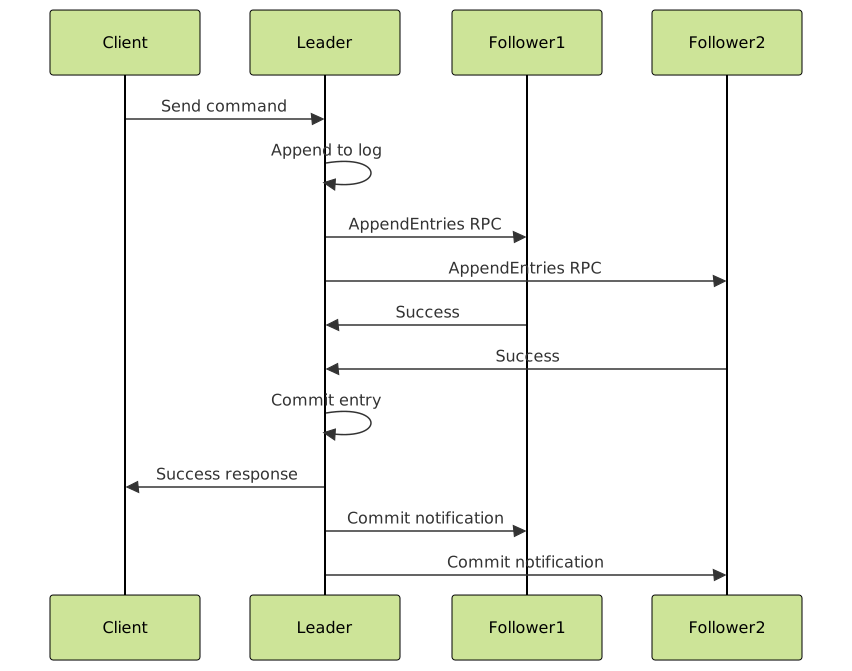
The leader receives client requests, appends them to its log, and replicates entries to follower nodes. Once a majority of nodes acknowledge the entry, it becomes committed.
3. Safety Properties
Raft ensures that committed entries are never lost and that all nodes apply the same sequence of commands in the same order.
Raft Algorithm Steps
Here’s how Raft operates in practice:
Raft Terms and Elections
Raft divides time into arbitrary-length terms, each beginning with an election. If no leader is elected (split vote), the term ends immediately, and a new term begins.
class RaftNode:
    def __init__(self, node_id):
        self.node_id = node_id
        self.current_term = 0
        self.voted_for = None
        self.log = []
        self.state = "follower"  # follower, candidate, leader
        self.commit_index = 0
        self.last_applied = 0

    def start_election(self):
        self.current_term += 1
        self.state = "candidate"
        self.voted_for = self.node_id
        votes_received = 1

        # Request votes from other nodes
        for node in other_nodes:
            if node.request_vote(self.current_term, self.node_id):
                votes_received += 1

        if votes_received > len(all_nodes) // 2:
            self.become_leader()

    def become_leader(self):
        self.state = "leader"
        # Send heartbeats to maintain leadership
        self.send_heartbeats()
Raft Advantages
- Understandability: Clear separation of concerns makes it easier to implement and debug
- Strong leadership: Simplifies log replication and reduces conflicts
- Membership changes: Supports dynamic cluster reconfiguration
- Log compaction: Efficiently handles growing log sizes through snapshots
Paxos Consensus Algorithm
Paxos, developed by Leslie Lamport in the 1980s, is a family of protocols for solving consensus in a network of unreliable processors. While more complex than Raft, Paxos has been proven correct and widely implemented in production systems.
Paxos Roles
Paxos defines three distinct roles that nodes can play:
- Proposers: Propose values for consensus
- Acceptors: Vote on proposed values
- Learners: Learn the chosen value once consensus is reached
Basic Paxos Algorithm
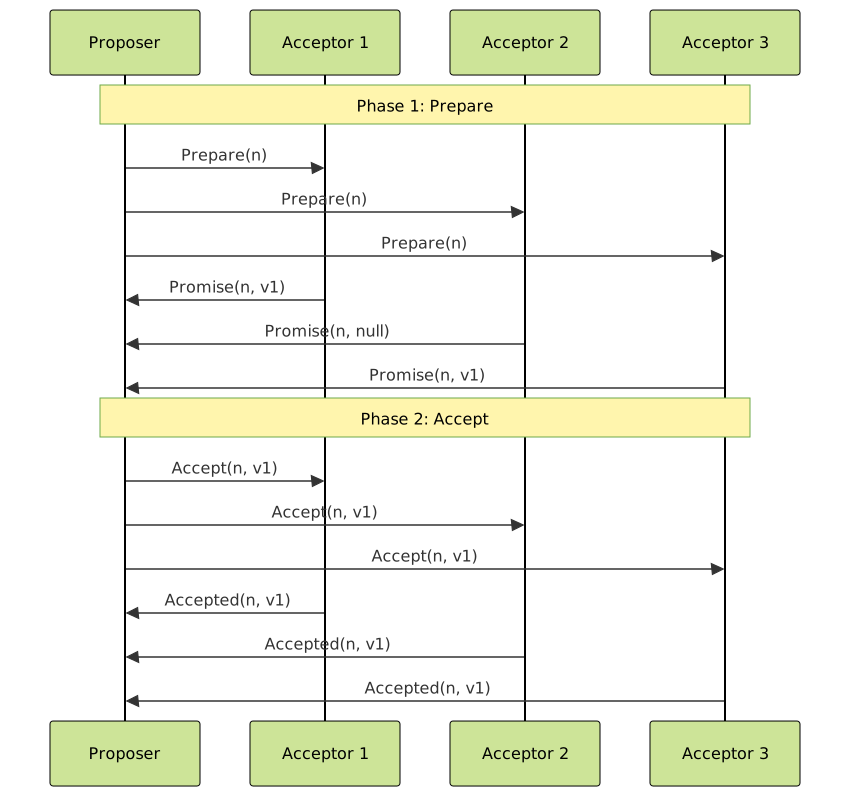
Basic Paxos operates in two phases:
Phase 1: Prepare
- Proposer selects a unique proposal number
nand sendsPrepare(n)to a majority of acceptors - Acceptors respond with
Promise(n, v)ifnis higher than any previously seen proposal, wherevis the highest-numbered proposal they’ve accepted
Phase 2: Accept
- If the proposer receives promises from a majority, it sends
Accept(n, v)wherevis either the highest-numbered proposal value from Phase 1 or its own value if no previous proposals exist - Acceptors accept the proposal if they haven’t promised to ignore it
Multi-Paxos
Basic Paxos requires two round trips for each decision, making it inefficient for multiple consecutive decisions. Multi-Paxos optimizes this by electing a distinguished proposer (leader) who can skip Phase 1 for subsequent proposals.
class PaxosNode:
    def __init__(self, node_id):
        self.node_id = node_id
        self.highest_proposal = 0
        self.accepted_proposal = None
        self.accepted_value = None
        self.promised_proposal = 0

    def prepare(self, proposal_number):
        if proposal_number > self.promised_proposal:
            self.promised_proposal = proposal_number
            return {
                'promise': True,
                'accepted_proposal': self.accepted_proposal,
                'accepted_value': self.accepted_value
            }
        return {'promise': False}

    def accept(self, proposal_number, value):
        if proposal_number >= self.promised_proposal:
            self.accepted_proposal = proposal_number
            self.accepted_value = value
            return {'accepted': True}
        return {'accepted': False}
Paxos Variants
- Fast Paxos: Reduces latency by allowing acceptors to accept values directly from clients
- Cheap Paxos: Uses auxiliary acceptors to maintain availability with fewer main acceptors
- Byzantine Paxos: Handles malicious nodes in addition to crash failures
Raft vs Paxos Comparison

| Aspect | Raft | Paxos |
|---|---|---|
| Complexity | Lower – designed for understandability | Higher – requires deep theoretical understanding |
| Leadership Model | Strong leader – all requests go through leader | Multiple proposers – can handle concurrent proposals |
| Performance | Good – single leader may become bottleneck | Excellent – can optimize for specific workloads |
| Fault Tolerance | Tolerates (n-1)/2 failures in n-node cluster | Tolerates (n-1)/2 failures in n-node cluster |
| Implementation | Easier to implement correctly | More error-prone implementation |
| Flexibility | Less flexible – fixed roles | More flexible – nodes can play multiple roles |
Real-World Applications
Raft Implementations
- etcd: Kubernetes’ key-value store uses Raft for consensus
- CockroachDB: Distributed SQL database built on Raft
- Consul: Service discovery and configuration tool
- TiKV: Distributed key-value database
Paxos Implementations
- Google Chubby: Lock service for loosely-coupled distributed systems
- Apache Cassandra: Uses Paxos for lightweight transactions
- Google Spanner: Globally distributed database
- Microsoft Azure Cosmos DB: Multi-model database service
Implementation Considerations
Network Partitions
Both algorithms handle network partitions by requiring majority consensus. During a partition:
- The partition with majority nodes continues operating
- The minority partition becomes unavailable
- When the partition heals, nodes synchronize their state
Performance Optimizations
# Raft optimization: Batch log entries
class OptimizedRaftLeader:
    def __init__(self):
        self.pending_entries = []
        self.batch_timeout = 10  # milliseconds

    def append_entry(self, entry):
        self.pending_entries.append(entry)
        if len(self.pending_entries) >= BATCH_SIZE:
            self.replicate_batch()
        else:
            self.schedule_batch_timeout()

    def replicate_batch(self):
        # Send all pending entries in single RPC
        for follower in self.followers:
            follower.append_entries(self.pending_entries)
        self.pending_entries.clear()
Testing Distributed Consensus
Testing consensus algorithms requires simulating various failure scenarios:
- Node failures: Randomly kill and restart nodes
- Network partitions: Simulate network splits and healing
- Message delays: Introduce random latency
- Clock skew: Test with unsynchronized clocks
Advanced Topics
Log Compaction
As systems run longer, logs grow indefinitely. Both Raft and Paxos implement log compaction:
- Snapshotting: Periodically create snapshots of current state
- Log truncation: Remove entries older than latest snapshot
- Incremental snapshots: Only snapshot changed data
Membership Changes
Dynamic cluster reconfiguration allows adding or removing nodes:

Byzantine Fault Tolerance
While Raft and basic Paxos handle crash failures, Byzantine fault-tolerant variants handle malicious behavior:
- PBFT: Practical Byzantine Fault Tolerance
- HotStuff: Modern Byzantine consensus used in blockchains
- Tendermint: Byzantine fault-tolerant consensus engine
Choosing Between Raft and Paxos
Choose Raft when:
- Team needs to understand and modify the consensus implementation
- Building a new distributed system from scratch
- Consistency is more important than maximum performance
- Want proven, production-ready implementations
Choose Paxos when:
- Need maximum performance and flexibility
- Have expertise in distributed systems theory
- Require specific optimizations (Fast Paxos, etc.)
- Building on existing Paxos infrastructure
Future of Consensus Algorithms
The field continues evolving with new challenges:
- Blockchain consensus: Proof-of-Stake, delegated consensus
- Multi-datacenter replication: Cross-region consistency
- Edge computing: Consensus in resource-constrained environments
- Quantum-resistant consensus: Preparing for quantum computers
Understanding Raft and Paxos provides a solid foundation for building reliable distributed systems. While Raft offers simplicity and understandability, Paxos provides flexibility and performance optimization opportunities. Both algorithms have proven their worth in production systems and continue to be essential tools for distributed system architects.
The choice between these algorithms depends on your specific requirements, team expertise, and system constraints. Regardless of which you choose, implementing distributed consensus correctly requires careful consideration of failure modes, thorough testing, and continuous monitoring in production environments.