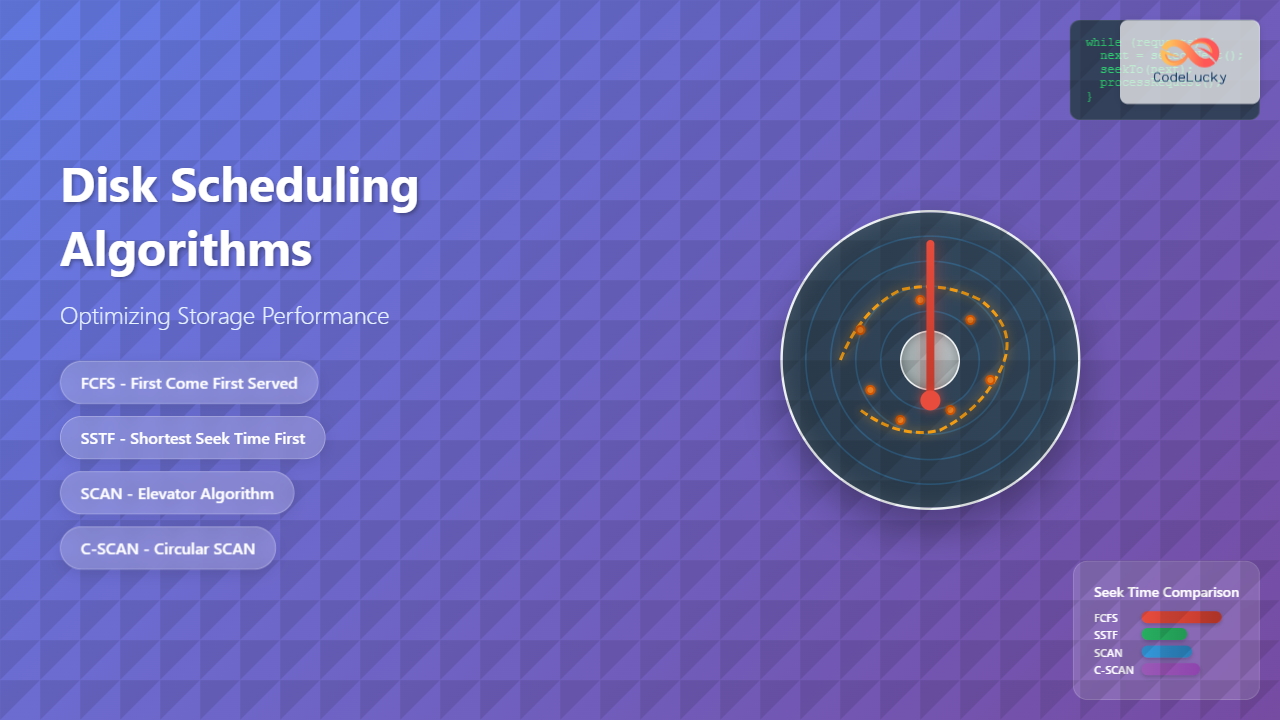
Disk scheduling algorithms are fundamental components of operating systems that determine the order in which disk I/O requests are processed. These algorithms significantly impact system performance by minimizing seek time and optimizing data access patterns. Understanding these algorithms is crucial for system administrators, developers, and anyone working with storage systems.
Understanding Disk Scheduling Fundamentals
Before diving into specific algorithms, it’s essential to understand the physical structure of a disk drive. A hard disk consists of multiple platters with read/write heads that move across tracks to access data. The seek time – the time required to move the head to the correct track – is typically the most significant factor in disk access time.
Disk scheduling algorithms aim to:
- Minimize total seek time
- Maximize throughput
- Ensure fairness among requests
- Prevent starvation of requests

First-Come, First-Served (FCFS) Algorithm
FCFS is the simplest disk scheduling algorithm that processes requests in the order they arrive. While easy to implement and inherently fair, it doesn’t optimize for seek time reduction.
How FCFS Works
The algorithm maintains a queue of disk requests and processes them sequentially without considering the current head position or the physical location of requested tracks.
FCFS Implementation Example
Let’s consider a disk with 200 tracks (0-199) and the following request sequence:
Request Queue: 98, 183, 37, 122, 14, 124, 65, 67
Initial Head Position: 53
| Step | Current Track | Next Request | Seek Distance | Total Seek Time |
|---|---|---|---|---|
| 1 | 53 | 98 | 45 | 45 |
| 2 | 98 | 183 | 85 | 130 |
| 3 | 183 | 37 | 146 | 276 |
| 4 | 37 | 122 | 85 | 361 |
| 5 | 122 | 14 | 108 | 469 |
| 6 | 14 | 124 | 110 | 579 |
| 7 | 124 | 65 | 59 | 638 |
| 8 | 65 | 67 | 2 | 640 |
Total Seek Time: 640 units
Average Seek Time: 640/8 = 80 units per request
FCFS Advantages and Disadvantages
Advantages:
- Simple to implement and understand
- Fair to all requests (no starvation)
- Low overhead
Disadvantages:
- High average seek time
- Poor performance with random access patterns
- No optimization for disk head movement
Shortest Seek Time First (SSTF) Algorithm
SSTF selects the request with the minimum seek time from the current head position. This greedy approach significantly reduces total seek time compared to FCFS but may cause starvation of requests located far from the current position.
SSTF Implementation Example
Using the same request queue and initial position:
Request Queue: 98, 183, 37, 122, 14, 124, 65, 67
Initial Head Position: 53
| Step | Current Track | Available Requests | Closest Request | Seek Distance | Total Seek Time |
|---|---|---|---|---|---|
| 1 | 53 | 98, 183, 37, 122, 14, 124, 65, 67 | 65 | 12 | 12 |
| 2 | 65 | 98, 183, 37, 122, 14, 124, 67 | 67 | 2 | 14 |
| 3 | 67 | 98, 183, 37, 122, 14, 124 | 98 | 31 | 45 |
| 4 | 98 | 183, 37, 122, 14, 124 | 122 | 24 | 69 |
| 5 | 122 | 183, 37, 14, 124 | 124 | 2 | 71 |
| 6 | 124 | 183, 37, 14 | 183 | 59 | 130 |
| 7 | 183 | 37, 14 | 37 | 146 | 276 |
| 8 | 37 | 14 | 14 | 23 | 299 |
Total Seek Time: 299 units
Average Seek Time: 299/8 = 37.4 units per request

SSTF Advantages and Disadvantages
Advantages:
- Better average response time than FCFS
- Reduced total seek time
- Good performance for localized access patterns
Disadvantages:
- Potential starvation of distant requests
- Not optimal in all cases
- Unfair to requests at disk extremes
SCAN Algorithm (Elevator Algorithm)
The SCAN algorithm moves the disk head in one direction, servicing all requests in its path until it reaches the end of the disk, then reverses direction. This approach eliminates starvation while maintaining reasonable seek times.
SCAN Implementation Example
Assuming the head is moving toward higher tracks initially:
Request Queue: 98, 183, 37, 122, 14, 124, 65, 67
Initial Head Position: 53 (moving right)
Disk Size: 0-199
Sorted requests by track number: 14, 37, 65, 67, 98, 122, 124, 183
| Step | Current Track | Next Request | Seek Distance | Total Seek Time | Direction |
|---|---|---|---|---|---|
| 1 | 53 | 65 | 12 | 12 | Right |
| 2 | 65 | 67 | 2 | 14 | Right |
| 3 | 67 | 98 | 31 | 45 | Right |
| 4 | 98 | 122 | 24 | 69 | Right |
| 5 | 122 | 124 | 2 | 71 | Right |
| 6 | 124 | 183 | 59 | 130 | Right |
| 7 | 183 | 199 (end) | 16 | 146 | Right |
| 8 | 199 | 37 | 162 | 308 | Left |
| 9 | 37 | 14 | 23 | 331 | Left |
Total Seek Time: 331 units
Average Seek Time: 331/8 = 41.4 units per request

SCAN Advantages and Disadvantages
Advantages:
- Eliminates starvation
- Good for systems with heavy disk usage
- Predictable access patterns
- Better than FCFS for most scenarios
Disadvantages:
- Requests at disk extremes may wait longer
- Head movement to disk ends even without requests
- Not always optimal for seek time
Circular SCAN (C-SCAN) Algorithm
C-SCAN improves upon SCAN by treating the disk as circular. After reaching one end, the head immediately returns to the other end and continues in the same direction, providing more uniform wait times.
C-SCAN Implementation Example
Using the same scenario with head moving toward higher tracks:
Request Queue: 98, 183, 37, 122, 14, 124, 65, 67
Initial Head Position: 53 (moving right)
| Step | Current Track | Next Request | Seek Distance | Total Seek Time | Direction |
|---|---|---|---|---|---|
| 1 | 53 | 65 | 12 | 12 | Right |
| 2 | 65 | 67 | 2 | 14 | Right |
| 3 | 67 | 98 | 31 | 45 | Right |
| 4 | 98 | 122 | 24 | 69 | Right |
| 5 | 122 | 124 | 2 | 71 | Right |
| 6 | 124 | 183 | 59 | 130 | Right |
| 7 | 183 | 199 (end) | 16 | 146 | Right |
| 8 | 199 | 0 (start) | 199 | 345 | Jump |
| 9 | 0 | 14 | 14 | 359 | Right |
| 10 | 14 | 37 | 23 | 382 | Right |
Total Seek Time: 382 units
Average Seek Time: 382/8 = 47.8 units per request

C-SCAN Advantages and Disadvantages
Advantages:
- More uniform wait times than SCAN
- Better for requests distributed across the disk
- Eliminates the bias against requests at disk ends
- Predictable performance characteristics
Disadvantages:
- Higher seek time due to head return
- More complex implementation
- May not be optimal for clustered requests
Performance Comparison and Analysis
Let’s compare the performance of all four algorithms using our example:
| Algorithm | Total Seek Time | Average Seek Time | Best Use Case |
|---|---|---|---|
| FCFS | 640 units | 80 units | Light disk usage, fairness critical |
| SSTF | 299 units | 37.4 units | Localized access patterns |
| SCAN | 331 units | 41.4 units | Heavy disk usage, mixed patterns |
| C-SCAN | 382 units | 47.8 units | Uniform access distribution |
Algorithm Selection Guidelines
Choose the appropriate algorithm based on your system requirements:
- FCFS: Use when fairness is more important than performance, or for systems with light disk usage
- SSTF: Ideal for applications with localized data access patterns and where some starvation is acceptable
- SCAN: Best for general-purpose systems with moderate to heavy disk usage
- C-SCAN: Optimal for systems requiring uniform response times across all disk locations
Real-World Considerations
Modern storage systems often implement hybrid approaches that consider:
- Request priorities: Critical system requests may bypass normal scheduling
- Deadline scheduling: Ensuring requests complete within time limits
- Anticipatory scheduling: Briefly waiting for nearby requests before moving the head
- SSD considerations: Solid-state drives don’t have mechanical seek times, changing optimization strategies

Implementation Tips and Best Practices
When implementing disk scheduling algorithms:
- Monitor system performance: Use metrics like average seek time, throughput, and request latency
- Consider workload patterns: Database systems may benefit from different algorithms than web servers
- Implement adaptive scheduling: Switch algorithms based on current load and access patterns
- Account for modern hardware: NCQ (Native Command Queuing) in SATA drives provides hardware-level optimization
- Test thoroughly: Benchmark different algorithms with realistic workloads
Understanding disk scheduling algorithms is crucial for optimizing system performance and ensuring efficient resource utilization. Each algorithm offers distinct advantages and trade-offs, making the choice dependent on specific system requirements, workload characteristics, and performance goals. As storage technology continues to evolve, these fundamental concepts remain relevant for system designers and administrators seeking to maximize storage efficiency.
Related Posts

Device Scheduling: Complete Guide to I/O Request Scheduling Algorithms
Device scheduling is a critical component of operating system design that determines how I/O requests are ordered and executed to...
CPU Scheduling Algorithms: FCFS, SJF, Round Robin Complete Guide
CPU scheduling is a fundamental concept in operating systems that determines how processes are allocated processor time. The CPU scheduler...
Log-structured File System: Sequential Write Optimization for High-Performance Storage
Log-structured File Systems (LFS) represent a revolutionary approach to data storage that fundamentally changes how operating systems handle file operations....
File Allocation Methods: Contiguous, Linked and Indexed Storage Techniques
Understanding File Allocation Methods in Operating Systems File allocation methods are fundamental techniques used by operating systems to organize and...
Storage Management: Complete Guide to Primary, Secondary and Tertiary Storage Systems
Storage management is one of the most critical components of an operating system, responsible for efficiently organizing, accessing, and maintaining...
ionice Command Linux: Master IO Scheduling Priority for Optimal System Performance
The ionice command is a powerful Linux utility that allows system administrators and developers to control the Input/Output (IO) scheduling...
Process Scheduling in Operating System: Algorithms, Types & Implementation Guide
Process scheduling is one of the most critical components of an operating system that determines how the CPU time is...

C++ Priority Queue: Heap-Based Priority Management
In the world of C++ data structures, the priority queue stands out as a powerful tool for managing elements based...
File System Cache: Buffer Cache and Page Cache Explained with Examples
File system caching is a fundamental performance optimization technique in modern operating systems that dramatically reduces disk I/O operations by...
File System Types: FAT32, NTFS, ext4 and Modern Linux Filesystems Explained
Understanding File Systems: The Foundation of Data Storage A file system is the method and data structure that an operating...

Fair Share Scheduling: Resource Allocation by User Groups in Operating Systems
Introduction to Fair Share Scheduling Fair Share Scheduling (FSS) is a sophisticated CPU scheduling algorithm designed to allocate computing resources...
File System Implementation: Boot Block, Super Block and Inodes Explained
Understanding File System Implementation File system implementation is a critical component of operating systems that manages how data is stored,...
- Understanding Disk Scheduling Fundamentals
- First-Come, First-Served (FCFS) Algorithm
- Shortest Seek Time First (SSTF) Algorithm
- SCAN Algorithm (Elevator Algorithm)
- Circular SCAN (C-SCAN) Algorithm
- Performance Comparison and Analysis
- Algorithm Selection Guidelines
- Real-World Considerations
- Implementation Tips and Best Practices