Derivatives: How Futures Contracts Work
Futures contracts are among the most powerful and widely traded financial instruments in the global markets. Understanding how they function is key for anyone interested in finance, investment, or risk management. In this article, we’ll explore what futures are, how they work, their uses, and some practical examples with visual explanations.
What Are Futures Contracts?
A futures contract is an agreement between two parties to buy or sell an asset at a predetermined price on a future date. Unlike spot trades, which occur instantly, futures defer the transaction until a later date. This makes them valuable for hedging against price changes and for speculation.
Futures can be based on:
- Commodities (gold, oil, wheat)
- Financial instruments (stock indices, bonds, interest rates)
- Cryptocurrencies (Bitcoin, Ethereum)
The key point is that both parties are obligated to fulfill the contract unless they offset their positions before the expiration date.
Structure of a Futures Contract
Each futures contract specifies:
- The asset to be traded (e.g., crude oil, wheat, S&P 500)
- The price agreed upon
- The expiration date
- Contract size (how much of the asset one contract controls)
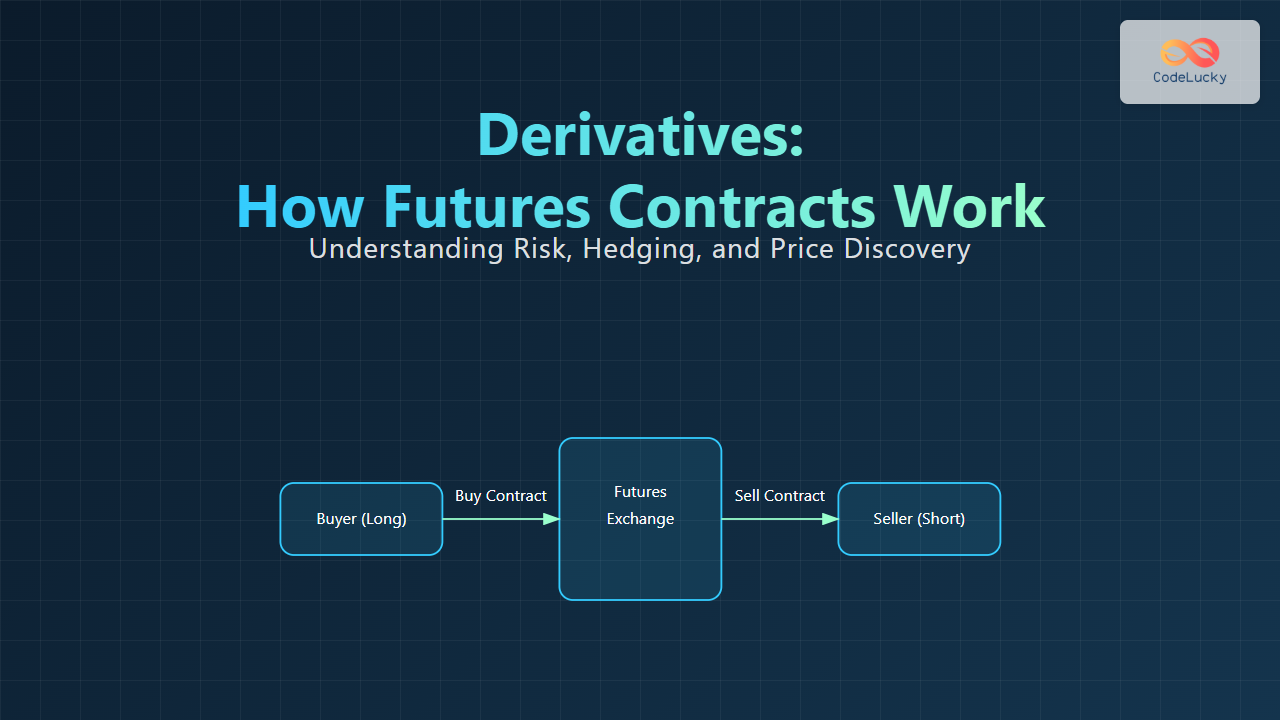
This diagram shows the relationship between buyers, sellers, and the exchange, which acts as the intermediary guaranteeing contract performance.
How Futures Contracts Work in Practice
Let’s look at a simple example:
Example: Assume that oil is currently trading at $70 per barrel. A company expects to need 10,000 barrels in three months. It buys a futures contract to lock in the $70 price. When the contract expires, if the market price rises to $80, the company benefits, as it will still pay $70. Conversely, the seller benefits if the price drops below $70.
This mechanism ensures price stability and allows both hedgers (like companies) and speculators (like traders) to participate efficiently.
Types of Futures Participants
- Hedgers: Businesses or investors who use futures to protect against adverse price movements.
- Speculators: Traders who aim to profit from anticipating market price changes.
- Arbitrageurs: Participants who exploit price differences across markets for risk-free profit.

Mark-to-Market and Margin Mechanism
Futures positions are marked to market daily — meaning profits and losses are calculated each day based on that day’s closing price. Traders must maintain a margin, which is a form of collateral to ensure contract performance.
| Day | Opening Price | Closing Price | Daily P&L | Cumulative Margin Balance |
|---|---|---|---|---|
| 1 | $70 | $72 | +$2000 | $7000 |
| 2 | $72 | $68 | – $4000 | $3000 |
If the margin falls below a maintenance threshold, a margin call is issued, requiring the trader to deposit more funds.

Settlement of Futures Contracts
Futures contracts can be settled in two ways:
- Physical delivery: The actual commodity is delivered upon contract expiration (common in commodities markets).
- Cash settlement: No physical delivery; instead, parties exchange the cash difference between contract price and market price (common in index futures).
For most traders, cash settlement is preferred because it’s simpler and avoids logistical challenges of delivery.
Example of Profit and Loss Calculation
Example: Suppose you take a long position on one gold futures contract at $2,000 per ounce. Each contract represents 100 ounces. If the price rises to $2,050, your gain is:
\( (2,050 – 2,000) \times 100 = $5,000 \)
If it drops to $1,980, your loss is:
\( (1,980 – 2,000) \times 100 = -$2,000 \)
Why Futures Matter in Modern Finance
Futures play an essential role in ensuring liquidity, price discovery, and hedging. They are crucial for industries dependent on stable input costs, for institutional investors, and even for governments managing economic risks.

Advantages of Futures
- Provides leverage with low initial investment.
- Offers high liquidity and transparency through regulated exchanges.
- Useful for hedging against adverse price movements.
- Enables portfolio diversification.
Risks Associated with Futures
- Leverage risk: Small price changes can result in large gains or losses.
- Liquidity risk: Some contracts may lack sufficient buyers/sellers.
- Market volatility: Unexpected events can lead to sharp price changes.
Interactive Exploration
Try this simple thought experiment:
- If you expect prices to rise, what happens if you take a long futures position?
- If you expect prices to fall, what happens with a short position?
Changing these assumptions helps you understand how traders position themselves based on market sentiment.
Final Thoughts
Futures contracts are a cornerstone of the global financial system. They serve as both a risk management tool for producers and consumers and a trading opportunity for speculators. Whether you are an investor, a business, or an enthusiast, understanding how futures work gives you a deeper insight into market behavior and the economic forces that shape asset prices.
Mastering futures trading starts with knowledge — and a commitment to disciplined risk management. With that foundation, futures can become a versatile instrument in your financial toolkit.