Demonstrative Pronouns are among the most commonly used words in English. They help us point to specific things or people and clarify what or whom we are referring to. In this article, we’ll dive deep into their meaning, types, examples, and interactive exercises so you can master them confidently.
What Are Demonstrative Pronouns?
A demonstrative pronoun is a word used to point to something specific within a sentence. It identifies nouns by indicating their position (near or far) in relation to the speaker or listener.
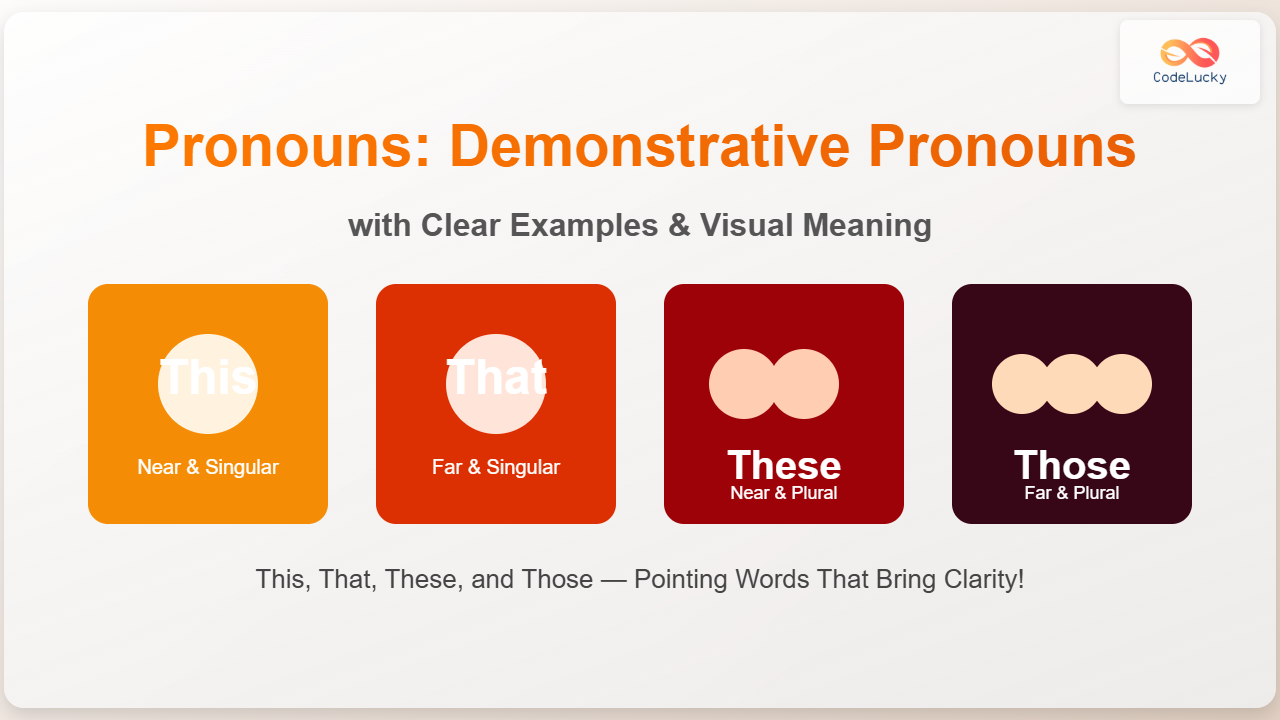
English has four main demonstrative pronouns:
- This – used for singular and near objects.
- That – used for singular and far objects.
- These – used for plural and near objects.
- Those – used for plural and far objects.
Function of Demonstrative Pronouns
These pronouns replace nouns that have already been mentioned or are understood from context. They signal both number (singular/plural) and distance (near/far).
| Pronoun | Number | Distance | Example |
|---|---|---|---|
| This | Singular | Near | This is my cup. |
| That | Singular | Far | That is your pen. |
| These | Plural | Near | These are fresh apples. |
| Those | Plural | Far | Those are old houses. |
Demonstrative Pronouns vs. Demonstrative Adjectives
While both types use the same words (this, that, these, those), their grammatical function differs. Demonstrative pronouns stand alone, replacing nouns. Demonstrative adjectives accompany nouns.

Examples of Demonstrative Pronouns in Sentences
- This is delicious. (Refers to something close.)
- That was a great game. (Refers to something farther away in time or space.)
- These belong to me. (Multiple things nearby.)
- Those were his best years. (Multiple things far away in time or distance.)
Real-Life Usage Scenarios
1. In Conversations
We often use demonstrative pronouns to clarify objects while talking:
Person A: Is this your notebook?
Person B: No, that is mine.
2. In Storytelling
Writers use demonstrative pronouns to maintain flow and avoid repetition:
“Those were the days we will never forget.”
3. In Classroom or Presentation Contexts
Speakers point at materials or slides:
“These are the concepts we’ll learn today.”
Visual Guide: Choosing the Right Pronoun

Common Mistakes with Demonstrative Pronouns
- Using plural with singular nouns: ❌ These pen is mine. ✅ This pen is mine.
- Mixing up distance: ❌ That people here are nice. ✅ These people here are nice.
- Double usage: Avoid saying “This these books” — pick one demonstrative pronoun.
Interactive Practice Exercise
Try identifying the correct demonstrative pronoun for each sentence:
- ________ (This/These) is my favorite photo from the trip.
- ________ (That/Those) are the shoes I told you about.
- Can you hand me ________ (this/that) book on the shelf?
- ________ (These/This) look delicious!
Answers: 1. This, 2. Those, 3. That, 4. These.

Quick Recap
- This / These = near objects in distance or time.
- That / Those = far objects in distance or time.
- Used to point out things, people, or ideas clearly.
Final Thoughts
Demonstrative pronouns bring clarity and precision to your English communication. By mastering this, that, these, and those, you can make your sentences cleaner and more natural. Practice daily using real-life objects around you, such as This chair is comfortable and Those pictures are amazing, to develop fluency quickly.