Delaunay Triangulation is a fundamental algorithm in computational geometry, extensively used for creating optimal triangle meshes from a given set of points. It maximizes the minimum angle of all triangles in the mesh, preventing skinny or badly shaped triangles which can degrade the quality of numerical simulations, graphics rendering, or geographic modeling. This article presents an in-depth exploration of Delaunay Triangulation, its properties, construction methods, applications, and illustrative examples with visual and interactive explanations using mermaid diagrams for better conceptual clarity.
What is Delaunay Triangulation?
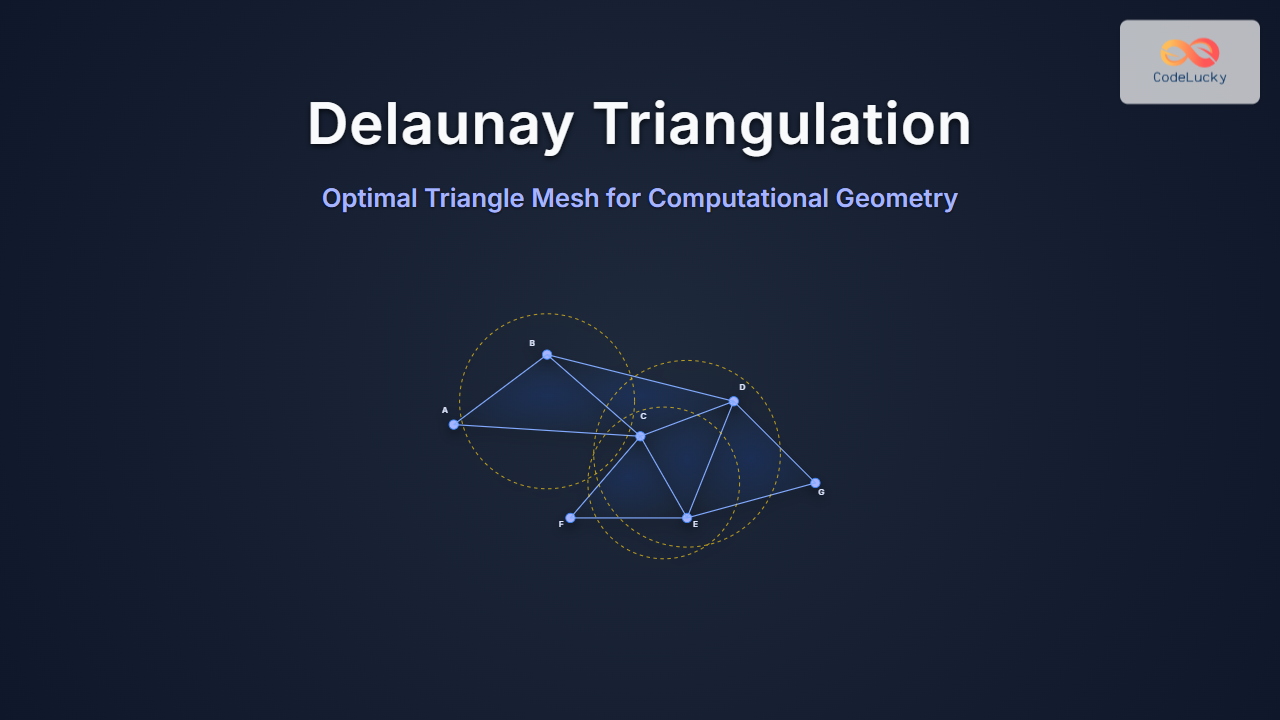
Delaunay Triangulation for a set of points in a plane is a triangulation such that no point in the set is inside the circumcircle of any triangle in the triangulation. This property ensures that the triangles are as close to equilateral as possible, optimizing triangle quality across the mesh. Named after Boris Delaunay, who introduced it in 1934, it is widely used in mesh generation, finite element analysis, computer graphics, and geographic information systems.
Key Properties of Delaunay Triangulation
- Maximizes Minimum Angles: Avoids skinny triangles ensuring mesh stability.
- Uniqueness: For a set of points in general position (no four points cocircular), the Delaunay Triangulation is unique.
- Empty Circumcircle Property: The circumcircle of each triangle contains no other point from the set in its interior.
- Dual of the Voronoi Diagram: The edges of the Delaunay Triangulation correspond to edges between cells in the Voronoi diagram.

Constructing Delaunay Triangulation
There are several algorithms to compute Delaunay Triangulation. The choice depends on application needs and efficiency requirements:
1. Incremental Algorithm
Points are added one by one, retriangulating affected regions to maintain the Delaunay property.
2. Divide and Conquer Algorithm
The point set is recursively divided, triangulated individually, then merged while preserving the Delaunay property.
3. Sweep Line Algorithm
Processes points in sorted order using a sweep line that builds the triangulation progressively.
4. Flip Algorithm
Starts from any triangulation and iteratively edge-flips triangles that violate the Delaunay condition until all are valid.

Example: Delaunay Triangulation of a Point Set
Consider the following set of points:
(2, 3), (5, 7), (9, 6), (4, 2), (7, 1), (8, 4)
The Delaunay Triangulation for these points will connect them with edges that form triangles without any points lying inside the circumcircles of these triangles.

Interactive Visualization Opportunity
For a practical understanding, visualizing the triangulation dynamically by moving points and observing changes in the mesh can be invaluable. This can be done with tools such as:
Applications of Delaunay Triangulation
- Mesh Generation: Creating efficient and stable meshes for finite element analysis and computational fluid dynamics.
- Computer Graphics: Terrain modeling, texture mapping, and shape reconstruction.
- Geographic Information Systems (GIS): Terrain modeling and spatial analysis.
- Pathfinding and Navigation: Networks for movement in robotics and games.
- Interpolation: Creating natural neighbor interpolation for scattered data points.
Advantages Over Other Triangulation Methods
Compared to arbitrary triangulations, Delaunay Triangulation:
- Produces meshes with higher minimum angles, reducing numerical instability.
- Has a unique or near-unique solution in most cases, ensuring reproducibility.
- Is computationally efficient with known algorithms scalable to large datasets.
Summary
Delaunay Triangulation is the premier choice for generating quality triangle meshes in computational geometry applications. By enforcing the empty circumcircle property, it guarantees optimal triangles maximizing minimum angles and equilateral-like shapes. Understanding its construction algorithms and applications is critical in fields ranging from scientific computing to computer graphics. The integration of visual diagrams and interactive tools enhances comprehension, making it invaluable for learners and professionals alike.