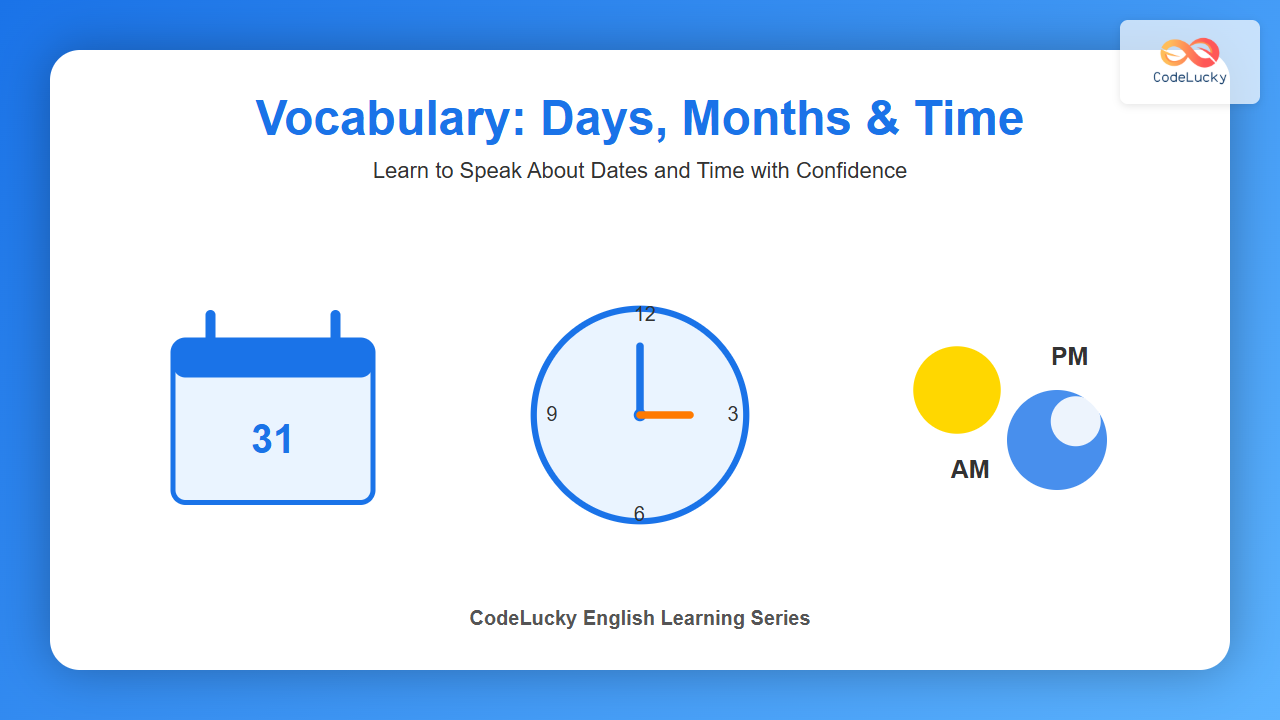
Vocabulary: Days, Months, and Time Vocabulary is one of the essential building blocks for anyone learning English. Understanding how to express time, date, and schedules correctly helps you communicate naturally in daily conversation, meetings, and travel situations. Let’s dive into an easy yet thorough explanation of how days, months, and time expressions work in English—complete with examples, charts, and simple visuals.
1. Days of the Week
There are seven days in a week. Each day begins with a capital letter in English. Here’s how they are written and pronounced:
| Day | Abbreviation | Example Sentence |
|---|---|---|
| Monday | Mon | I go jogging every Monday. |
| Tuesday | Tue | We have a meeting on Tuesday. |
| Wednesday | Wed | My English class is every Wednesday. |
| Thursday | Thu | He works from home on Thursday. |
| Friday | Fri | Let’s have dinner this Friday. |
| Saturday | Sat | We relax on Saturday. |
| Sunday | Sun | Sunday is my favorite day. |

Tip: In many countries, Sunday is considered the first day of the week, though in others, Monday is used as the starting point.
2. Months of the Year
There are twelve months in the Gregorian calendar. Each begins with a capital letter and sometimes is abbreviated in writing, especially in date formats.
| Month | Abbreviation | Example |
|---|---|---|
| January | Jan | My birthday is in January. |
| February | Feb | Valentine’s Day is in February. |
| March | Mar | Spring begins in March. |
| April | Apr | April showers bring May flowers. |
| May | May | May is a beautiful month. |
| June | Jun | We start summer in June. |
| July | Jul | Independence Day is in July. |
| August | Aug | School holidays end in August. |
| September | Sep | Autumn begins in September. |
| October | Oct | We celebrate Halloween in October. |
| November | Nov | Thanksgiving is in November. |
| December | Dec | Christmas comes in December. |

3. Talking About Dates
In English, dates are written in two common formats:
- British format: DD/MM/YYYY → 20/12/2025 (20th December 2025)
- American format: MM/DD/YYYY → 12/20/2025 (December 20th, 2025)
When speaking, we use ordinal numbers:
- 1 → first
- 2 → second
- 3 → third
- 21 → twenty-first
- 31 → thirty-first
Example Sentences:
- My flight is on the fifth of May.
- School starts on September first.
- The meeting is on July twentieth.
4. Time Vocabulary and Expressions
Learning how to tell and describe time correctly is crucial for clear communication.
Basic Time Units
| Unit | Meaning | Example |
|---|---|---|
| Second | 1/60 of a minute | Wait a second. |
| Minute | 60 seconds | Be ready in five minutes. |
| Hour | 60 minutes | I work for eight hours daily. |
| Day | 24 hours | There are 7 days in a week. |
| Week | 7 days | We meet once a week. |
| Month | About 30 days | The project ends in a month. |
| Year | 12 months | A year has 365 days. |
How to Tell Time
There are two common ways:
- Digital: “It’s 3:45.”
- Analog/Spoken: “It’s quarter to four.”
Useful time expressions:
- O’clock: It’s five o’clock (5:00).
- Quarter past: It’s quarter past three (3:15).
- Half past: It’s half past six (6:30).
- Quarter to: It’s quarter to seven (6:45).

5. Time of the Day Vocabulary
English uses specific words to describe times of the day.
| Term | Time Range | Example |
|---|---|---|
| Morning | 5 a.m. – 12 p.m. | I exercise in the morning. |
| Noon | 12 p.m. | Lunch is at noon. |
| Afternoon | 12 p.m. – 6 p.m. | Work continues through the afternoon. |
| Evening | 6 p.m. – 9 p.m. | I study in the evening. |
| Night | 9 p.m. – 12 a.m. | We watch movies at night. |
| Midnight | 12 a.m. | She goes to bed after midnight. |

6. Interactive Practice: Match and Identify
Try answering these simple practice tasks to test what you learned:
- Write today’s date in both British and American formats.
- What time is “quarter past two” in digital form?
- Which month comes after September?
- Name the three days that come before Friday.
- Say what you usually do in the evening.
Such exercises help internalize the vocabulary and naturally improve fluency.
Final Tips for Mastery
- Practice describing your daily routine using time words.
- Use an English calendar app to learn spelling and pronunciation.
- Watch English news and listen to how time expressions are used naturally.
- Repeat aloud phrases like “at seven in the morning” or “on Tuesday evening.”
Conclusion: Mastering days, months, and time vocabulary is the key to building real-world English fluency. Whether you’re scheduling meetings, talking about holidays, or planning your day, these words help you sound clear, confident, and accurate.