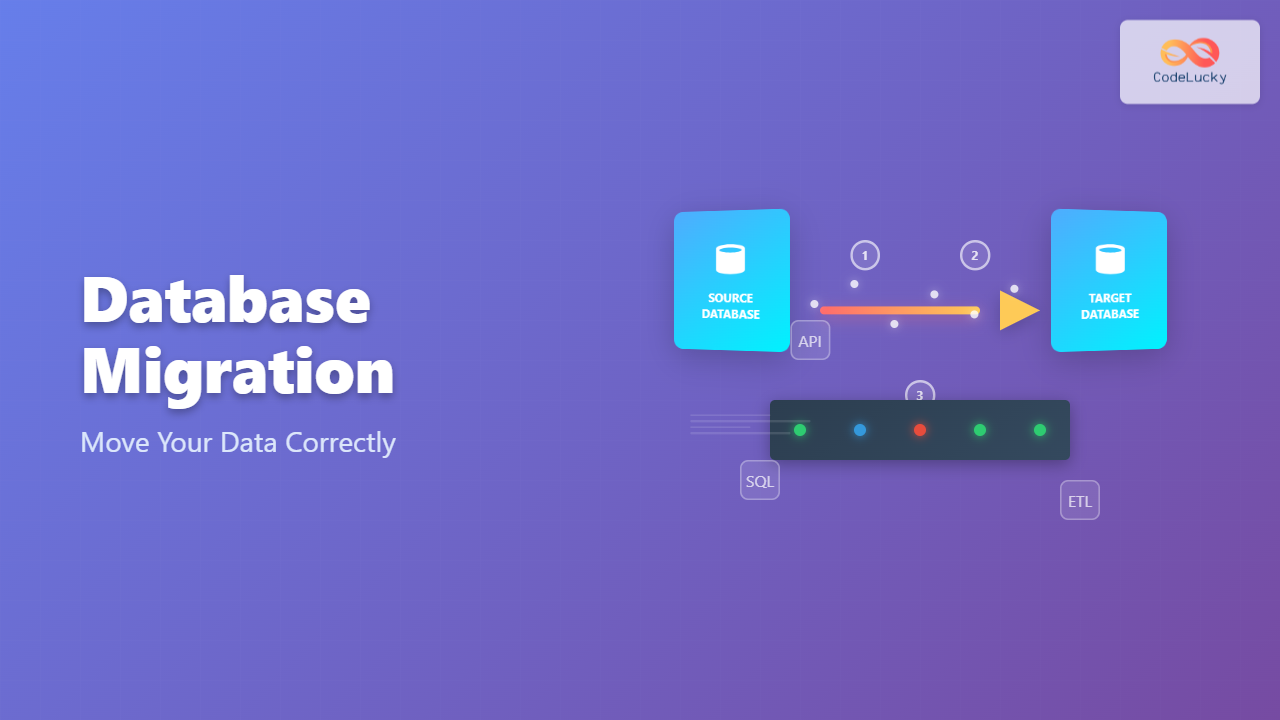
Database migration is a critical process that involves moving data, schema, or entire databases from one environment to another. Whether you’re upgrading systems, changing database platforms, or moving to the cloud, understanding proper migration techniques ensures data integrity, minimizes downtime, and prevents costly mistakes.
What is Database Migration?
Database migration refers to the process of transferring data and database structures from one database management system (DBMS) to another, or from one version to another. This process can involve:
- Schema migration: Moving database structure (tables, indexes, constraints)
- Data migration: Transferring actual data records
- Application migration: Updating applications to work with new database systems
- Platform migration: Moving between different database technologies

Types of Database Migrations
1. Homogeneous Migration
Moving between similar database systems (e.g., MySQL 5.7 to MySQL 8.0). These migrations typically involve:
- Version upgrades
- Hardware migrations
- Cloud migrations within the same database family
2. Heterogeneous Migration
Moving between different database systems (e.g., Oracle to PostgreSQL). These require:
- Data type mapping
- Query syntax conversion
- Feature compatibility analysis
Pre-Migration Planning
Assessment and Analysis
Before starting any migration, conduct a thorough assessment:
-- Example: Analyzing database size and structure
SELECT
    table_name,
    table_rows,
    data_length,
    index_length,
    (data_length + index_length) as total_size
FROM information_schema.tables
WHERE table_schema = 'your_database_name'
ORDER BY total_size DESC;
Dependency Mapping
Identify all database dependencies:
- Foreign key relationships
- Stored procedures and functions
- Triggers and views
- Application connections

Migration Strategies
1. Big Bang Migration
Complete migration during a planned downtime window.
Advantages:
- Simpler to execute
- No data synchronization issues
- Lower complexity
Disadvantages:
- Extended downtime
- Higher risk if issues occur
- Difficult rollback
2. Trickle Migration
Gradual migration with continuous data synchronization.
# Example: Python script for incremental data sync
import pymysql
from datetime import datetime

def sync_incremental_data(source_conn, target_conn, table_name, timestamp_col):
    # Get last sync timestamp
    cursor = target_conn.cursor()
    cursor.execute(f"SELECT MAX({timestamp_col}) FROM {table_name}_sync_log")
    last_sync = cursor.fetchone()[0] or '1970-01-01'

    # Fetch new/updated records
    source_cursor = source_conn.cursor()
    query = f"""
        SELECT * FROM {table_name}
        WHERE {timestamp_col} > %s
        ORDER BY {timestamp_col}
    """
    source_cursor.execute(query, (last_sync,))

    # Insert/update records in target
    for row in source_cursor.fetchall():
        # Process each row
        insert_or_update_record(target_conn, table_name, row)

    # Log sync completion
    log_sync_completion(target_conn, table_name, datetime.now())
3. Hybrid Approach
Combines both strategies, migrating static data first, then dynamic data during downtime.
Step-by-Step Migration Process
Step 1: Environment Setup
# Create target database
mysql -u root -p -e "CREATE DATABASE target_db CHARACTER SET utf8mb4 COLLATE utf8mb4_unicode_ci;"

# Grant permissions
mysql -u root -p -e "GRANT ALL PRIVILEGES ON target_db.* TO 'migration_user'@'%';"
Step 2: Schema Migration
-- Export schema structure
mysqldump -u username -p --no-data --routines --triggers source_db > schema.sql

-- Import to target database
mysql -u username -p target_db < schema.sql

-- Verify schema migration
SELECT COUNT(*) as table_count FROM information_schema.tables
WHERE table_schema = 'target_db';
Step 3: Data Migration
# For large datasets, use parallel processing
mysqldump -u username -p --single-transaction --routines --triggers \
  --where="id BETWEEN 1 AND 100000" source_db table_name > chunk1.sql

# Import chunks
mysql -u username -p target_db < chunk1.sql
Step 4: Data Validation
-- Compare row counts
SELECT
    'source' as source,
    (SELECT COUNT(*) FROM source_db.users) as user_count,
    (SELECT COUNT(*) FROM source_db.orders) as order_count
UNION ALL
SELECT
    'target' as source,
    (SELECT COUNT(*) FROM target_db.users) as user_count,
    (SELECT COUNT(*) FROM target_db.orders) as order_count;

-- Data integrity checks
SELECT
    table_name,
    checksum_value
FROM (
    SELECT 'users' as table_name,
           BIT_XOR(CAST(CRC32(CONCAT_WS(',', id, email, created_at)) AS UNSIGNED)) as checksum_value
    FROM source_db.users
) source_checksums;

Handling Different Database Systems
MySQL to PostgreSQL Migration
-- MySQL syntax
CREATE TABLE users (
    id INT AUTO_INCREMENT PRIMARY KEY,
    email VARCHAR(255) NOT NULL,
    created_at TIMESTAMP DEFAULT CURRENT_TIMESTAMP
);

-- PostgreSQL equivalent
CREATE TABLE users (
    id SERIAL PRIMARY KEY,
    email VARCHAR(255) NOT NULL,
    created_at TIMESTAMP DEFAULT CURRENT_TIMESTAMP
);
Data Type Mapping
| MySQL | PostgreSQL | SQL Server |
|---|---|---|
| INT AUTO_INCREMENT | SERIAL | INT IDENTITY |
| VARCHAR(n) | VARCHAR(n) | NVARCHAR(n) |
| TEXT | TEXT | NVARCHAR(MAX) |
| DATETIME | TIMESTAMP | DATETIME2 |
| BOOLEAN | BOOLEAN | BIT |
Migration Tools and Technologies
Open Source Tools
- Flyway: Version control for databases
- Liquibase: Database schema migration tool
- mysqldump/pg_dump: Native backup utilities
- Pentaho Data Integration: ETL tool for complex migrations
Cloud Migration Services
- AWS Database Migration Service (DMS)
- Azure Database Migration Service
- Google Cloud Database Migration Service
# Example: Using AWS DMS with Python
import boto3

dms_client = boto3.client('dms', region_name='us-east-1')

# Create replication instance
response = dms_client.create_replication_instance(
    ReplicationInstanceIdentifier='my-replication-instance',
    ReplicationInstanceClass='dms.t2.micro',
    VpcSecurityGroupIds=['sg-12345678'],
    ReplicationSubnetGroupIdentifier='my-subnet-group'
)

# Create migration task
migration_task = dms_client.create_replication_task(
    ReplicationTaskIdentifier='my-migration-task',
    SourceEndpointArn='arn:aws:dms:us-east-1:123456789:endpoint:source',
    TargetEndpointArn='arn:aws:dms:us-east-1:123456789:endpoint:target',
    ReplicationInstanceArn=response['ReplicationInstance']['ReplicationInstanceArn'],
    MigrationType='full-load-and-cdc',
    TableMappings=json.dumps({
        "rules": [
            {
                "rule-type": "selection",
                "rule-id": "1",
                "rule-name": "1",
                "object-locator": {
                    "schema-name": "myapp",
                    "table-name": "%"
                },
                "rule-action": "include"
            }
        ]
    })
)
Testing and Validation
Pre-Migration Testing
-- Create test migration with sample data
CREATE DATABASE test_migration;

-- Copy sample data (10% of production)
INSERT INTO test_migration.users
SELECT * FROM production.users
WHERE id % 10 = 0;

-- Run validation queries
SELECT
    COUNT(*) as total_records,
    COUNT(DISTINCT email) as unique_emails,
    MIN(created_at) as earliest_record,
    MAX(created_at) as latest_record
FROM test_migration.users;
Post-Migration Validation
# Automated validation script
def validate_migration(source_config, target_config, tables):
    validation_results = {}

    for table in tables:
        source_count = get_record_count(source_config, table)
        target_count = get_record_count(target_config, table)

        validation_results[table] = {
            'source_count': source_count,
            'target_count': target_count,
            'match': source_count == target_count
        }

    return validation_results

# Data integrity validation
def validate_data_integrity(source_conn, target_conn, table, key_column):
    # Check for missing records
    query = f"""
        SELECT {key_column} FROM {table}
        WHERE {key_column} NOT IN (SELECT {key_column} FROM target.{table})
    """
    missing_records = execute_query(source_conn, query)

    return len(missing_records) == 0

Common Migration Challenges and Solutions
Challenge 1: Downtime Minimization
Solution: Use read replicas and synchronized cutover
-- Setup read replica for zero-downtime migration
CREATE REPLICA my_replica FOR DATABASE source_db;

-- During cutover, promote replica
PROMOTE REPLICA my_replica TO PRIMARY;
Challenge 2: Large Dataset Migration
Solution: Implement chunked migration with progress tracking
def migrate_large_table(source_conn, target_conn, table_name, chunk_size=10000):
    total_rows = get_table_row_count(source_conn, table_name)
    chunks = (total_rows // chunk_size) + 1

    for i in range(chunks):
        offset = i * chunk_size

        # Extract chunk
        query = f"SELECT * FROM {table_name} LIMIT {chunk_size} OFFSET {offset}"
        chunk_data = execute_query(source_conn, query)

        # Load chunk
        insert_batch(target_conn, table_name, chunk_data)

        # Progress tracking
        progress = ((i + 1) / chunks) * 100
        print(f"Migration progress: {progress:.2f}%")
Challenge 3: Data Transformation
Solution: Implement ETL pipeline with data mapping
def transform_data(source_row):
    transformed_row = {}

    # Data type conversions
    transformed_row['id'] = int(source_row['id'])
    transformed_row['email'] = source_row['email'].lower().strip()

    # Date format conversion
    transformed_row['created_at'] = datetime.strptime(
        source_row['created_date'], '%Y-%m-%d %H:%M:%S'
    ).isoformat()

    # Business logic transformations
    transformed_row['full_name'] = f"{source_row['first_name']} {source_row['last_name']}"

    return transformed_row
Best Practices for Database Migration
Planning and Preparation
- Create comprehensive migration plan with timelines and rollback procedures
- Perform multiple test migrations in staging environments
- Document all dependencies and integration points
- Establish clear success criteria and validation checkpoints
Execution Best Practices
- Always backup source data before starting migration
- Use transaction logs for point-in-time recovery
- Monitor performance throughout the migration process
- Implement checksum validation for data integrity
Post-Migration Optimization
-- Rebuild indexes for optimal performance
ALTER TABLE users REBUILD INDEX;

-- Update table statistics
ANALYZE TABLE users;

-- Optimize query plans
EXPLAIN SELECT * FROM users WHERE email = '[email protected]';
Rollback Strategies
Always prepare rollback procedures before migration:
-- Create rollback script template
-- 1. Stop application connections
-- 2. Restore from backup
mysqldump -u username -p --single-transaction source_db > pre_migration_backup.sql

-- 3. Verify data integrity
SELECT COUNT(*) FROM critical_table;

-- 4. Update application configuration
-- 5. Restart application services
Performance Optimization During Migration
Optimization Techniques
- Disable foreign key checks during bulk loading
- Use bulk insert operations instead of row-by-row inserts
- Temporarily disable triggers and indexes
- Increase buffer pool size for better I/O performance
-- Optimization settings for MySQL
SET foreign_key_checks = 0;
SET unique_checks = 0;
SET sql_log_bin = 0;

-- Bulk insert with optimal settings
LOAD DATA INFILE '/path/to/data.csv'
INTO TABLE target_table
FIELDS TERMINATED BY ','
LINES TERMINATED BY '\n'
IGNORE 1 ROWS;

-- Re-enable constraints
SET foreign_key_checks = 1;
SET unique_checks = 1;
SET sql_log_bin = 1;
Monitoring and Maintenance
Post-migration monitoring ensures optimal performance:
-- Monitor query performance
SELECT
    query_id,
    query_time,
    lock_time,
    rows_sent,
    rows_examined,
    sql_text
FROM mysql.slow_log
WHERE start_time > DATE_SUB(NOW(), INTERVAL 24 HOUR)
ORDER BY query_time DESC;

-- Check for missing indexes
SELECT
    table_schema,
    table_name,
    column_name
FROM information_schema.statistics
WHERE table_schema = 'your_database'
  AND cardinality < 10;
Conclusion
Successful database migration requires careful planning, thorough testing, and systematic execution. By following the strategies and best practices outlined in this guide, you can ensure your data migration project minimizes risks, reduces downtime, and maintains data integrity throughout the process.
Remember that every migration is unique, and you may need to adapt these approaches based on your specific requirements, constraints, and business needs. Always prioritize data safety, plan for contingencies, and maintain clear communication with all stakeholders throughout the migration process.
The key to successful database migration lies in preparation, validation, and having robust rollback procedures. Take time to understand your data, test thoroughly, and never rush the process when dealing with critical business data.