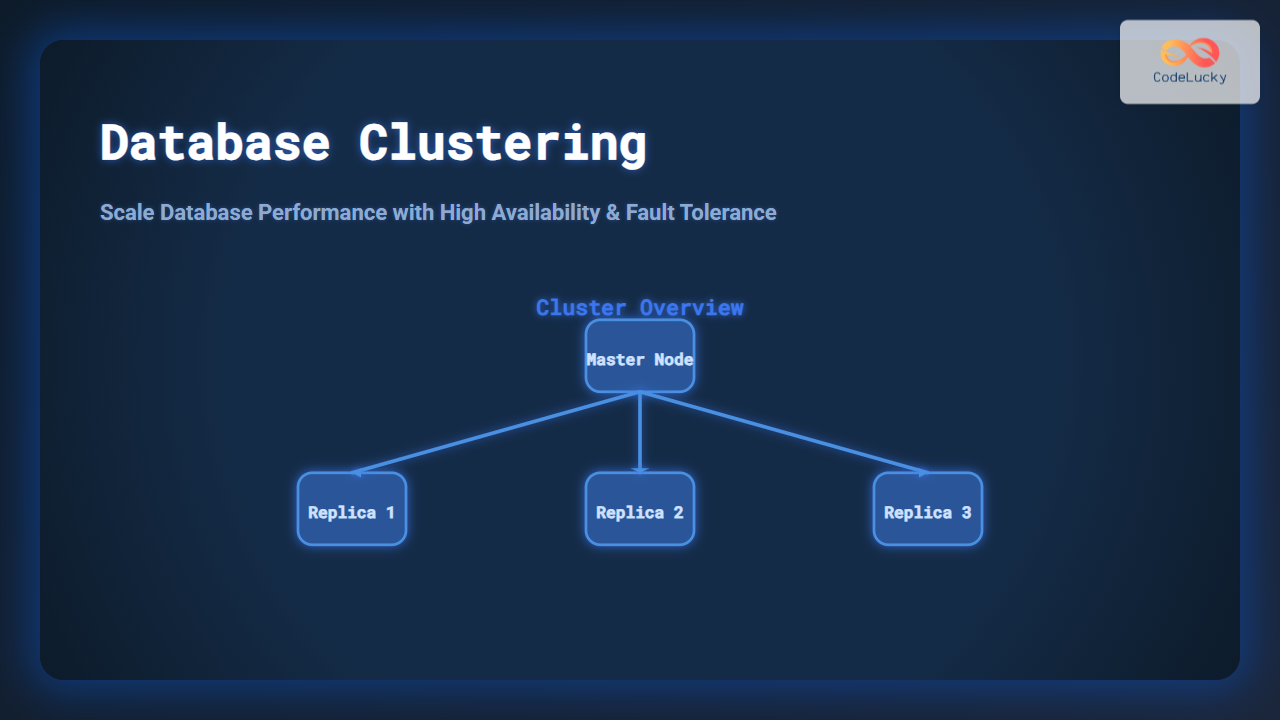
Managing growing data volumes and increasing user demands is a challenge for any modern application. Database clustering emerges as a vital strategy for scaling database performance while ensuring high availability and fault tolerance. This comprehensive guide dives deep into database clustering fundamentals, architectures, use cases, pros and cons, and implementation examples with clear visual diagrams and outputs. Whether working with SQL or NoSQL, understanding clustering can revolutionize how your systems handle data under load.
What Is Database Clustering?
Database clustering is the technique of linking multiple database servers to work as a unified system, sharing the workload of queries and data management. The cluster distributes client requests across database nodes to improve performance, increase fault tolerance, and provide continuous service availability. If one node fails, others take over seamlessly, eliminating downtime.

Key Benefits of Database Clustering
- Scalability: Easily add more nodes to the cluster to handle increased traffic and data volume.
- High Availability (HA): Failover mechanisms keep databases available despite hardware or software failures.
- Load Balancing: Query load is spread, reducing bottlenecks and improving response times.
- Data Redundancy: Data replication across nodes ensures durability and disaster recovery.
Common Database Clustering Architectures
There are several clustering models with different approaches to data distribution and consistency:
- Master-Slave (Primary-Replica): One master node handles writes; replicas synchronize changes and serve read requests.
- Master-Master: Multiple nodes accept writes with conflict resolution, improving write availability.
- Shared-Nothing: Each node has independent storage; data is partitioned by shards for scalability.
- Shared-Disk: All nodes access the same storage unit, coordinating access to prevent conflicts.

Example: Master-Slave Clustering with MySQL
In a typical MySQL master-slave cluster, the master database accepts all write operations, while one or more slave databases replicate the master’s data asynchronously and handle read operations.
Setup overview:
- Configure binary logging on the master.
- Create a replication user on the master with replication privileges.
- Start slave servers and point them to master’s binary log position.
Sample SQL commands for master to create replication user:
CREATE USER 'repl'@'%' IDENTIFIED BY 'password';
GRANT REPLICATION SLAVE ON *.* TO 'repl'@'%';
FLUSH PRIVILEGES;
SHOW MASTER STATUS;
On slave node, configure replication start:
CHANGE MASTER TO
MASTER_HOST='master_ip',
MASTER_USER='repl',
MASTER_PASSWORD='password',
MASTER_LOG_FILE='mysql-bin.000001',
MASTER_LOG_POS=  154;
START SLAVE;
SHOW SLAVE STATUS\G;
Once replication is running, client applications can be directed to send write queries to the master and read queries to slaves, effectively distributing load.
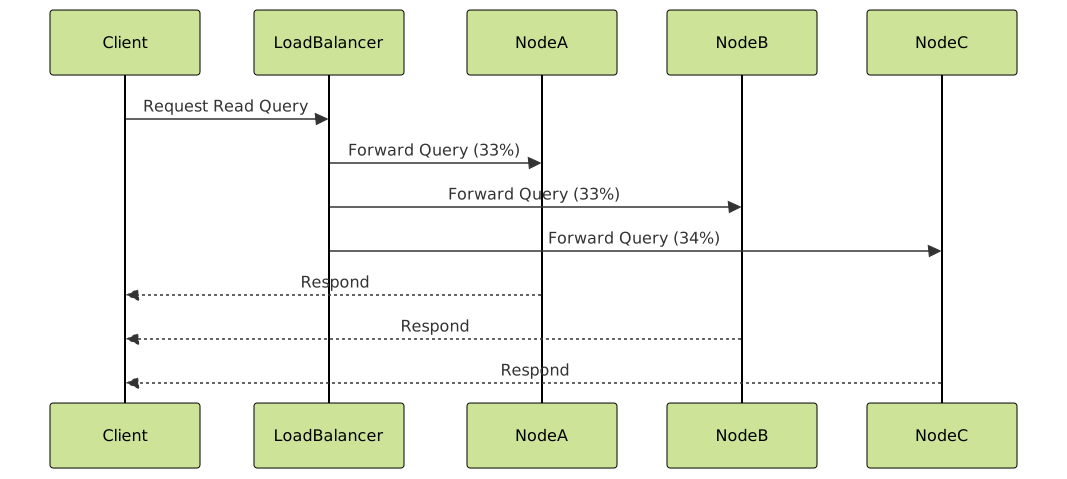
Interactive Scalability Example: Query Load Distribution
Imagine three database nodes in a cluster: Node A, Node B, and Node C. When clients send read requests, the load balancer routes them to these nodes evenly for faster response.
Drawbacks and Challenges of Clustering
- Complexity: Setting up and managing clusters requires expertise in configuration, monitoring, and troubleshooting.
- Consistency: Replication lag can cause data inconsistencies, especially in asynchronous replication setups.
- Cost: More servers and infrastructure increase operational expenses.
- Network Latency: Cross-node communication can add latency impacting performance.
When to Use Database Clustering
- Applications with large-scale read/write workloads requiring failover and zero downtime.
- Systems demanding horizontal scalability for growing data volume across distributed locations.
- Environments where disaster recovery and data redundancy are critical.
Best Practices for Implementing Database Clustering
- Choose the appropriate clustering model aligned with application consistency needs.
- Employ monitoring and alerting to detect node failures and replication delays early.
- Use load balancers or proxy servers to intelligently route queries.
- Test failover and recovery procedures regularly to maintain availability.
- Optimize network infrastructure for cluster communication efficiency.
Summary
Database clustering is a powerful method to scale database performance by distributing workload, ensuring high availability, and increasing fault tolerance. Whether through master-slave replication or multi-master clusters, this strategy helps manage growing data demands effectively. While it introduces complexity and costs, the benefits for robust, scalable, and responsive applications are compelling.
Mastering clustering concepts and implementation best practices enables developers and DBAs to build resilient database systems ready for the challenges of modern data-driven applications.