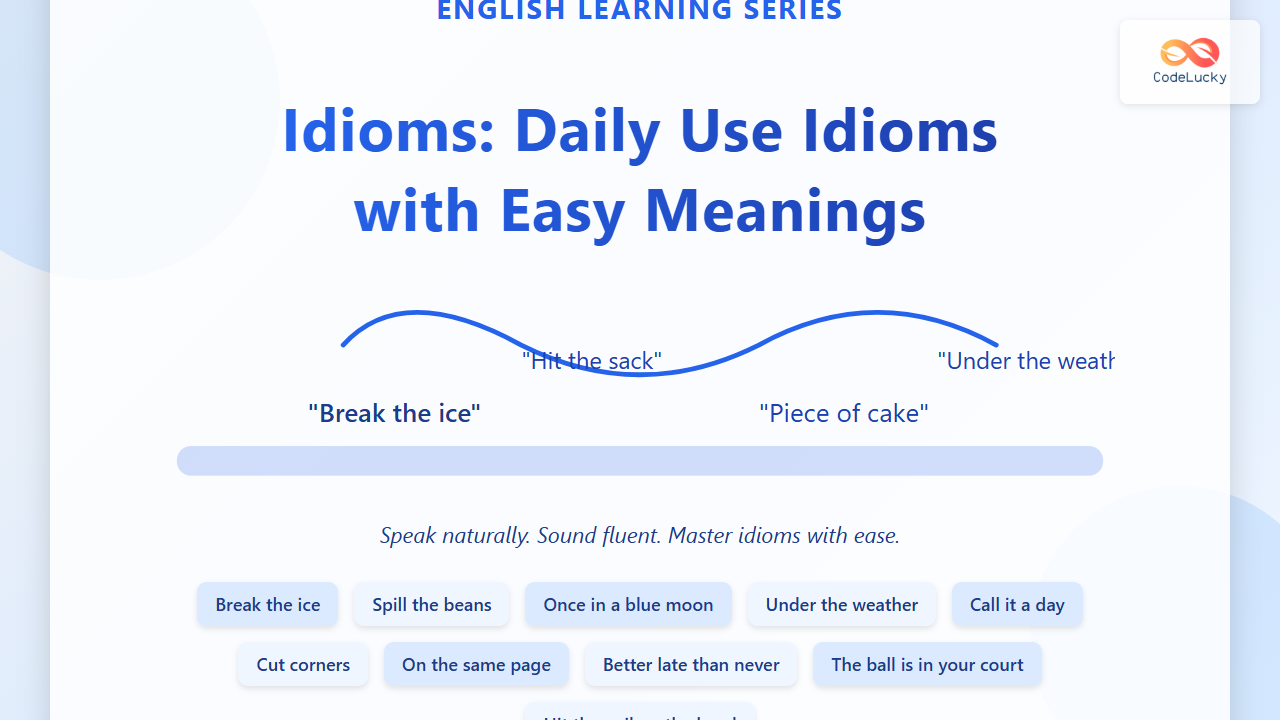
Idioms are an essential part of fluent English. They add color, depth, and natural flow to conversations. In this article from CodeLucky.com, we’ll explore the most common daily use idioms with easy meanings and real-life examples. Each idiom is explained simply so that even beginners can start using them today.
What Are Idioms?
An idiom is a phrase whose meaning isn’t obvious from the individual words. For example, “break the ice” doesn’t literally mean breaking frozen water — it means starting a friendly conversation in a social setting.

Why Learn Idioms?
- They make your English sound more natural and less robotic.
- You can understand native speakers better in movies, TV shows, and daily life.
- Idioms can help create emotional or humorous tone in conversation.
Common Daily Use Idioms with Meanings and Examples
1. Break the ice
Meaning: To start a conversation in a social situation.
Example: “At the meeting, the manager told a joke to break the ice.”
2. Hit the sack
Meaning: To go to bed or sleep.
Example: “I’m so tired; I think I’ll hit the sack early tonight.”
3. Once in a blue moon
Meaning: Something that happens very rarely.
Example: “I go out for dinner once in a blue moon.”
4. Piece of cake
Meaning: Something very easy to do.
Example: “Learning basic HTML is a piece of cake.”
5. Spill the beans
Meaning: To reveal a secret.
Example: “She spilled the beans about the surprise party.”
6. Under the weather
Meaning: Not feeling well.
Example: “I stayed home today because I was under the weather.”
7. Costs an arm and a leg
Meaning: Very expensive.
Example: “Their new smartphone costs an arm and a leg.”
8. Let the cat out of the bag
Meaning: Accidentally reveal a secret.
Example: “John let the cat out of the bag about the gift.”
9. The ball is in your court
Meaning: It’s your decision to act now.
Example: “I’ve done my part, now the ball is in your court.”
10. Hit the nail on the head
Meaning: To describe exactly what is causing a situation or problem.
Example: “You hit the nail on the head when you said we need better communication.”

Interactive Idiom Practice
Try to complete these sentences using the idioms above:
- I’m exhausted, I’ll ___________ after dinner.
- He rarely visits, only ___________.
- The exam was easy; it was a ___________.
- Don’t ___________ about the surprise!
- I’m not feeling well today; I’m ___________.
Tip: Scroll up to find and match the correct idioms!
Idioms About Time
- In the nick of time: Exactly at the right moment. Example: “He caught the bus in the nick of time.”
- Better late than never: It’s good to do something even if delayed. Example: “She apologized — better late than never.”
- Call it a day: Stop working for the day. Example: “Let’s call it a day and go home.”

Common Idioms Used at Work
- Back to the drawing board: To start over after failure.
- Cut corners: To do something cheaply or carelessly.
- On the same page: To agree or understand each other.
- In the loop: To be kept informed about something.
Idioms at work make your language sound more professional and collaborative. For example:
“The design didn’t work, so we’ll go back to the drawing board.”
“Let’s make sure we’re on the same page before finalizing the project.”

Idioms in Daily Conversations
Even informal chats use idioms all the time. They make speech lively and relatable. Think of idioms as the spices of language. Without them, English can sound dull or too formal.
Examples in Conversation:
A: How was the exam?
B: Piece of cake! I finished early.
A: Lucky you! I was under the weather and couldn’t focus.
Tips to Learn and Remember Idioms
- Use idioms in your daily conversations.
- Connect idioms to visual images or stories.
- Write short paragraphs using new idioms each week.
- Watch English movies or series and note idioms used by characters.
Quick Recap Table
| Idiom | Meaning | Example |
|---|---|---|
| Break the ice | Start a conversation | The teacher broke the ice with a fun game. |
| Hit the sack | Go to sleep | I’ll hit the sack after this show. |
| Piece of cake | Very easy | The quiz was a piece of cake. |
| Under the weather | Feeling sick | I stayed home as I felt under the weather. |
| In the nick of time | Just in time | We reached the airport in the nick of time. |
Conclusion
Learning daily use idioms is a powerful way to sound fluent, natural, and confident in English. The more you hear and use them, the more comfortable they become. Start by memorizing a few today, use them in your conversations, and watch your English become more expressive and fun!
By mastering idioms, you don’t just learn English words — you learn English culture.