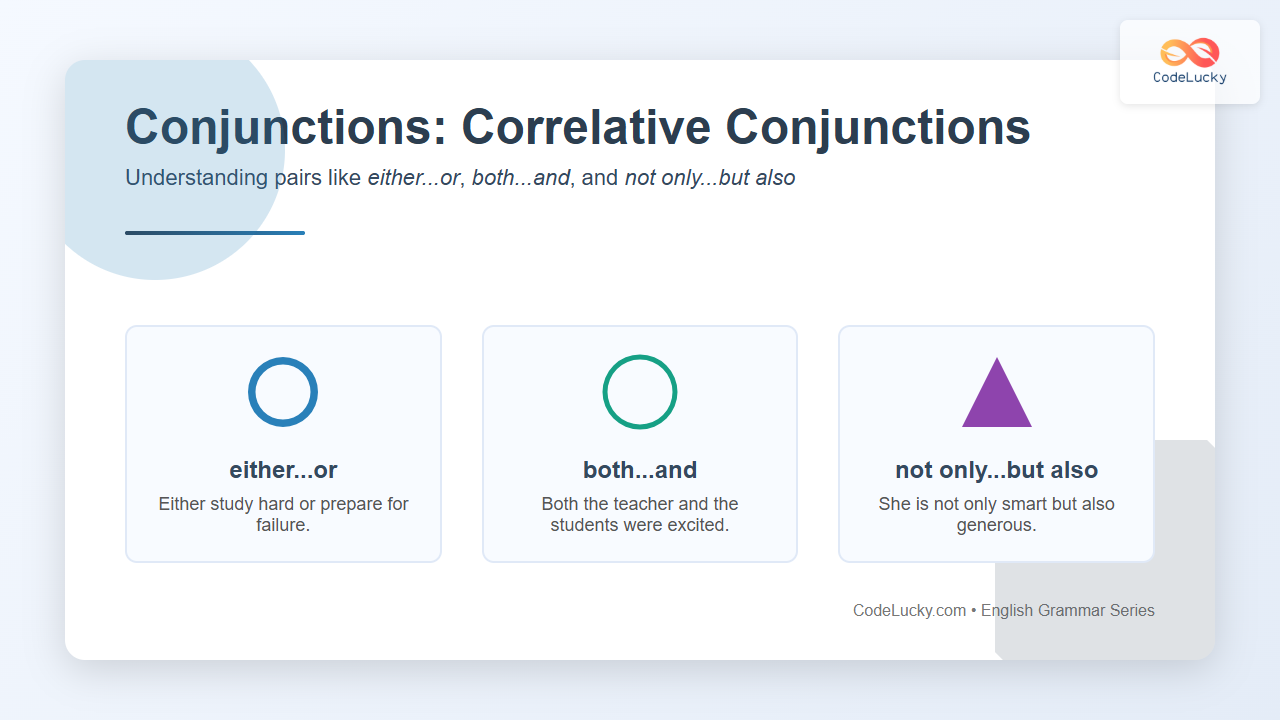
Conjunctions are the linking words of English. They connect words, phrases, and clauses to make our sentences smoother and more meaningful. Among all types, correlative conjunctions stand out because they always appear in pairs and balance ideas perfectly. This article will help you learn exactly how to use them with real-life examples and simple explanations.
What Are Correlative Conjunctions?
Correlative conjunctions are pairs of conjunctions that work together to join equal sentence elements. They create natural rhythm and balance when combining two similar or contrasting ideas.
Some of the most common correlative conjunction pairs are:
- either…or
- neither…nor
- both…and
- not only…but also
- whether…or
- no sooner…than
Each pair must be used together to make sense. The first word introduces one part of an idea, and the second word completes the connection.
Visual Concept Map

Correlative Conjunctions List with Examples
Let’s go through each correlative pair one by one with clear examples:
1. Either…or
Usage: Used to present two possibilities or choices.
Example: Either you call him now or you apologize later.

2. Neither…nor
Usage: Connects two negative ideas.
Example: Neither the teacher nor the students knew the answer.
3. Both…and
Usage: Emphasizes inclusion or combination of two ideas.
Example: Both the movie and the soundtrack were excellent.
4. Not only…but also
Usage: Used to emphasize an additional surprising or important element.
Example: She is not only intelligent but also kind.

5. Whether…or
Usage: Shows alternatives or possibilities.
Example: You must go whether it rains or it shines.
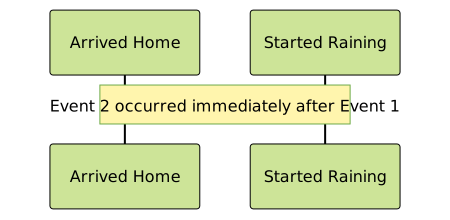
6. No sooner…than
Usage: Expresses that one event happened immediately after another.
Example: No sooner had I reached home than it started raining.
Rules to Remember
- Balance both sides: The parts connected must be grammatically similar.
Example: She likes both reading and writing. ✅ - Keep consistency: Do not mix structures.
Incorrect: He is either smart or he works hard. ❌
Correct: He is either smart or hardworking. ✅ - Avoid redundancy: Don’t repeat unnecessary words with correlative pairs.
Interactive Understanding: Try to Identify!
Choose the correct correlative conjunction pair for each blank:
- ____ you come today ____ you send the file by email.
- She is ____ talented ____ humble.
- ____ the manager ____ his assistant was informed.
Answers: (1) either…or, (2) both…and, (3) neither…nor
Advanced Usage Tips
Correlative conjunctions improve writing style by making sentences sound more balanced and natural. They are especially effective in persuasive writing, speeches, and formal essays. Use commas if the clauses are long or complex, but avoid unnecessary punctuation for simple phrases.
Example with comma for clarity:
Not only did he finish the project early, but he also improved its quality dramatically.

Common Errors to Avoid
- Omitting one half of the pair (e.g., using “either” without “or”).
- Using unequal sentence structures on both sides.
- Forgetting to maintain logical parallelism.
Summary Table of Correlative Conjunctions
| Correlative Pair | Function | Example |
|---|---|---|
| either…or | Offers a choice | Either go now or stay forever. |
| neither…nor | Connects negative ideas | Neither he nor his wife agreed. |
| both…and | Adds inclusion | Both the teacher and the student smiled. |
| not only…but also | Adds emphasis or surprise | She not only danced but also sang. |
| whether…or | Shows alternatives | Whether you like it or not, you must attend. |
| no sooner…than | Shows immediate succession | No sooner had we arrived than the bell rang. |
Conclusion
Correlative conjunctions help you express relationships between ideas clearly, making your writing smoother and more dynamic. Once you master their usage, your sentences will sound more natural and your communication will become far more effective. Practice them often, and soon they’ll come naturally to you in both writing and speech.
Explore more lessons in the CodeLucky English Grammar Series to boost your language confidence.