Conjunctions are the words that join other words, phrases, or clauses in a sentence. Among conjunctions, the most common type is the Coordinating Conjunction. These are small but powerful words that glue ideas together seamlessly and give our sentences meaning and flow.
In this article, we’ll deeply explore Coordinating Conjunctions (FANBOYS) with clear examples, usage rules, and diagrams to make learning engaging and memorable.
What Are Coordinating Conjunctions?
Coordinating conjunctions join two or more ideas of equal grammatical importance. They connect words, phrases, or independent clauses that could stand alone as complete sentences.
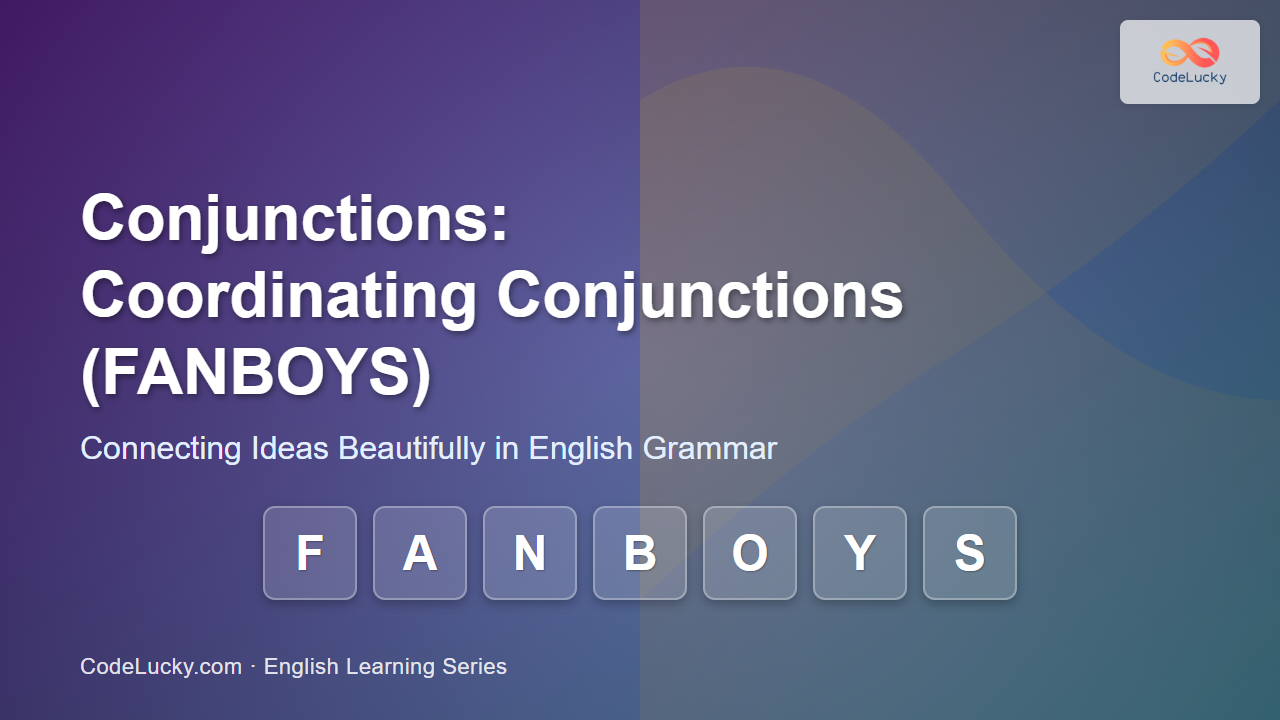
These conjunctions fall under the famous acronym FANBOYS, representing seven basic connectors:
- F – For
- A – And
- N – Nor
- B – But
- O – Or
- Y – Yet
- S – So
Visual Overview of FANBOYS

Function and Meaning of Each FANBOYS Conjunction
1. For – Reason or Cause
“For” introduces a reason or explanation for the first clause.
Example: She stayed inside, for it was raining heavily.
Interactive Tip: Try replacing “for” with “because” and see if the sentence still makes sense!
2. And – Addition
“And” adds one idea to another, often showing continuation or connection.
Example: He bought a book and a notebook.

3. Nor – Negative Alternative
“Nor” connects two negative ideas, usually after “neither.”
Example: She didn’t sing, nor did she dance.
Grammar Note: When “nor” starts a clause, invert the subject and the verb, just like in a question.
4. But – Contrast
“But” shows contrast between two ideas.
Example: I wanted to go out, but it started to rain.

5. Or – Choice or Alternative
“Or” suggests a choice between two or more possibilities.
Example: Do you want tea or coffee?
6. Yet – Contrast (Unexpected)
“Yet” is similar to “but” but implies a surprising contrast.
Example: The exam was tough, yet everyone passed.
7. So – Result or Effect
“So” introduces a logical result or outcome.
Example: It was late, so we decided to leave.

Rules for Using Coordinating Conjunctions
Here are the most common rules for proper use:
- Always join equal grammatical units. Example: word + word, clause + clause.
- Use a comma before the conjunction when joining two independent clauses.
Example: “I was tired, but I finished the work.” - No comma is needed when connecting short elements.
Example: “Bread and butter.” - Do not start too many sentences with conjunctions. It can make the writing repetitive.
Common Mistakes to Avoid
- Using a comma after the conjunction (wrong: but,).
- Joining complete clauses without a comma before the conjunction.
- Overusing conjunctions in consecutive sentences.
Practice: Choose the Correct FANBOYS Conjunction
Try filling in the blanks below to test your understanding.
- I was hungry, ______ I made a sandwich.
- He doesn’t like coffee, ______ does he enjoy tea.
- It was cold, ______ we stayed indoors.
Possible answers: so, nor, so
Visual Recap of Sentence Connection

Summary Table of FANBOYS
| Conjunction | Function | Example |
|---|---|---|
| For | Shows reason | She was tired, for she worked all day. |
| And | Adds information | He plays guitar and sings. |
| Nor | Negative connection | They didn’t call, nor did they message. |
| But | Shows contrast | I wanted to go, but I was sick. |
| Or | Offers choice | Tea or coffee? |
| Yet | Unexpected contrast | He failed, yet he smiled. |
| So | Shows result | It rained, so we stayed inside. |
Key Takeaway
Coordinating conjunctions (FANBOYS) give smooth transitions and logical connections in your sentences. They not only enhance readability but also balance ideas effectively. Knowing when and how to use each can significantly elevate your English writing and speaking.
If you’re building your English foundation, mastering FANBOYS is a small but vital step toward becoming a confident communicator.