In distributed systems, consistency models define how data remains synchronized across multiple nodes. Understanding the trade-offs between strong consistency and eventual consistency is crucial for designing scalable, reliable systems. This comprehensive guide explores both models with practical examples and implementation strategies.
What Are Consistency Models?
Consistency models are contracts that define the behavior of concurrent operations in distributed systems. They specify how and when updates to data become visible across different nodes in a network.
The choice of consistency model directly impacts:
- Data accuracy – How synchronized data remains across nodes
- System performance – Latency and throughput characteristics
- Availability – System uptime during network partitions
- Scalability – Ability to handle increased load

Strong Consistency Explained
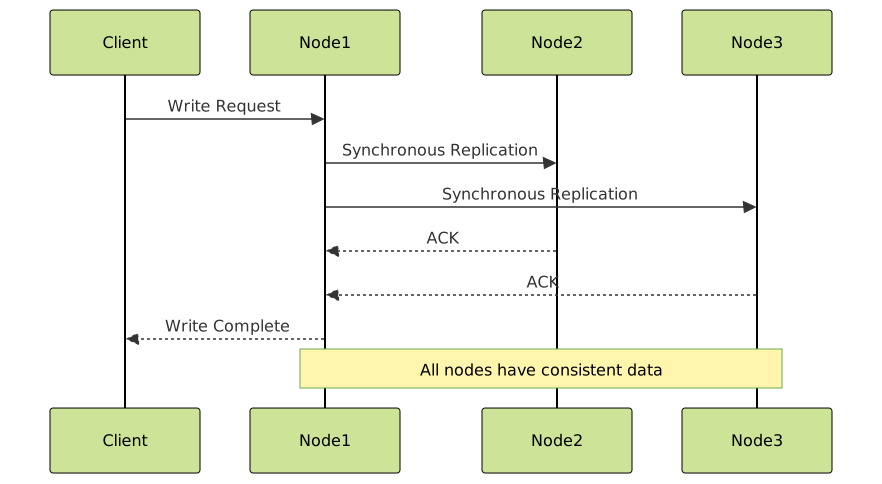
Strong consistency guarantees that all nodes in a distributed system see the same data at the same time. Once a write operation completes, all subsequent read operations return the updated value, regardless of which node serves the request.
Key Characteristics of Strong Consistency
- Immediate visibility – Updates are instantly visible across all nodes
- Atomic operations – All operations appear to execute instantaneously
- Linearizability – Operations appear to execute in real-time order
- No stale reads – Clients never see outdated data
Strong Consistency Example
Consider a banking system where account balances must be accurate across all locations:
# Strong Consistency in Banking System
class StrongConsistentBank:
    def __init__(self):
        self.accounts = {}
        self.lock = threading.Lock()

    def transfer(self, from_account, to_account, amount):
        with self.lock:  # Ensures atomic operation
            if self.accounts[from_account] >= amount:
                self.accounts[from_account] -= amount
                self.accounts[to_account] += amount
                # Synchronously replicate to all nodes
                self.replicate_to_all_nodes()
                return True
            return False

    def get_balance(self, account):
        with self.lock:
            return self.accounts[account]
Advantages of Strong Consistency
- Data integrity – No risk of inconsistent or stale data
- Simplified application logic – Developers don’t need to handle conflicts
- ACID compliance – Perfect for financial and critical applications
- Predictable behavior – Easy to reason about system state
Disadvantages of Strong Consistency
- Higher latency – Must wait for all nodes to acknowledge
- Reduced availability – System fails if majority of nodes are down
- Limited scalability – Performance degrades with more nodes
- Network dependency – Sensitive to network partitions
Eventual Consistency Explained
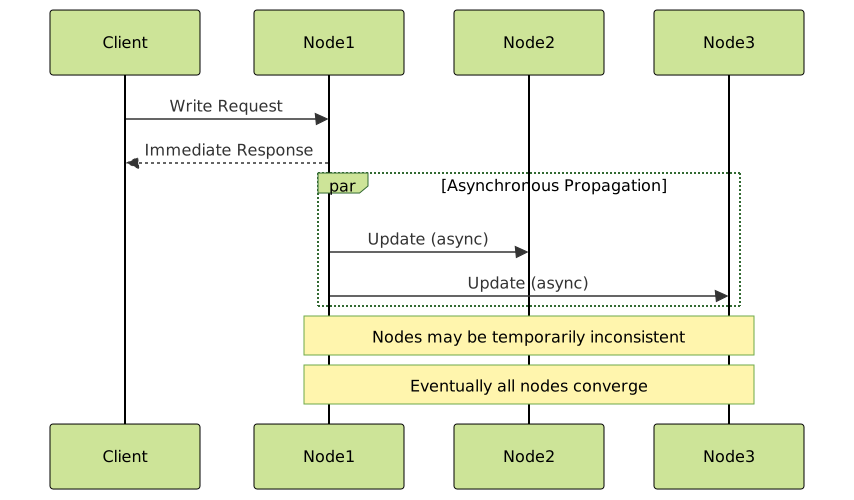
Eventual consistency guarantees that if no new updates are made to a data item, eventually all nodes will converge to the same value. The system prioritizes availability and partition tolerance over immediate consistency.
Key Characteristics of Eventual Consistency
- Asynchronous propagation – Updates spread gradually across nodes
- Temporary inconsistency – Nodes may have different values temporarily
- Convergence guarantee – All nodes eventually reach the same state
- High availability – System remains operational during network issues
Eventual Consistency Example
Consider a social media platform where post likes can be updated asynchronously:
# Eventual Consistency in Social Media
class EventuallyConsistentSocialMedia:
    def __init__(self, node_id):
        self.node_id = node_id
        self.posts = {}
        self.update_queue = []

    def like_post(self, post_id, user_id):
        # Update local node immediately
        if post_id not in self.posts:
            self.posts[post_id] = {'likes': set()}

        self.posts[post_id]['likes'].add(user_id)

        # Queue update for other nodes (asynchronous)
        update = {
            'type': 'like',
            'post_id': post_id,
            'user_id': user_id,
            'timestamp': time.time()
        }
        self.propagate_async(update)

        return len(self.posts[post_id]['likes'])

    def get_like_count(self, post_id):
        # Return current local count (may be temporarily inconsistent)
        if post_id in self.posts:
            return len(self.posts[post_id]['likes'])
        return 0
Types of Eventual Consistency
1. Causal Consistency
Operations that are causally related are seen in the same order by all nodes, while concurrent operations may be seen in different orders.
2. Session Consistency
Within a single session, reads reflect the effects of previous writes in that session.
3. Monotonic Read Consistency
If a process reads a value, any subsequent reads will return the same or more recent values.
4. Monotonic Write Consistency
Writes by a single process are seen in the order they were written.
Advantages of Eventual Consistency
- High availability – System remains operational during failures
- Better performance – Lower latency for read/write operations
- Scalability – Can handle more nodes efficiently
- Partition tolerance – Works well during network splits
Disadvantages of Eventual Consistency
- Temporary inconsistency – Users may see different data
- Complex conflict resolution – Need strategies for handling conflicts
- Application complexity – Developers must handle inconsistent states
- Debugging challenges – Harder to track system state
CAP Theorem and Consistency Trade-offs
The CAP theorem states that distributed systems can only guarantee two of three properties:
- Consistency (C) – All nodes see the same data simultaneously
- Availability (A) – System remains operational
- Partition tolerance (P) – System continues despite network failures

When to Use Strong vs Eventual Consistency
Choose Strong Consistency When:
- Financial transactions – Banking, payment processing
- Inventory management – Stock levels, seat reservations
- Critical business data – Customer records, legal documents
- ACID requirements – Traditional database operations
- Small-scale systems – Limited number of nodes
Choose Eventual Consistency When:
- Social media platforms – Likes, comments, shares
- Content delivery – Static files, images, videos
- Analytics systems – Metrics, logging, monitoring
- Collaborative tools – Document editing, wikis
- Large-scale systems – Global distribution requirements
Implementation Strategies
Strong Consistency Implementation
Two-Phase Commit (2PC)
class TwoPhaseCommit:
    def __init__(self, coordinator, participants):
        self.coordinator = coordinator
        self.participants = participants

    def commit_transaction(self, transaction):
        # Phase 1: Prepare
        prepare_responses = []
        for participant in self.participants:
            response = participant.prepare(transaction)
            prepare_responses.append(response)

        # Check if all participants can commit
        if all(response == "YES" for response in prepare_responses):
            # Phase 2: Commit
            for participant in self.participants:
                participant.commit(transaction)
            return "COMMITTED"
        else:
            # Phase 2: Abort
            for participant in self.participants:
                participant.abort(transaction)
            return "ABORTED"
Raft Consensus Algorithm
Raft ensures strong consistency through leader election and log replication:
- Leader election – One node becomes the leader
- Log replication – Leader replicates entries to followers
- Safety guarantee – Committed entries are never lost
Eventual Consistency Implementation
Vector Clocks
class VectorClock:
    def __init__(self, node_id, num_nodes):
        self.node_id = node_id
        self.clock = [0] * num_nodes

    def increment(self):
        self.clock[self.node_id] += 1

    def update(self, other_clock):
        for i in range(len(self.clock)):
            self.clock[i] = max(self.clock[i], other_clock[i])
        self.increment()

    def happens_before(self, other_clock):
        return (any(self.clock[i] < other_clock[i] for i in range(len(self.clock))) and
                all(self.clock[i] <= other_clock[i] for i in range(len(self.clock))))
Conflict-Free Replicated Data Types (CRDTs)
CRDTs automatically resolve conflicts in eventually consistent systems:
class GCounterCRDT:
    def __init__(self, node_id, num_nodes):
        self.node_id = node_id
        self.counters = [0] * num_nodes

    def increment(self):
        self.counters[self.node_id] += 1

    def merge(self, other_crdt):
        for i in range(len(self.counters)):
            self.counters[i] = max(self.counters[i], other_crdt.counters[i])

    def value(self):
        return sum(self.counters)
Real-World Examples
Strong Consistency Systems
- Google Spanner – Global database with strong consistency
- Apache Kafka – Message ordering with leader-follower replication
- etcd – Key-value store using Raft consensus
- PostgreSQL – ACID-compliant relational database
Eventual Consistency Systems
- Amazon DynamoDB – NoSQL database with eventual consistency
- Apache Cassandra – Distributed database prioritizing availability
- DNS System – Global name resolution with propagation delays
- Redis Cluster – In-memory data structure store
Performance Comparison

| Aspect | Strong Consistency | Eventual Consistency |
|---|---|---|
| Read Latency | Higher (coordination required) | Lower (local reads) |
| Write Latency | Higher (synchronous replication) | Lower (asynchronous replication) |
| Availability | Limited by slowest node | High (independent nodes) |
| Scalability | Decreases with more nodes | Increases with more nodes |
| Data Accuracy | Always accurate | Eventually accurate |
| Network Partition | System may become unavailable | Continues operating |
Hybrid Approaches
Modern systems often combine both consistency models based on data requirements:
1. Multi-Level Consistency
Different consistency levels for different types of data within the same system.
2. Tunable Consistency
Allow applications to choose consistency levels per operation:
# Cassandra-style tunable consistency
def read_data(key, consistency_level="QUORUM"):
    if consistency_level == "ONE":
        return read_from_any_node(key)
    elif consistency_level == "QUORUM":
        return read_from_majority(key)
    elif consistency_level == "ALL":
        return read_from_all_nodes(key)
3. Bounded Staleness
Allow controlled inconsistency with time or version bounds.
Best Practices for Implementation
For Strong Consistency:
- Minimize coordination – Reduce cross-node communication
- Use batching – Group operations to reduce overhead
- Implement timeouts – Handle slow or failed nodes gracefully
- Monitor performance – Track latency and availability metrics
For Eventual Consistency:
- Design for conflicts – Implement robust conflict resolution
- Use versioning – Track data evolution with timestamps or versions
- Implement read-repair – Fix inconsistencies during reads
- Monitor convergence – Ensure replicas eventually sync
Conclusion
The choice between strong consistency and eventual consistency depends on your specific application requirements. Strong consistency ensures data accuracy at the cost of performance and availability, while eventual consistency provides better scalability and availability with temporary inconsistencies.
Consider these key factors when making your decision:
- Data criticality – How important is immediate consistency?
- Scale requirements – How many nodes and users?
- Geographic distribution – Are users globally distributed?
- Performance needs – What are your latency requirements?
- Availability demands – Can your system tolerate downtime?
Understanding these consistency models enables you to design distributed systems that balance data integrity, performance, and availability according to your specific use case requirements.