In graph theory, a connected component is a subgraph where any two vertices are connected by a path, and which is not connected to any additional vertices in the supergraph. Finding connected components is a fundamental problem in computer algorithms with applications in social network analysis, clustering, image segmentation, and network reliability.
One of the most efficient ways to detect connected components in an undirected graph is by using the Union-Find Data Structure, also known as Disjoint Set Union (DSU). The Union-Find algorithm allows us to dynamically keep track of which nodes belong to the same component with two main operations: find and union.
Why Use Union-Find for Connected Components?
The Union-Find algorithm is especially powerful for dynamic connectivity problems. Unlike DFS or BFS, which require graph traversal, Union-Find efficiently merges and queries components, making it an excellent fit for problems where edges are added dynamically.
- Find Operation: Determines which component a particular element belongs to.
- Union Operation: Merges two disjoint sets into a single component.
- Path Compression: Optimizes the find operation by flattening the structure of the tree.
- Union by Rank/Size: Balances the tree height to improve efficiency.
Visualizing Connected Components
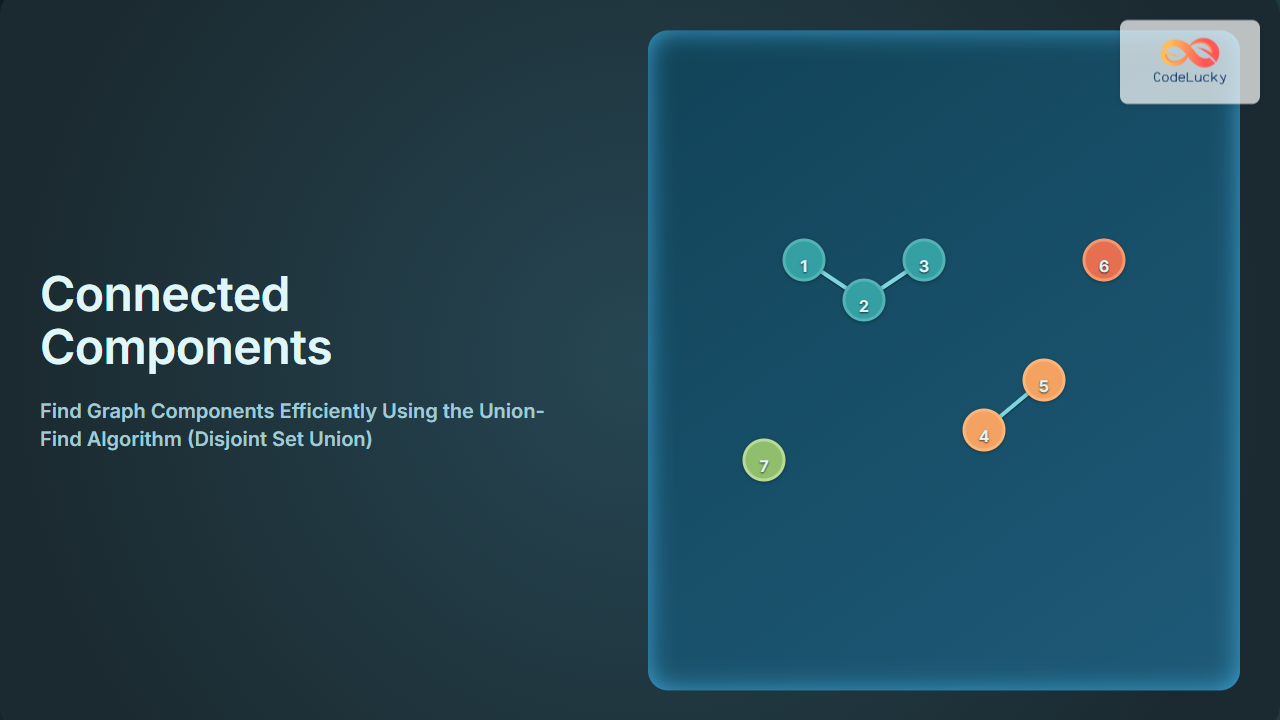
Consider the following undirected graph with 7 vertices and multiple edges. We want to identify its connected components using Union-Find:
In this graph:
- Vertices {1, 2, 3} form a connected component.
- Vertices {4, 5} form another connected component.
- Vertices {6} and {7} are isolated components.
Union-Find Implementation in Python
Let’s implement a Union-Find solution to detect connected components in an undirected graph.
class UnionFind:
    def __init__(self, n):
        self.parent = [i for i in range(n)]
        self.rank = [0] * n

    def find(self, x):
        if self.parent[x] != x:
            self.parent[x] = self.find(self.parent[x])  # Path compression
        return self.parent[x]

    def union(self, x, y):
        rootX = self.find(x)
        rootY = self.find(y)
        if rootX != rootY:
            if self.rank[rootX] < self.rank[rootY]:
                self.parent[rootX] = rootY
            elif self.rank[rootX] > self.rank[rootY]:
                self.parent[rootY] = rootX
            else:
                self.parent[rootY] = rootX
                self.rank[rootX] += 1

def find_connected_components(n, edges):
    uf = UnionFind(n)
    for u, v in edges:
        uf.union(u, v)

    components = {}
    for i in range(n):
        root = uf.find(i)
        if root not in components:
            components[root] = []
        components[root].append(i)

    return list(components.values())

# Example usage
n = 7
edges = [(0,1), (1,2), (3,4)]
components = find_connected_components(n, edges)
print("Connected Components:", components)
Output:
Connected Components: [[0, 1, 2], [3, 4], [5], [6]]
This output shows that nodes [0,1,2] form one connected component, [3,4] is another, and nodes [5] and [6] are isolated components, perfectly matching the expected result from our example diagram.
Step-by-Step Execution
Let’s illustrate how Union-Find merges nodes step by step for edges (0,1), (1,2), and (3,4):
Initially, each node is its own parent set. After applying union, the parent references merge nodes progressively until the connected components are formed.
Complexity Analysis
- Find Operation: Amortized O(α(N)), where α is the inverse Ackermann function (practically constant).
- Union Operation: Amortized O(α(N)) with path compression + union by rank.
- Overall Complexity: O(N + M α(N)) for N nodes and M edges.
Applications of Connected Components
Detecting connected components with Union-Find has a wide range of applications:
- Social Networks: Identifying groups of connected friends or communities.
- Clustering: Grouping similar items together in machine learning.
- Image Processing: Detecting clusters in pixel connectivity for segmentation.
- Network Reliability: Understanding resilience by checking network partitions.
Interactive Example
Try running this snippet in a Python environment by changing the graph edges. Add or remove edges to see how the connected components change dynamically:
edges = [(0,1), (1,2), (3,4), (5,6)]
components = find_connected_components(7, edges)
print("Updated Components:", components)
Output:
Updated Components: [[0,1,2], [3,4], [5,6]]
Conclusion
The Union-Find algorithm offers an efficient, scalable way to find connected components in a graph. With optimizations like path compression and union by rank, it runs in nearly constant time per operation. Whether applied to networks, clustering, or image analysis, mastering Union-Find makes graph connectivity problems significantly easier to solve.