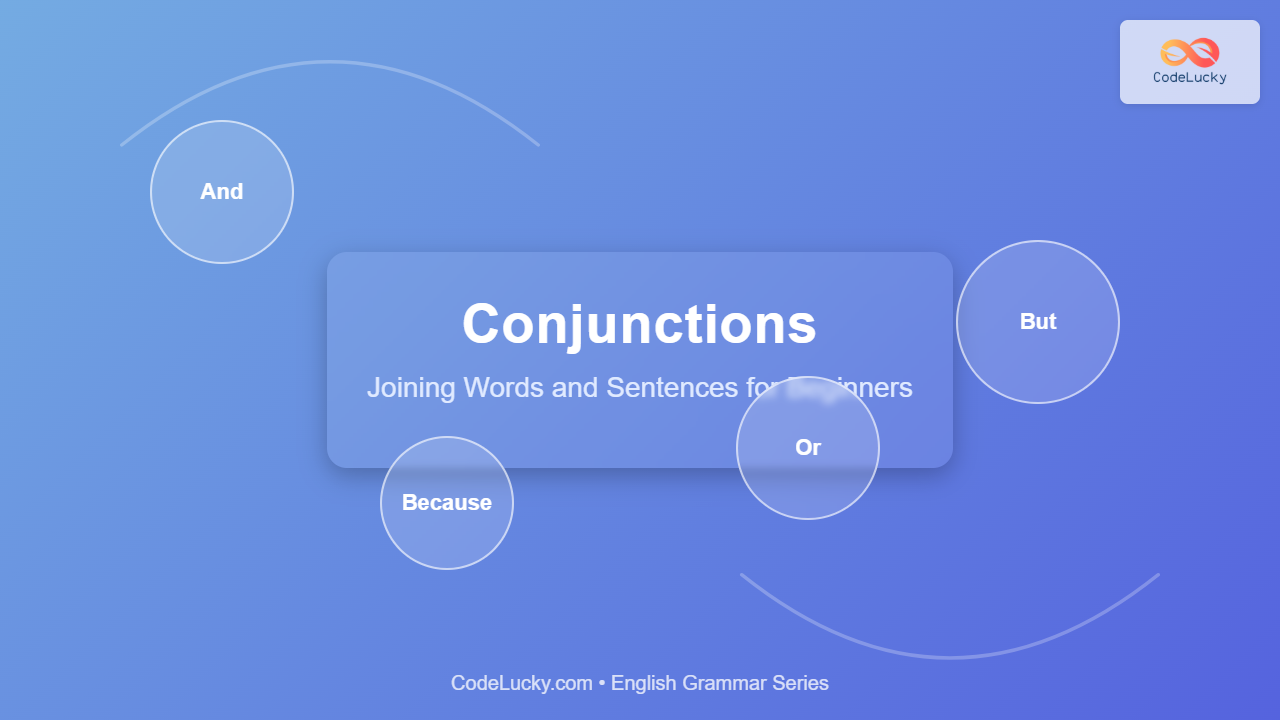
Conjunctions are the connecting tools of English. They help join words, phrases, and ideas so your speech and writing feel smooth and logical. Without them, every sentence would sound broken and disconnected. This beginner-friendly guide explains every type of conjunction with clear examples, tables, and visual diagrams to make learning interactive and fun.
What Are Conjunctions?
A conjunction is a word that links two or more words, phrases, clauses, or sentences. Think of them as bridges that connect ideas together.
Examples:
- Riya and Priya are sisters.
- I wanted to go out, but it started raining.
- He worked hard because he wanted to succeed.
In these examples, and, but, and because act as conjunctions linking thoughts and actions.

Why Are Conjunctions Important?
Conjunctions make communication clear and coherent. Instead of using several short and choppy sentences, conjunctions help express relationships such as cause, contrast, choice, and sequence.
Example:
Without conjunctions: “I like coffee. I like tea.”
With conjunction: “I like coffee and tea.”
Types of Conjunctions
There are mainly three types of conjunctions in English grammar:
- Coordinating Conjunctions
- Subordinating Conjunctions
- Correlative Conjunctions

1. Coordinating Conjunctions
These conjunctions join words, phrases, or clauses that are equal in importance. The seven main coordinating conjunctions are easy to remember with the acronym FANBOYS:
| Conjunction | Meaning / Use | Example |
|---|---|---|
| For | Reason | I stayed home, for I was tired. |
| And | Addition | She bought apples and bananas. |
| Nor | Negative addition | He didn’t call nor reply. |
| But | Contrast | He is rich but unhappy. |
| Or | Choice | Do you want tea or coffee? |
| Yet | Contrast (like “but”) | It’s late, yet I’m awake. |
| So | Result / Effect | It rained, so we stayed in. |

2. Subordinating Conjunctions
These connect a main clause with a dependent clause, showing relationships like cause, condition, contrast, or time.
Common Subordinating Conjunctions: because, although, unless, if, when, before, after, since, while, though, as, until.
| Conjunction | Relation | Example |
|---|---|---|
| Because | Cause | He is happy because he passed. |
| Although | Contrast | Although it rained, they played. |
| If | Condition | You can go if you’re ready. |
| When | Time | I called her when I arrived. |
| Unless | Negative condition | Stay here unless I call you. |

3. Correlative Conjunctions
These pairs of conjunctions work together to join equal parts of a sentence.
Common Pairs: either…or, neither…nor, both…and, not only…but also, whether…or.
| Pair | Example |
|---|---|
| Either…or | Either you come now or stay forever. |
| Neither…nor | Neither John nor David was ready. |
| Both…and | Both Riya and Priya are reading. |
| Not only…but also | Not only she sang but also danced. |
| Whether…or | Whether you win or lose, enjoy it. |

Interactive Practice: Choose the Right Conjunction
Try filling in the blanks mentally before revealing the answers:
- He was tired, ___ he kept working. (but/yet)
- You can stay here ___ go home. (or/and)
- ___ it rains, the match will be canceled. (If/Because)
- She plays ___ sings beautifully. (not only/but also)
Answers: 1. yet, 2. or, 3. If, 4. not only… but also.
Tips for Using Conjunctions Effectively
- Avoid overusing conjunctions in one sentence; it may become confusing.
- Use commas before conjunctions when joining independent clauses (e.g., “I was tired, but I finished my work.”).
- Understand the relationship you want to express—reason, contrast, condition, or time—and choose your conjunction wisely.
Conclusion
Conjunctions are the glue that holds sentences together. Mastering them makes your English more natural, expressive, and connected. Keep practicing small examples daily, and soon you’ll use conjunctions effortlessly while speaking and writing!
Continue your English learning journey with CodeLucky.com — step by step, concept by concept.