Learning common verbs is the first step toward mastering English communication. Verbs are the action words that give energy to sentences — they tell us what’s happening, who’s doing it, and when it takes place. In this article by CodeLucky.com, we’ll explore the most important everyday verbs every beginner should learn, complete with practical examples and interactive learning ideas.
Why You Must Learn Common Verbs First
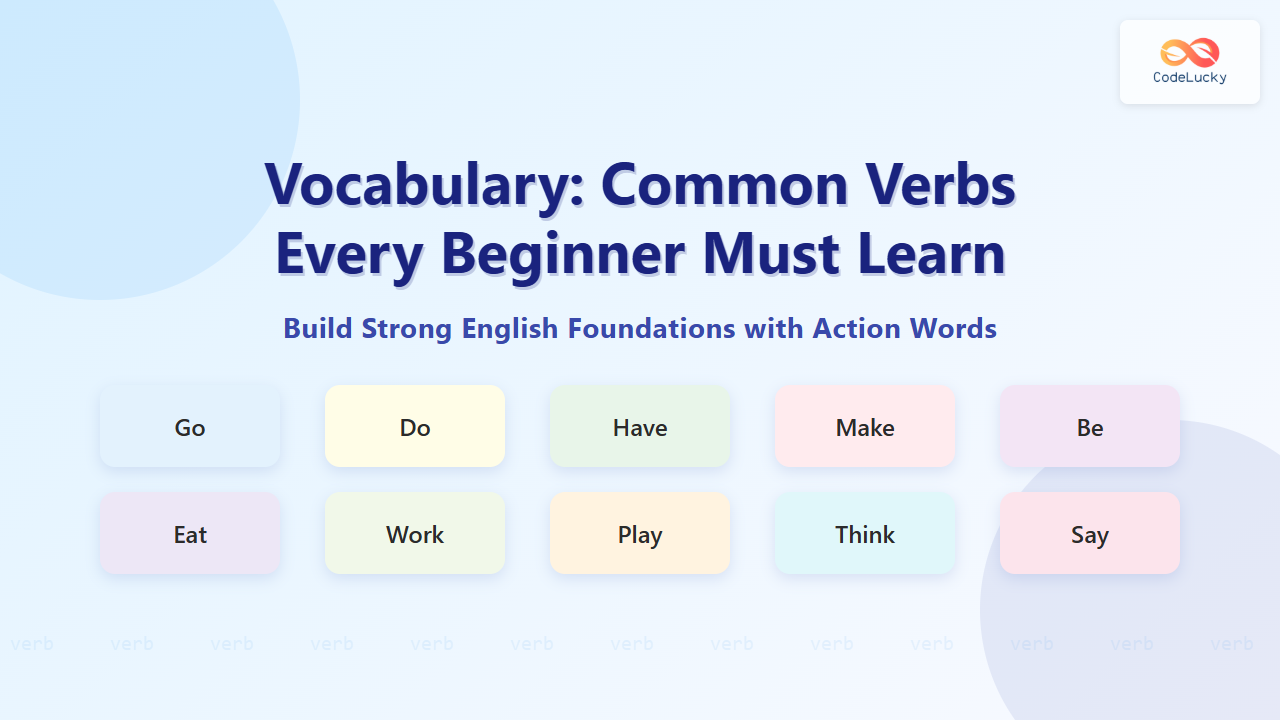
Verbs act as the backbone of any sentence. By mastering a set of high-frequency verbs, beginners can express dozens of everyday ideas, build confidence, and start speaking sooner. For instance, with verbs like go, do, have, make, and see, you can already form hundreds of simple sentences.

1. The “Big Five” Verbs You Should Start With
Let’s start with five ultra-common verbs that appear in almost every English conversation.
| Verb | Meaning | Example Sentence |
|---|---|---|
| Be | Describes identity, condition, or existence. | I am happy. / You are a student. |
| Have | To own, hold, or experience something. | I have a book. |
| Do | Used to perform an action or activity. | She does her homework. |
| Go | To move or travel from one place to another. | We go to school every day. |
| Make | To create or produce something. | They make delicious cakes. |
Note: These verbs can change forms depending on tense — practice with “am/is/are,” “had,” “did,” “went,” or “made.”
2. Everyday Action Verbs You’ll Use Constantly
Once you’re comfortable with the basics, expand your vocabulary with action verbs that describe your daily life.
- Eat – I eat breakfast at 8 a.m.
- Drink – He drinks coffee every morning.
- Work – They work hard every day.
- Play – We play football after school.
- Sleep – She sleeps late on weekends.
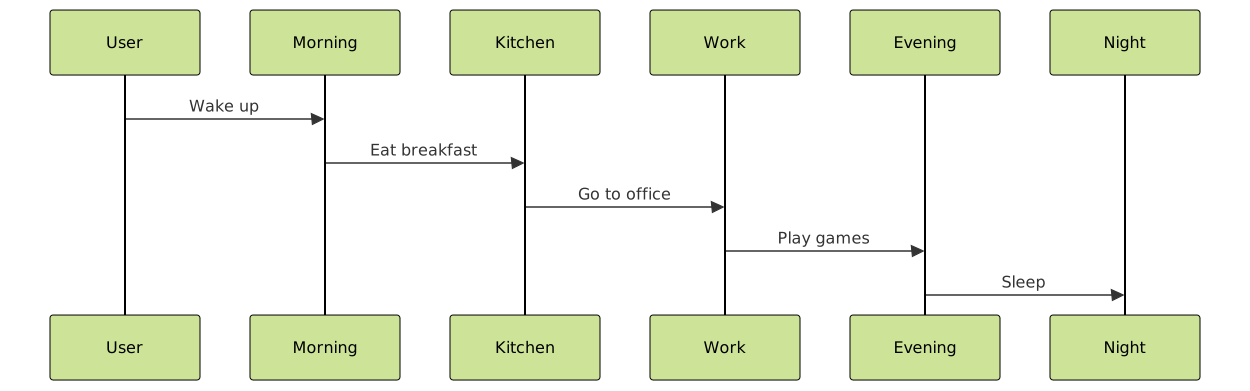
This simple sequence helps visualize how action verbs guide your day from morning to night.
3. Verbs for Thinking and Feeling
English isn’t only about physical actions. There are verbs that describe mental and emotional states too.
- Like – I like learning English.
- Know – She knows the answer.
- Think – We think it’s a good idea.
- Need – I need more time.
- Want – They want to travel soon.
Mastering these helps you describe preferences, reasoning, and emotions — essential for everyday communication.
4. Verbs for Talking and Socializing
When learning English, communication verbs allow you to connect with others. Here are some that will instantly improve your conversations:
- Say – She said hello.
- Tell – He told me a story.
- Ask – I ask questions in class.
- Answer – They answer quickly.
- Talk – We talk on the phone.

Just like this conversation flow, mastering communication verbs helps you navigate real-life dialogues more effectively.
5. How to Practice Common Verbs Interactively
Learning verbs becomes easier with small daily exercises. Try the following interactive methods:
- Flashcard Drill: Write verbs on cards — one side with the base form, the other with example sentences.
- Verb-of-the-Day: Pick one new verb daily, use it in 5 sentences, and say them aloud.
- Speaking Challenge: Record yourself describing your day using only English verbs learned so far.
- Mermaid Flow Practice: Draw sentence “flows” to visualize how verbs connect ideas (like the diagrams above).

6. Common Mistakes Beginners Make
Here are some common errors to avoid when learning verbs:
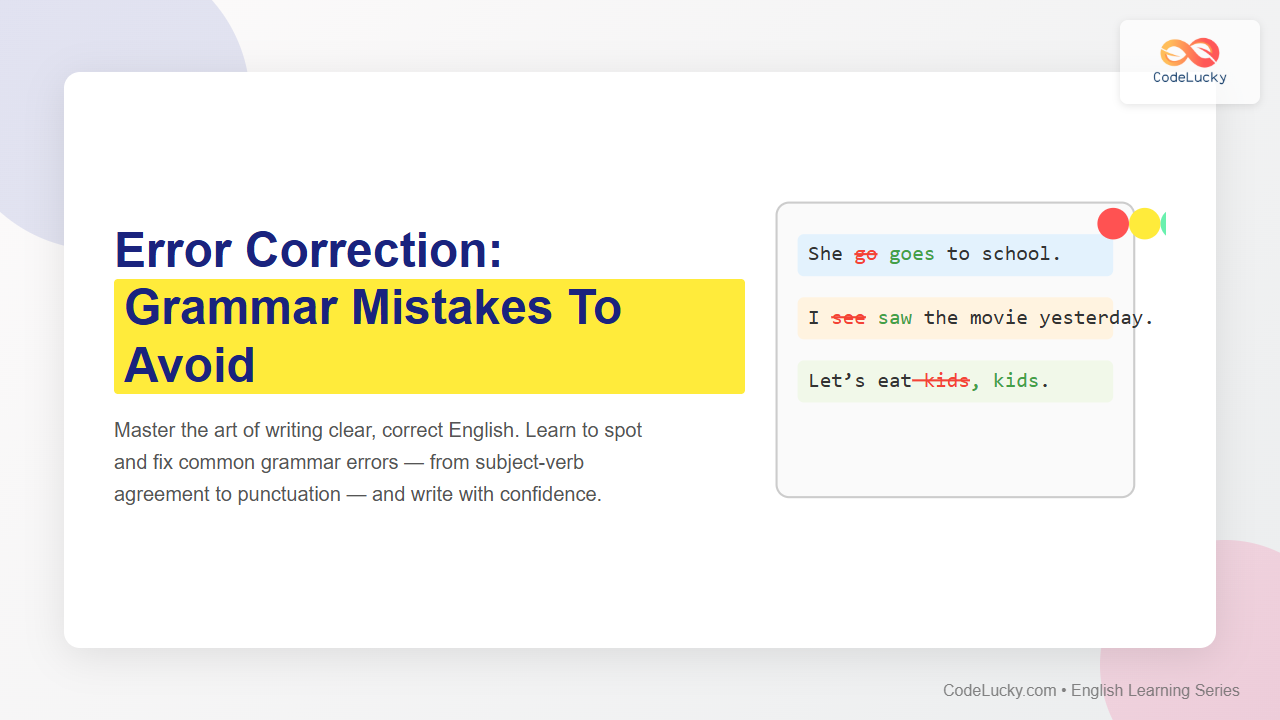
- Using do instead of make (“do a cake” ❌ → “make a cake” ✅)
- Wrong tense use (“He go” ❌ → “He goes” ✅)
- Missing to in infinitives (“want eat” ❌ → “want to eat” ✅)
- Forgetting auxiliary verbs (“I not understand” ❌ → “I do not understand” ✅)
Correcting these early will ensure smoother communication as you progress.
Quick Recap Table
| Category | Sample Verbs |
|---|---|
| Basic | be, have, do, go, make |
| Everyday Actions | eat, drink, play, sleep, work |
| Thinking/Feeling | like, know, think, need, want |
| Communication | say, tell, ask, answer, talk |
Final Thoughts
Learning common English verbs gives you the foundation to communicate clearly and confidently. Make a habit of using verbs in daily speech — describe your actions, explain your plans, and express your feelings in English. The more you use them, the more natural they’ll sound.
Keep practicing one verb at a time, and soon you’ll move from saying “I learn” to “I’m speaking fluently.”