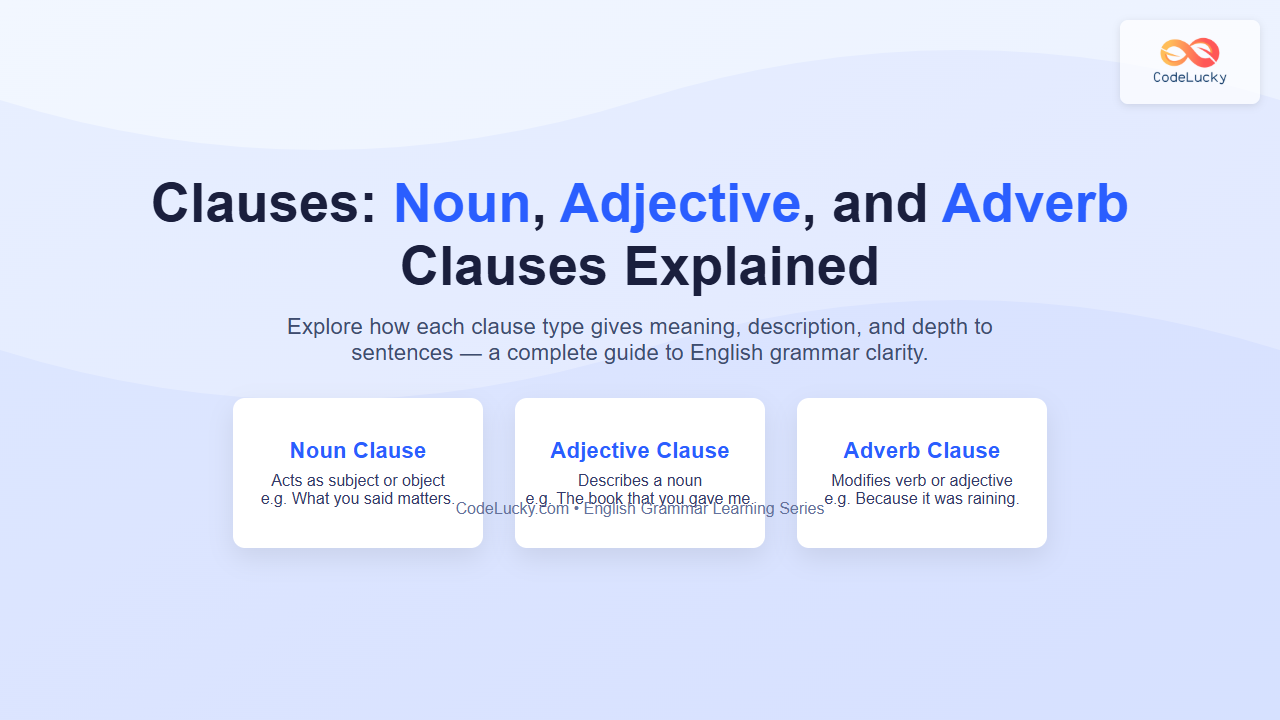
Clauses are one of the building blocks of English grammar. Understanding them can instantly improve sentence structure, clarity, and writing confidence. Let’s dive deep into the three main types—noun clauses, adjective clauses, and adverb clauses—with plenty of examples and visual aids.
What is a Clause?
A clause is a group of words that contains both a subject and a predicate (verb). Clauses can be independent (able to stand alone as a complete sentence) or dependent (needing another clause to complete their meaning).

This diagram shows that every dependent clause belongs to one of the three main types: noun, adjective, or adverb clause.
1. Noun Clauses
A noun clause acts as a noun in a sentence. That means it can serve as a subject, object, or complement.
Structure and Keywords
Noun clauses often begin with words like that, what, whatever, who, whom, whoever, whose, why, how, when, and where.
Examples
- What you said made me laugh. → (Acts as the subject of the sentence)
- I don’t know where she lives. → (Acts as the object of the verb “know”)
- The truth is that he lied. → (Acts as the complement of “is”)

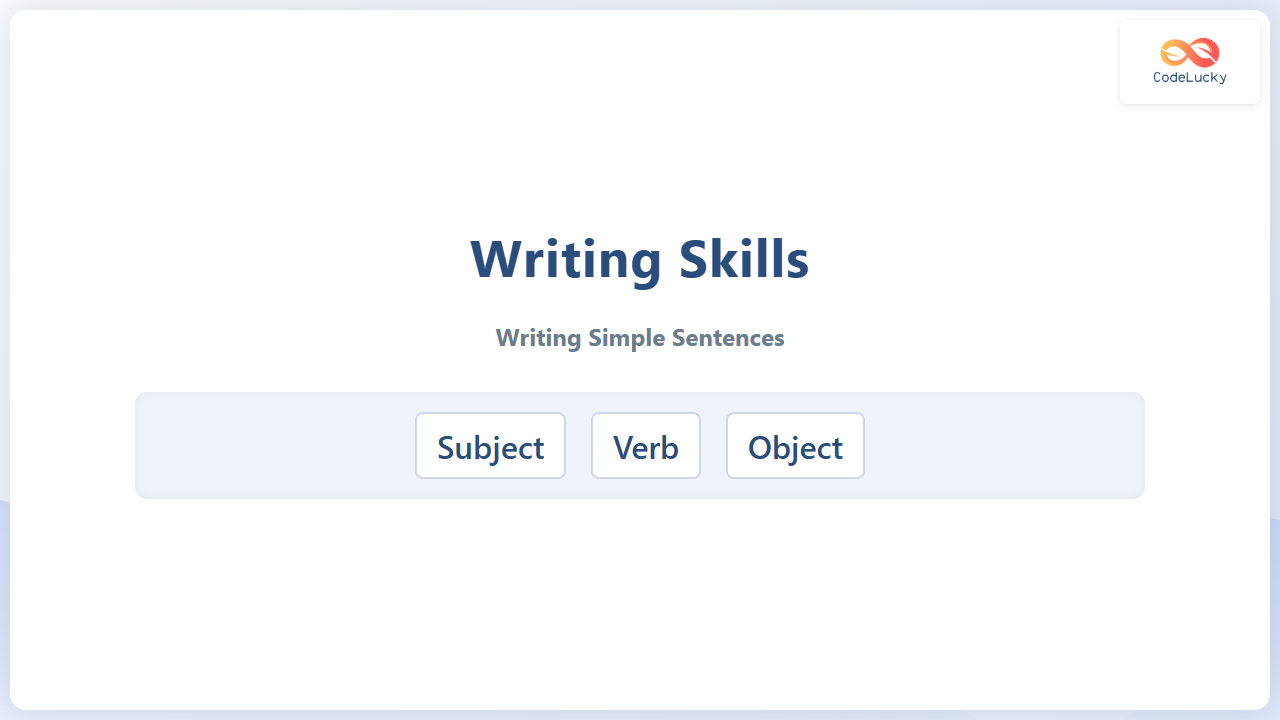
This visual shows a simple sentence structure dissecting subject and predicate to pinpoint the role of a noun clause.
Tip to Identify
If you can replace a clause with a single noun or pronoun like “something” or “that thing,” it’s a noun clause.
Example:
"What he wants" = "something"
✔ Something is unclear. → What he wants is unclear.
2. Adjective Clauses (Relative Clauses)
An adjective clause describes or gives more information about a noun or pronoun. It usually starts with relative pronouns such as who, whom, whose, which, or that.
Examples
- The book that you gave me is amazing.
- The person who helped me was kind.
- This is the place where we met.

Interactive Tip: Try removing the adjective clause from a sentence. If the sentence still makes sense but loses detail, it’s an adjective clause.
Without clause: The book is amazing. (Still logical, but less specific)
With clause: The book that you gave me is amazing.
Restrictive vs. Non-restrictive Clauses
When the clause is essential to the noun’s meaning, it’s restrictive (no commas used). When it only adds extra information, it’s non-restrictive (commas used).
- 🎯 Restrictive: The man who won is my brother.
- 🟢 Non-restrictive: My brother, who won, is happy.
3. Adverb Clauses
An adverb clause modifies a verb, adjective, or another adverb. It tells when, where, why, how, to what extent, or under what condition something happens.
Key Subordinating Conjunctions
Common words that start adverb clauses: because, although, since, when, if, unless, while, as, where.
Examples
- I went home because I was tired. → (Shows reason)
- When the bell rang, students left. → (Shows time)
- If you study, you will pass. → (Shows condition)

Adverb Clause Placement
Adverb clauses can appear at the beginning, middle, or end of a sentence. When they appear first, they’re often followed by a comma.
Because it was raining, we stayed inside.
We stayed inside because it was raining.
Clause Comparison Chart
| Type of Clause | Main Function | Introduced By | Example |
|---|---|---|---|
| Noun Clause | Acts as a noun (subject/object/complement) | that, what, how, why | I know that she’s right. |
| Adjective Clause | Describes a noun or pronoun | who, which, that, whose | The boy who won is my friend. |
| Adverb Clause | Modifies verb, adjective, or adverb | because, when, if, since | She smiled when he arrived. |
Quick Practice
Try identifying the clause type in each sentence below:
- What you said was interesting.
- The car that I bought is new.
- We left early because it started to rain.
Answers: (1) Noun Clause, (2) Adjective Clause, (3) Adverb Clause ✅
Final Thoughts
Understanding noun, adjective, and adverb clauses transforms your sentence-building skills. Clauses let you express detailed, complex ideas clearly and naturally. Whether writing essays, content, or scripts, mastering clauses gives you precision and variety in expression.
Keep practicing by identifying clauses in everyday reading. Over time, you’ll not only spot them easily but use them powerfully in your own writing.