Clauses are the essential building blocks of sentences in the English language. Understanding how independent and dependent clauses function helps you write clearly, avoid fragments, and build complex, expressive sentences. This article from CodeLucky.com breaks down both types with examples, diagrams, and interactive learning hints.
What is a Clause?
A clause is a group of words containing a subject and a predicate (verb). Unlike phrases, which may lack either, a clause expresses an idea or action that contributes to the sentence’s meaning.
Example:
- She runs every morning. – This is a complete thought, so it’s an independent clause.
- Because she runs every morning – This leaves you expecting more, so it’s dependent.

Independent Clauses: The Sentence Builders
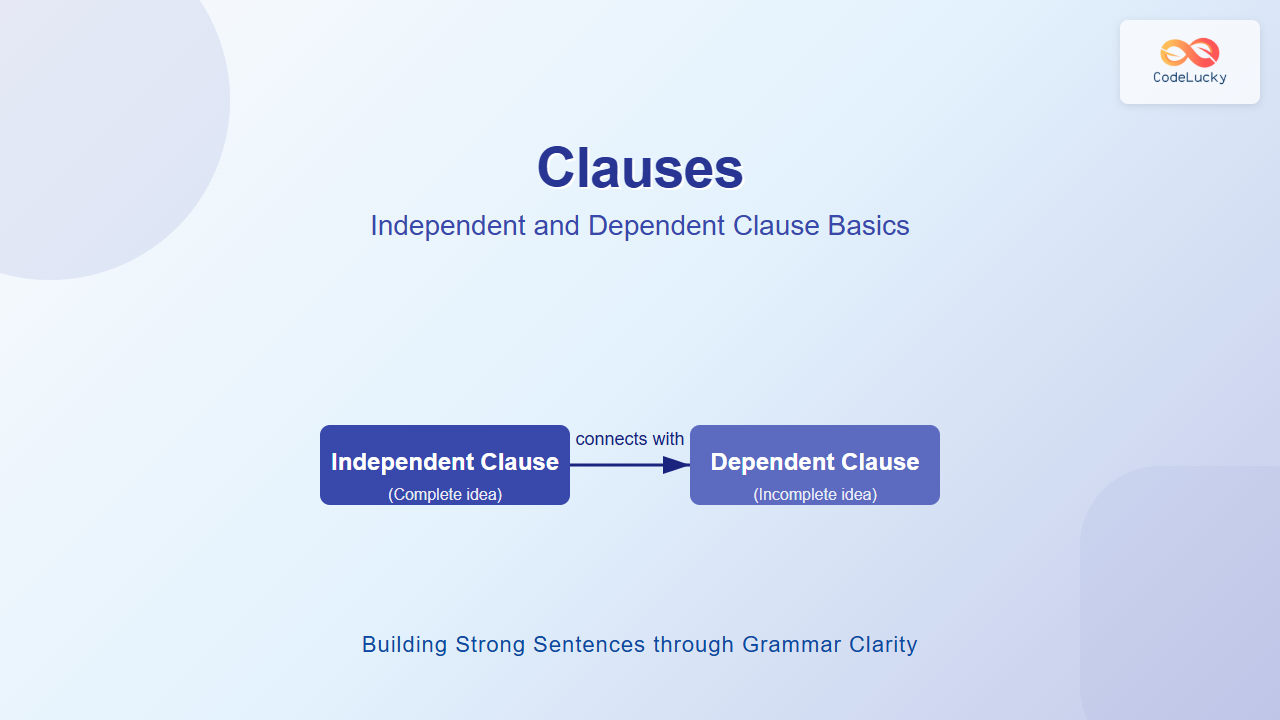
An independent clause expresses a complete thought. It can stand alone as a complete sentence because it provides both a subject and a predicate that make sense on their own.
Characteristics of Independent Clauses
- Contain a subject and a verb.
- Express a complete thought.
- Can stand alone as a sentence.
Examples:
- I love playing chess.
- The cat slept on the couch.
- Rain fell softly all night.
Each of these sentences can stand independently, meaning they form a complete idea.

Dependent Clauses: The Sentence Completers
A dependent clause (also called a subordinate clause) cannot stand alone. It depends on an independent clause to complete its meaning. It often starts with a subordinating conjunction like because, although, when, if, unless, or a relative pronoun like who, which, that.
Characteristics of Dependent Clauses
- Contain a subject and a verb but do not express a complete thought.
- Always start with a subordinating word.
- Depend on another clause to make sense.
Examples:
- Although I love chess – incomplete idea.
- Because it was raining – incomplete on its own.
- When the movie ended – leaves you expecting continuation.
Each of these clauses needs another clause to become meaningful:
- Although I love chess, I rarely find time to play.
- Because it was raining, we stayed indoors.
- When the movie ended, everyone clapped.

Combining Clauses: Creating Complex Sentences
Independent and dependent clauses often work together to create complex sentences. When joined correctly, they express relationships of cause, time, contrast, or condition.
Structure Formula:
Independent Clause + Subordinating Conjunction + Dependent Clause
Example:
- I stayed home because it was raining.
- Although she was tired, she completed her homework.
You can change the position of the dependent clause, but punctuation rules change accordingly:
- Because it was raining, I stayed home. ✅ (Comma required)
- I stayed home because it was raining. ✅ (No comma needed)

Interactive Practice Example
Try this: identify the independent and dependent clauses below. Click or hover to see answers (use CSS/JS interactivity if embedding on CodeLucky.com).
Sentence 1: Though it was late, we decided to go out.
Show Explanation
“Though it was late” = dependent clause.
“we decided to go out” = independent clause.
Sentence 2: I didn’t go because I was tired.
Show Explanation
“I didn’t go” = independent clause.
“because I was tired” = dependent clause.
How to Identify Clauses Easily
- Find the verb and subject pair.
- Check if it forms a complete thought.
- Look for joining words: because, although, when, if, who.
- If the idea feels incomplete, it’s dependent.
- If it stands alone, it’s independent.

Common Mistakes to Avoid
- Sentence fragments: Using a dependent clause alone, e.g., Because I was tired.
- Comma splices: Joining two independent clauses with a comma instead of a conjunction.
- Run-on sentences: Forgetting punctuation or conjunctions between clauses.
Quick Reference Table
| Clause Type | Example | Can Stand Alone? | Starts With |
|---|---|---|---|
| Independent Clause | I enjoy writing articles. | Yes | Usually none |
| Dependent Clause | Because I enjoy writing articles | No | Subordinating conjunction or relative pronoun |
Final Thoughts
Mastering independent and dependent clauses is key to writing grammatically correct, expressive sentences. Recognizing how they interact helps you avoid fragments and run-ons while improving your overall fluency. Practice combining clauses to form smoother, more meaningful sentences — a skill every confident English writer possesses.
Learn more grammar lessons and interactive English guides only on CodeLucky.com.