The race for computational supremacy is no longer just about shrinking transistors or adding more cores to a CPU. We are standing on the precipice of a fundamental shift in how we process information. While classical computers have powered the digital revolution for decades, Quantum Computing is emerging as a paradigm-shifting technology that promises to solve problems previously thought impossible.
In this guide, we will dissect the core differences between the machines that power our daily lives and the quantum giants that are being built in supercooled labs around the world.
The Fundamental Unit: Bits vs. Qubits
To understand the difference, we must look at the most basic unit of information.
Classical Computing: The Bit
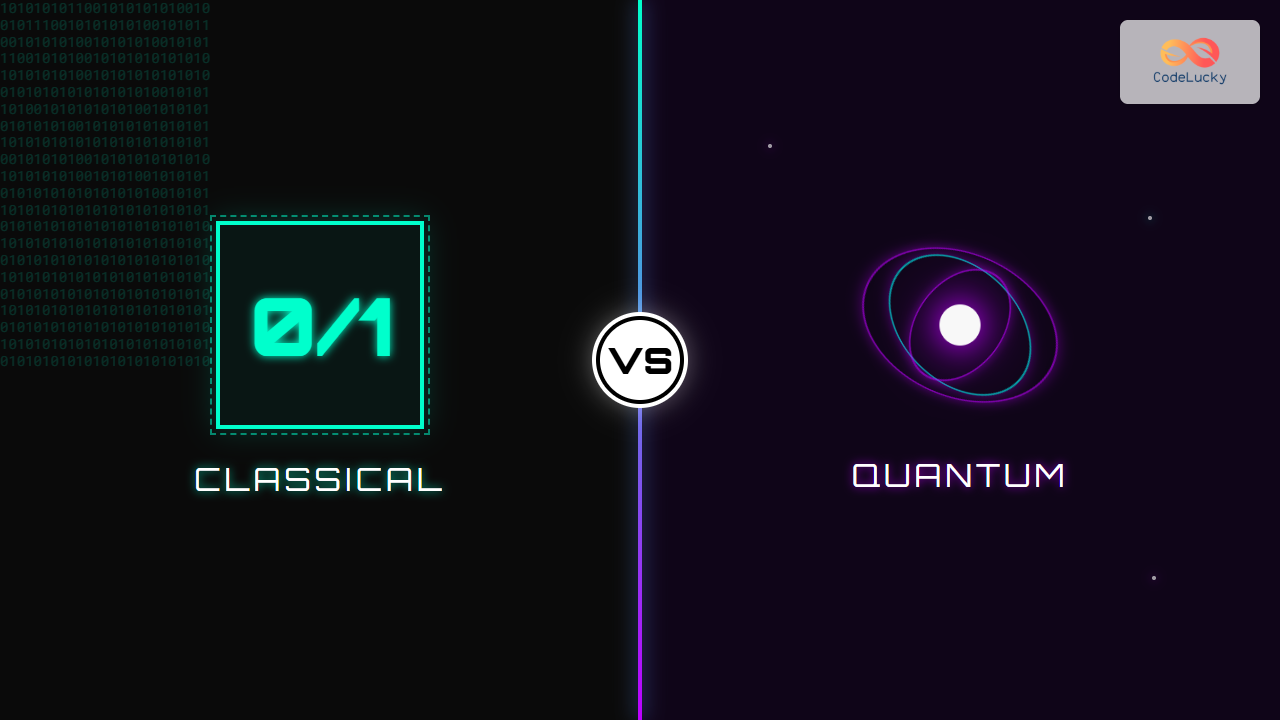
Your laptop, smartphone, and the server hosting this website all run on Classical Computing. They operate using binary logic. Information is stored in bits, which can exist in one of two distinct states: 0 (off) or 1 (on). It’s like a light switch—it is either clearly on or clearly off.
Quantum Computing: The Qubit
Quantum computers use Quantum Bits, or Qubits. Unlike a standard bit, a qubit can exist in a state of 0, 1, or a complex combination of both simultaneously. This phenomenon is known as Superposition.

Key Concepts: Superposition and Entanglement
Two principles of quantum mechanics give these machines their immense power.
1. Superposition
Imagine a coin spinning on a table. While it’s spinning, is it heads or tails? It’s effectively both until it stops. A classical computer waits for the coin to land (measure 0 or 1). A quantum computer performs calculations on the spinning coin, leveraging all probable states at once.
2. Entanglement
This is what Einstein famously called “spooky action at a distance.” In a quantum system, qubits can become entangled. This means the state of one qubit is directly correlated to the state of another, no matter how far apart they are. If you change one, the other changes instantly.
Processing Power: Linear vs. Exponential
The real magic happens when you scale up. In a classical system, if you want to double the processing power, you roughly need to double the number of transistors (Moore’s Law). The relationship is linear (1:1).
In a quantum system, the power grows exponentially. Because of superposition:
- 2 Classical Bits = 4 combinations (00, 01, 10, 11), but you can only use one at a time.
- 2 Qubits = Can represent all 4 states simultaneously.
- 50 Qubits = Can represent 250 states at once. That is roughly 1.1 quadrillion operations in parallel.
Visualizing the Search Problem
Imagine trying to find a specific “X” in a library of books.
Classical Computer Approach (Sequential):
Check Book 1: No
Check Book 2: No
Check Book 3: No
...
Check Book 500: YES
It checks one by one. In the worst case, it checks every book.
Quantum Computer Approach (Grover’s Algorithm):
Check [All Books]: YES (Found at index 500)
It uses probability amplitudes to lower the probability of wrong answers and raise the probability of the right answer, finding it in roughly the square root of the number of steps.

When Should We Use Quantum?
It is a common misconception that quantum computers will replace our laptops. They won’t. They are terrible at browsing the web, checking email, or streaming video. They are specialized engines designed for specific types of hard problems.

Real-World Applications
- Drug Discovery: Simulating molecular interactions is incredibly complex for classical supercomputers. Quantum computers can model atomic structures precisely to find new cures.
- Logistics Optimization: Finding the absolute best route for 1,000 delivery trucks involves more combinations than atoms in the universe. Quantum algorithms can solve this “Traveling Salesman” problem much faster.
- Cryptography: Modern encryption (RSA) relies on the fact that factoring large prime numbers is hard for classical computers. Shor’s Algorithm on a quantum computer could theoretically break this encryption in hours, leading to the rise of “Post-Quantum Cryptography.”
Conclusion
We are still in the “Noisy Intermediate-Scale Quantum” (NISQ) era. Quantum computers are unstable, prone to error (decoherence), and require temperatures colder than deep space to operate. However, the theoretical foundation is solid.
Classical computing gave us the internet and the smartphone. Quantum computing holds the key to understanding the fabric of reality, creating materials we’ve never seen, and solving the unsolvable. The future isn’t just binary anymore.