Introduction to CDN Security Features: Protection Beyond Speed
Content Delivery Networks (CDNs) are widely celebrated for their ability to accelerate website load times and deliver content swiftly to users worldwide. However, the role of modern CDNs extends far beyond mere speed enhancement. Today’s CDN security features play a pivotal role in defending web applications from diverse and evolving cyber threats. This article explores the comprehensive security capabilities built into CDNs, showing how they safeguard websites, applications, and APIs at the network edge—as well as providing examples and visual explanations to underline their significance.
Understanding the Security Landscape Addressed by CDNs
Websites and applications face continuous threats ranging from volumetric Distributed Denial of Service (DDoS) attacks to more sophisticated application-layer intrusions. Traditional security approaches based solely on origin servers have limited scope, making CDNs essential in a layered defense strategy. CDNs provide a distributed network architecture close to users, helping to detect malicious traffic early and mitigate attacks before they reach the origin.

Key CDN Security Features Explained
1. DDoS Protection
One of the most critical CDN security functions is mitigating large-scale DDoS attacks. CDNs absorb and distribute traffic across their global network, identifying abnormal spikes and filtering out malicious requests automatically.
2. Web Application Firewall (WAF)
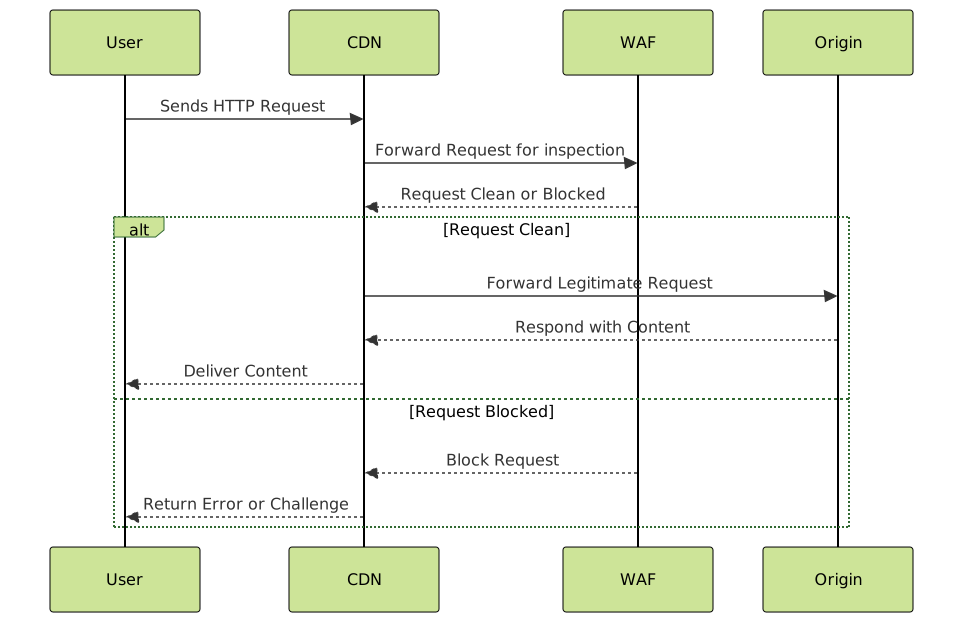
A WAF integrated with CDN inspects HTTP/HTTPS requests for threats such as SQL injection, cross-site scripting (XSS), and other OWASP top 10 vulnerabilities. By filtering harmful requests at the edge, it protects the origin server and preserves website integrity.
3. Secure Socket Layer (SSL)/Transport Layer Security (TLS) Encryption
By managing SSL/TLS termination at edge servers, CDNs ensure encrypted data transmission, defending against man-in-the-middle attacks and providing secure connections for users.
4. Bot Management
CDNs differentiate between legitimate bot traffic (e.g., search engine crawlers) and malicious bots (e.g., scrapers, credential stuffing attacks) using behavioral analytics and challenge-response tests to block or throttle harmful bots.
5. Access Control and Authentication
Content Access Rules and token-based authentication mechanisms help restrict content delivery to authorized users only, protecting premium or private content from unauthorized access.
Example: Protecting Against DDoS with a CDN
Consider a scenario where a website is targeted by a Volumetric DDoS attack involving millions of requests per second. Without a CDN, the origin server would become overwhelmed and crash. With a CDN, traffic is funneled through edge servers that identify attack patterns and absorb malicious requests, allowing legitimate traffic through uninterrupted.
curl -I https://example-website.com
HTTP/2 200
x-cdn-cache-status: HIT
x-waf-action: ALLOW
x-ddos-protection: ACTIVE
This simplified response header snippet shows that the CDN cache responded to the request (HIT), the WAF allowed the request (no threat detected), and DDoS protection is actively monitoring the traffic.
Mermaid Diagram: How CDN WAF Protects Requests
Interactive Example: Rate Limiting and Security
Rate limiting is a vital feature to stop brute-force or scraping attacks. We can simulate a simple rate limit in a node.js-like pseudocode example:
let requestCount = 0;
const MAX_REQUESTS = 5;
const TIME_WINDOW = 60000; // 1 minute

function handleRequest() {
  if(requestCount >= MAX_REQUESTS) {
    return '429 Too Many Requests - Please try later.';
  }
  requestCount++;
  setTimeout(() => requestCount--, TIME_WINDOW);
  return '200 OK - Request processed.';
}
This logic demonstrates a limit of 5 requests per minute per user. CDNs implement such policies globally at edge locations to preempt abusive behavior and protect backend resources.
Additional CDN Security Enhancements
- Bot Challenge & CAPTCHA Integration: Blocks suspicious automated traffic with interactive challenges.
- Geo-Blocking: Restricting access from specific geographic regions to reduce risk exposure.
- HTTP/2 and HTTP/3 Support: Secure, modern protocols that improve security posture.
- Real-time Analytics and Alerts: Immediate visibility and response to emerging threats.
Mermaid Diagram: CDN Security Workflow Overview

Conclusion
Beyond accelerating content delivery, modern CDNs offer a crucial security layer that defends web properties from a myriad of online threats. From DDoS mitigation, WAF defenses, bot management, to encryption and access controls, CDN security features comprehensively shield applications at the network edge. Integrating CDN security into your web architecture is not only a performance optimization—it is a strategic defense imperative to ensure availability, integrity, and trust in your digital presence.