Capitalization is one of the most fundamental yet often overlooked aspects of proper English writing. It shapes how sentences appear, influences readability, and helps convey formality, emphasis, and meaning. In this comprehensive guide, you will learn every rule about capitalization — with examples, diagrams, and quick practice tips — so you can write polished, professional English confidently.
1. What Is Capitalization?
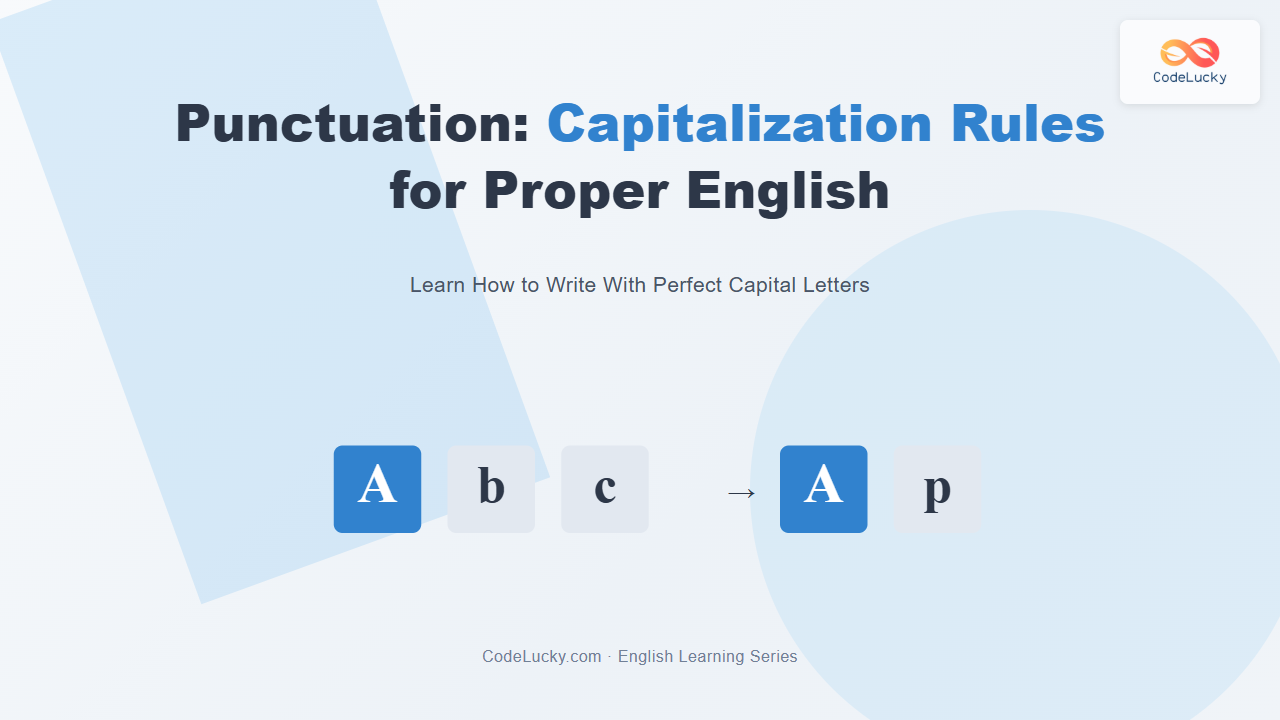
Capitalization means writing a letter in uppercase form (A, B, C…) instead of lowercase (a, b, c…). It’s used to mark the beginning of sentences, proper nouns, important titles, or words of special importance.
For instance:
Correct: English is a global language.
Incorrect: english is a global language.
2. Basic Capitalization Rules in English
Let’s start with the fundamental rules every English learner must master.
2.1 Capitalize the First Word of Every Sentence
The first word in any English sentence should begin with a capital letter.
Example:
✔️ She loves reading books.
❌ she loves reading books.
2.2 Capitalize Proper Nouns
Proper nouns refer to specific names of people, places, organizations, or things. Always capitalize them.
Correct: John lives in London.
Incorrect: john lives in london.
Examples of proper nouns:
- Names: David, Maria, Einstein
- Countries & Cities: India, Paris, New York
- Organizations: Microsoft, CodeLucky.com, NASA
- Days & Months: Monday, December
2.3 Capitalize the Pronoun “I”
✔️ I am learning English.
❌ i am learning English.
The pronoun “I” is always capitalized — even when it stands alone.
2.4 Capitalize Titles of Books, Movies, and Articles
The rule for titles depends on style guides (like APA, MLA, etc.), but commonly you capitalize the first, last, and all major words.
✔️ The Great Gatsby
✔️ Harry Potter and the Chamber of Secrets
❌ the great gatsby

2.5 Capitalize Direct Quotations (If Full Sentences)
If a quoted sentence starts a complete idea, the first word should be capitalized.
✔️ She said, “Learning never ends.”
✔️ He replied, “That’s true.”
❌ She said, “learning never ends.”
2.6 Capitalize the First Word After a Colon (Only If It Starts a Full Sentence)
English grammar allows a capital after a colon if the following part is a complete sentence.
✔️ Remember this rule: Always capitalize proper nouns.
❌ Remember this rule: always capitalize proper nouns.
2.7 Capitalize Names of Historical Events and Periods
Names of events, eras, and specific historical occurrences require capitalization.
✔️ The Renaissance changed art forever.
✔️ World War II ended in 1945.
3. Special Capitalization Contexts
3.1 Capitalization in Emails and Letters
- Begin with a capital in greetings.
Dear Mr. Smith, - Capitalize the first word after a closing such as Sincerely only in titles, not signatures.
3.2 Capitalization in Headings and Subtitles
Headings use title case (capitalize major words) or sentence case (capitalize only the first word). Use the same style throughout your writing for consistency.

3.3 Capitalization in Acronyms and Initialisms
Acronyms (like NASA, HTML, USA) are always in uppercase. When spelled out, capitalize only proper nouns.
✔️ NASA — National Aeronautics and Space Administration
✔️ HTML — HyperText Markup Language
❌ nasa — national aeronautics and space administration
4. Common Capitalization Mistakes to Avoid
- Capitalizing every word in sentences (only necessary words need it).
- Forgetting to capitalize “I” or proper nouns.
- Capitalizing random words for emphasis (bold or italics are better).

5. Interactive Quick Practice
Try correcting the capitalization in the following sentences:
my favorite month is january.the taj mahal is located in agra.she said, “technology will change everything.”
Answers:
- My favorite month is January.
- The Taj Mahal is located in Agra.
- She said, “Technology will change everything.”
6. Capitalization: A Summary at a Glance
Here’s a quick visual summary to recall when capitalization is needed.

7. Final Tips for Perfect Capitalization
- Check your writing against a trusted grammar checker or style guide.
- Keep a list of common proper nouns for your field (especially if you write professionally).
- Practice rewriting short paragraphs to apply capitalization consistency.
- Remember: good capitalization shows attention to detail — and makes you appear credible.
Mastering capitalization is not just about grammar rules. It’s about presenting your ideas clearly, respectfully, and professionally. Whether you’re writing an essay, blog, or email — proper capitalization ensures your words look as polished as your intent.