Idioms: Essential Work and Business English Idioms to Sound More Professional
Fluency in English isn’t just about grammar or vocabulary — it’s about expression. In today’s workplace, native speakers often use idioms that give color and emotion to what they say. If you’re learning Business English or aiming to sound more natural in meetings, emails, or presentations, mastering work-related idioms will give you a confident edge.
What Are Work and Business English Idioms?
Idioms are expressions whose meanings aren’t literal. For example, when someone says “hit the ground running,” they don’t mean to physically run — but to start a task quickly and effectively. These idioms often reflect workplace culture, teamwork, deadlines, or leadership. Understanding them is key to participating naturally in professional conversations.
Why Use Idioms in Business English?
- They help you sound fluent and confident in meetings.
- They make your business writing more engaging.
- They help you interpret what native speakers mean in context.
- They improve your understanding of workplace discussions and interviews.
Top Business Idioms With Meanings and Examples
1. Hit the ground running
Meaning: To start a job or project immediately and with high energy.
Example: “The new marketing team hit the ground running by launching three campaigns in the first week.”

2. Corner the market
Meaning: To dominate a specific market or area of business.
Example: “With their innovative app, they’ve cornered the market in food delivery services.”
3. Think outside the box
Meaning: To approach a problem creatively or unconventionally.
Example: “Our design team always thinks outside the box to find fresh ideas for clients.”

4. In the driver’s seat
Meaning: To be in control or in a position of power.
Example: “After the merger, our CEO is in the driver’s seat of the new company.”
5. On the same page
Meaning: To share the same understanding or goals.
Example: “Before we present to clients, let’s make sure we’re all on the same page.”

6. Cut corners
Meaning: To do something quickly and cheaply, often sacrificing quality.
Example: “We can’t afford to cut corners on product safety.”
7. A win-win situation
Meaning: A deal or result that benefits all parties.
Example: “Outsourcing IT turned out to be a win-win situation for both client and vendor.”
8. Back to the drawing board
Meaning: To start over after a plan or idea fails.
Example: “The prototype didn’t work, so it’s back to the drawing board for us.”
9. Touch base
Meaning: To briefly connect or update someone on progress.
Example: “Let’s touch base after the meeting to review next steps.”

10. Raise the bar
Meaning: To set a higher standard for performance or quality.
Example: “Their new product launch has raised the bar for the entire industry.”
Interactive Practice: Match the Idiom to Its Meaning
Try this short exercise. Match each idiom with its meaning:
- Think outside the box
- Cut corners
- On the same page
- In the driver’s seat
- A. Share the same understanding
- B. Be creative in problem-solving
- C. Be in control
- D. Reduce quality to save time or money
Answers: 1-B, 2-D, 3-A, 4-C
Idioms by Workplace Context
| Context | Common Idioms | Examples |
|---|---|---|
| Teamwork | On the same page, pull your weight | “Everyone on the team is pulling their weight this quarter.” |
| Leadership | Call the shots, in the driver’s seat | “As project manager, you get to call the shots.” |
| Decision-making | Get the ball rolling, take the plunge | “Let’s get the ball rolling on the new campaign.” |
| Failure and Recovery | Back to the drawing board, hit a snag | “We’ve hit a snag in the approval process.” |
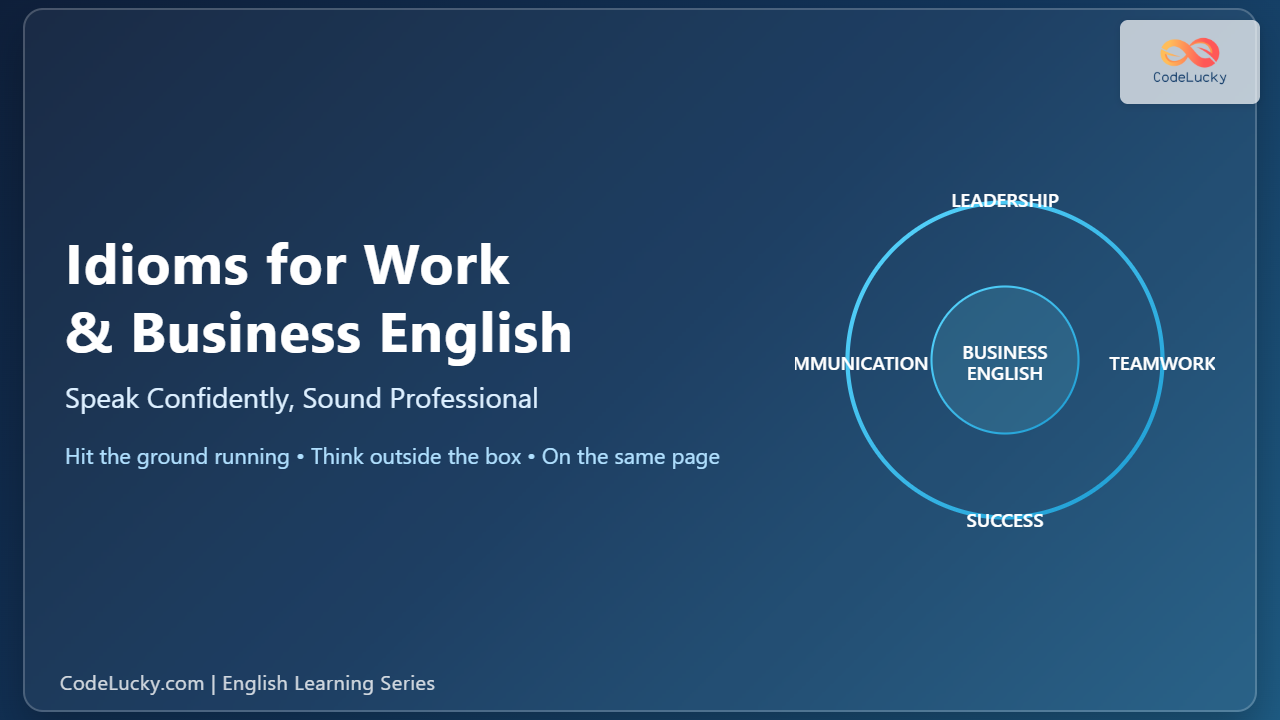
Visual Recap of Key Idioms

Tips for Using Business Idioms Naturally
- Don’t overuse idioms — one per sentence is enough.
- Use them in context, not just to sound fluent.
- Listen to how native speakers use them in meetings or media.
- Practice paraphrasing idioms into plain English to ensure you understand their meaning.
Conclusion
Idioms bring energy and authenticity to your business English. Whether you’re writing an email, giving a presentation, or negotiating with clients, idioms help you express yourself like a native speaker. Start with these ten, practice daily, and you’ll soon “hit the ground running” in every professional conversation!