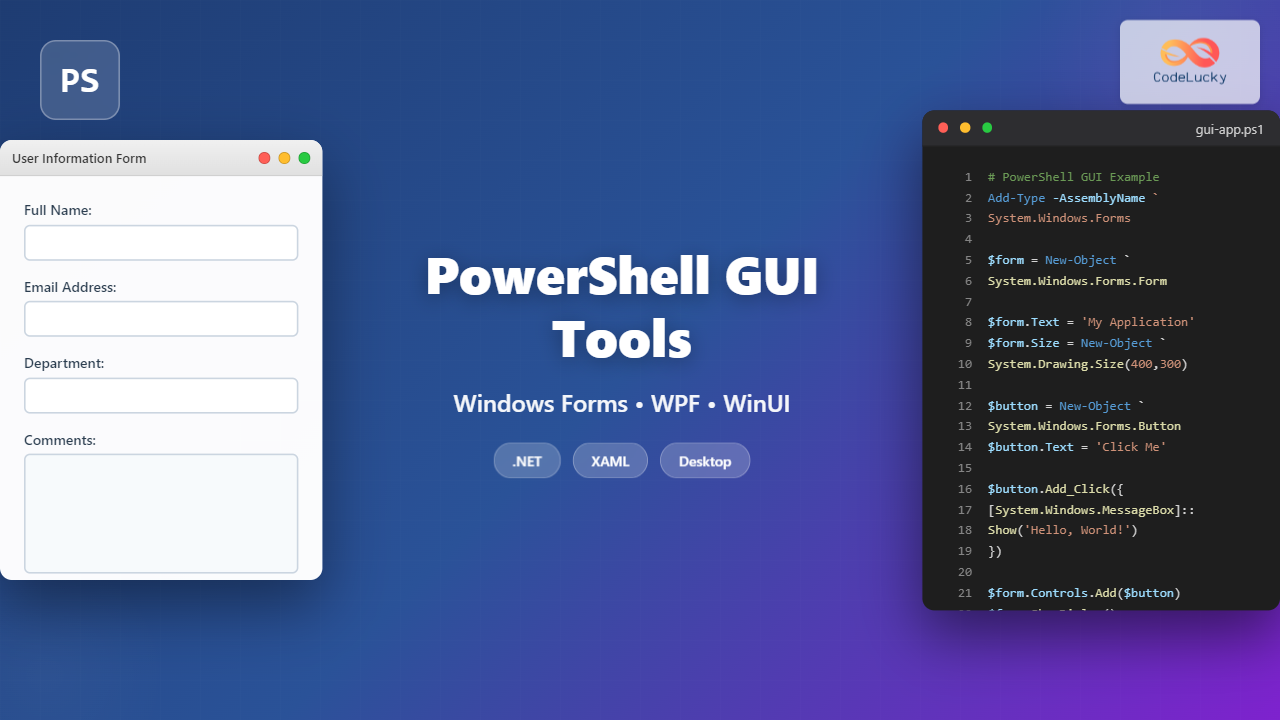
PowerShell isn’t just for command-line automation—it’s a powerful platform for building graphical user interfaces (GUIs) that transform scripts into user-friendly desktop applications. This comprehensive guide explores three primary frameworks for GUI development in PowerShell: Windows Forms, Windows Presentation Foundation (WPF), and the modern WinUI approach.
Why Build GUIs with PowerShell?
Creating GUI applications with PowerShell offers several compelling advantages for administrators, developers, and automation engineers:
- Rapid prototyping and development without compiling
- Leverage existing PowerShell scripts and modules
- Lower barrier to entry compared to C# or C++
- Direct access to .NET Framework and Windows APIs
- Distribution simplicity for enterprise environments

Windows Forms: The Classic Approach
Windows Forms (WinForms) represents the traditional GUI framework that’s been part of .NET since its inception. It’s straightforward, well-documented, and perfect for creating functional business applications quickly.
Setting Up Windows Forms
Windows Forms requires loading the appropriate .NET assembly. Here’s how to initialize a basic form:
Add-Type -AssemblyName System.Windows.Forms
Add-Type -AssemblyName System.Drawing

# Create the main form
$form = New-Object System.Windows.Forms.Form
$form.Text = 'PowerShell GUI Application'
$form.Size = New-Object System.Drawing.Size(400,300)
$form.StartPosition = 'CenterScreen'
$form.FormBorderStyle = 'FixedDialog'
$form.MaximizeBox = $false
Building a Complete Windows Forms Application
Let’s create a practical system information tool that demonstrates key Windows Forms concepts:
Add-Type -AssemblyName System.Windows.Forms
Add-Type -AssemblyName System.Drawing

# Create form
$form = New-Object System.Windows.Forms.Form
$form.Text = 'System Information Tool'
$form.Size = New-Object System.Drawing.Size(500,400)
$form.StartPosition = 'CenterScreen'

# Create label
$label = New-Object System.Windows.Forms.Label
$label.Location = New-Object System.Drawing.Point(10,20)
$label.Size = New-Object System.Drawing.Size(460,30)
$label.Text = 'Select information to retrieve:'
$label.Font = New-Object System.Drawing.Font("Segoe UI",10,[System.Drawing.FontStyle]::Bold)
$form.Controls.Add($label)

# Create ComboBox
$comboBox = New-Object System.Windows.Forms.ComboBox
$comboBox.Location = New-Object System.Drawing.Point(10,60)
$comboBox.Size = New-Object System.Drawing.Size(460,30)
$comboBox.DropDownStyle = 'DropDownList'
$comboBox.Items.AddRange(@('Computer Name', 'Operating System', 'IP Address', 'CPU Information', 'Memory Information'))
$comboBox.SelectedIndex = 0
$form.Controls.Add($comboBox)

# Create TextBox for output
$textBox = New-Object System.Windows.Forms.TextBox
$textBox.Location = New-Object System.Drawing.Point(10,100)
$textBox.Size = New-Object System.Drawing.Size(460,200)
$textBox.Multiline = $true
$textBox.ScrollBars = 'Vertical'
$textBox.ReadOnly = $true
$textBox.Font = New-Object System.Drawing.Font("Consolas",9)
$form.Controls.Add($textBox)

# Create Get Info button
$getButton = New-Object System.Windows.Forms.Button
$getButton.Location = New-Object System.Drawing.Point(10,310)
$getButton.Size = New-Object System.Drawing.Size(220,40)
$getButton.Text = 'Get Information'
$getButton.Font = New-Object System.Drawing.Font("Segoe UI",10)

$getButton.Add_Click({
    $textBox.Clear()

    switch ($comboBox.SelectedItem) {
        'Computer Name' {
            $textBox.Text = "Computer Name: $env:COMPUTERNAME"
        }
        'Operating System' {
            $os = Get-CimInstance Win32_OperatingSystem
            $textBox.Text = "OS: $($os.Caption)`r`nVersion: $($os.Version)`r`nBuild: $($os.BuildNumber)"
        }
        'IP Address' {
            $ips = Get-NetIPAddress -AddressFamily IPv4 | Where-Object {$_.InterfaceAlias -notlike '*Loopback*'}
            $textBox.Text = ($ips | ForEach-Object { "$($_.InterfaceAlias): $($_.IPAddress)" }) -join "`r`n"
        }
        'CPU Information' {
            $cpu = Get-CimInstance Win32_Processor
            $textBox.Text = "Processor: $($cpu.Name)`r`nCores: $($cpu.NumberOfCores)`r`nThreads: $($cpu.NumberOfLogicalProcessors)"
        }
        'Memory Information' {
            $mem = Get-CimInstance Win32_PhysicalMemory
            $totalMem = ($mem | Measure-Object Capacity -Sum).Sum / 1GB
            $textBox.Text = "Total Memory: $([math]::Round($totalMem, 2)) GB`r`nModules: $($mem.Count)"
        }
    }
})
$form.Controls.Add($getButton)

# Create Close button
$closeButton = New-Object System.Windows.Forms.Button
$closeButton.Location = New-Object System.Drawing.Point(250,310)
$closeButton.Size = New-Object System.Drawing.Size(220,40)
$closeButton.Text = 'Close'
$closeButton.Font = New-Object System.Drawing.Font("Segoe UI",10)
$closeButton.Add_Click({ $form.Close() })
$form.Controls.Add($closeButton)

# Show form
$form.ShowDialog()
Visual Output: This creates a window with a dropdown menu, text display area, and action buttons. When you select an option and click “Get Information,” the tool retrieves and displays the requested system information in real-time.
Advanced Windows Forms Controls
Windows Forms offers a rich set of controls for building sophisticated interfaces:
# DataGridView Example
$dataGrid = New-Object System.Windows.Forms.DataGridView
$dataGrid.Location = New-Object System.Drawing.Point(10,10)
$dataGrid.Size = New-Object System.Drawing.Size(560,300)
$dataGrid.AutoSizeColumnsMode = 'Fill'

# Populate with process data
$processes = Get-Process | Select-Object Name, Id, CPU, WorkingSet -First 10
$dataGrid.DataSource = [System.Collections.ArrayList]@($processes)

# TabControl Example
$tabControl = New-Object System.Windows.Forms.TabControl
$tabControl.Location = New-Object System.Drawing.Point(10,10)
$tabControl.Size = New-Object System.Drawing.Size(560,400)

$tab1 = New-Object System.Windows.Forms.TabPage
$tab1.Text = 'Processes'
$tab1.Controls.Add($dataGrid)

$tab2 = New-Object System.Windows.Forms.TabPage
$tab2.Text = 'Services'

$tabControl.TabPages.Add($tab1)
$tabControl.TabPages.Add($tab2)
Windows Presentation Foundation (WPF)
WPF represents a more modern approach to GUI development with powerful styling, data binding, and graphics capabilities. It uses XAML (Extensible Application Markup Language) for UI definition and provides superior visual quality.

Creating Your First WPF Application
WPF applications in PowerShell typically load XAML definitions and manipulate them programmatically:
Add-Type -AssemblyName PresentationFramework

[xml]$xaml = @"
<Window xmlns="http://schemas.microsoft.com/winfx/2006/xaml/presentation"
        xmlns:x="http://schemas.microsoft.com/winfx/2006/xaml"
        Title="WPF PowerShell Application" Height="350" Width="500"
        WindowStartupLocation="CenterScreen">
    <Grid>
        <Grid.RowDefinitions>
            <RowDefinition Height="Auto"/>
            <RowDefinition Height="*"/>
            <RowDefinition Height="Auto"/>
        </Grid.RowDefinitions>

        <TextBlock Grid.Row="0" Text="Enter Your Name:"
                   Margin="10" FontSize="14" FontWeight="Bold"/>

        <TextBox Grid.Row="1" Name="InputBox" Margin="10"
                 FontSize="14" VerticalAlignment="Top" Height="30"/>

        <StackPanel Grid.Row="2" Orientation="Horizontal"
                    HorizontalAlignment="Center" Margin="10">
            <Button Name="SubmitButton" Content="Submit"
                    Width="100" Height="35" Margin="5"/>
            <Button Name="ClearButton" Content="Clear"
                    Width="100" Height="35" Margin="5"/>
        </StackPanel>
    </Grid>
</Window>
"@

# Load XAML
$reader = New-Object System.Xml.XmlNodeReader $xaml
$window = [Windows.Markup.XamlReader]::Load($reader)

# Get controls
$inputBox = $window.FindName("InputBox")
$submitButton = $window.FindName("SubmitButton")
$clearButton = $window.FindName("ClearButton")

# Add event handlers
$submitButton.Add_Click({
    if ($inputBox.Text) {
        [System.Windows.MessageBox]::Show("Hello, $($inputBox.Text)!", "Greeting")
    }
})

$clearButton.Add_Click({
    $inputBox.Clear()
})

# Show window
$window.ShowDialog()
Visual Output: This creates a clean, modern window with a text input field and two buttons. The interface uses WPF’s automatic layout system and supports smooth animations and visual effects.
Advanced WPF: Data Binding and ListView
WPF’s data binding capabilities allow automatic UI updates when data changes:
Add-Type -AssemblyName PresentationFramework

[xml]$xaml = @"
<Window xmlns="http://schemas.microsoft.com/winfx/2006/xaml/presentation"
        Title="Process Monitor" Height="500" Width="700"
        WindowStartupLocation="CenterScreen">
    <Grid>
        <Grid.RowDefinitions>
            <RowDefinition Height="Auto"/>
            <RowDefinition Height="*"/>
            <RowDefinition Height="Auto"/>
        </Grid.RowDefinitions>

        <TextBlock Grid.Row="0" Text="Active Processes"
                   Margin="10" FontSize="16" FontWeight="Bold"/>

        <ListView Grid.Row="1" Name="ProcessList" Margin="10">
            <ListView.View>
                <GridView>
                    <GridViewColumn Header="Process Name" Width="200"
                                    DisplayMemberBinding="{Binding Name}"/>
                    <GridViewColumn Header="Process ID" Width="100"
                                    DisplayMemberBinding="{Binding Id}"/>
                    <GridViewColumn Header="CPU (s)" Width="100"
                                    DisplayMemberBinding="{Binding CPU}"/>
                    <GridViewColumn Header="Memory (MB)" Width="150"
                                    DisplayMemberBinding="{Binding WorkingSetMB}"/>
                </GridView>
            </ListView.View>
        </ListView>

        <StackPanel Grid.Row="2" Orientation="Horizontal"
                    HorizontalAlignment="Center" Margin="10">
            <Button Name="RefreshButton" Content="Refresh"
                    Width="100" Height="35" Margin="5"/>
            <Button Name="KillButton" Content="Kill Process"
                    Width="100" Height="35" Margin="5"/>
            <Button Name="CloseButton" Content="Close"
                    Width="100" Height="35" Margin="5"/>
        </StackPanel>
    </Grid>
</Window>
"@

$reader = New-Object System.Xml.XmlNodeReader $xaml
$window = [Windows.Markup.XamlReader]::Load($reader)

$processList = $window.FindName("ProcessList")
$refreshButton = $window.FindName("RefreshButton")
$killButton = $window.FindName("KillButton")
$closeButton = $window.FindName("CloseButton")

# Function to load processes
function Load-Processes {
    $processes = Get-Process | Select-Object Name, Id,
        @{Name='CPU';Expression={[math]::Round($_.CPU, 2)}},
        @{Name='WorkingSetMB';Expression={[math]::Round($_.WorkingSet / 1MB, 2)}} |
        Sort-Object CPU -Descending | Select-Object -First 50

    $processList.ItemsSource = $processes
}

# Initial load
Load-Processes

# Event handlers
$refreshButton.Add_Click({ Load-Processes })

$killButton.Add_Click({
    $selected = $processList.SelectedItem
    if ($selected) {
        $result = [System.Windows.MessageBox]::Show(
            "Kill process $($selected.Name) (PID: $($selected.Id))?",
            "Confirm",
            [System.Windows.MessageBoxButton]::YesNo,
            [System.Windows.MessageBoxImage]::Warning
        )

        if ($result -eq 'Yes') {
            Stop-Process -Id $selected.Id -Force -ErrorAction SilentlyContinue
            Load-Processes
        }
    }
})

$closeButton.Add_Click({ $window.Close() })

$window.ShowDialog()
Visual Output: This creates a sophisticated process monitoring application with sortable columns, real-time refresh capability, and process termination functionality. The ListView automatically formats data in a clean, grid-based layout.
WPF Styling and Theming
One of WPF’s greatest strengths is its styling system. Here’s how to create custom styled controls:
[xml]$xaml = @"
<Window xmlns="http://schemas.microsoft.com/winfx/2006/xaml/presentation"
        Title="Styled Application" Height="300" Width="400">
    <Window.Resources>
        <Style x:Key="ModernButton" TargetType="Button">
            <Setter Property="Background" Value="#007ACC"/>
            <Setter Property="Foreground" Value="White"/>
            <Setter Property="FontSize" Value="14"/>
            <Setter Property="Padding" Value="15,8"/>
            <Setter Property="Margin" Value="5"/>
            <Setter Property="Template">
                <Setter.Value>
                    <ControlTemplate TargetType="Button">
                        <Border Background="{TemplateBinding Background}"
                                CornerRadius="5" BorderThickness="0">
                            <ContentPresenter HorizontalAlignment="Center"
                                            VerticalAlignment="Center"/>
                        </Border>
                    </ControlTemplate>
                </Setter.Value>
            </Setter>
            <Style.Triggers>
                <Trigger Property="IsMouseOver" Value="True">
                    <Setter Property="Background" Value="#005A9E"/>
                </Trigger>
            </Style.Triggers>
        </Style>
    </Window.Resources>

    <StackPanel VerticalAlignment="Center" HorizontalAlignment="Center">
        <Button Style="{StaticResource ModernButton}" Content="Modern Button 1"/>
        <Button Style="{StaticResource ModernButton}" Content="Modern Button 2"/>
    </StackPanel>
</Window>
"@
Comparing Windows Forms and WPF

| Feature | Windows Forms | WPF |
|---|---|---|
| Learning Curve | Low – Simple event-driven model | Medium – Requires XAML knowledge |
| Visual Quality | Standard Windows controls | High-quality vector graphics |
| Customization | Limited styling options | Extensive styling and theming |
| Data Binding | Manual data management | Automatic two-way binding |
| Performance | Lightweight for simple apps | Hardware acceleration for graphics |
| Development Speed | Fast for basic interfaces | Slower initial setup, faster iteration |
Introduction to WinUI with PowerShell
WinUI represents Microsoft’s modern UI framework, designed specifically for Windows 10 and Windows 11. While WinUI primarily targets C# and C++ development, PowerShell can interact with WinUI components through .NET 6+ and Windows App SDK.
Setting Up WinUI Environment
WinUI requires PowerShell 7+ and the Windows App SDK. Here’s a basic setup:
# Requires PowerShell 7+ and Windows App SDK installed
# Install Windows App SDK via Visual Studio or winget

Add-Type -AssemblyName Microsoft.UI.Xaml
Add-Type -AssemblyName Microsoft.Windows.SDK.NET

# Note: Full WinUI support in PowerShell is limited
# Consider using Windows Forms or WPF for production PowerShell GUIs
WinUI vs Traditional Frameworks
WinUI brings modern design language and Windows 11 integration, but it’s more complex to implement in PowerShell. For most PowerShell GUI needs, WPF remains the recommended choice for modern interfaces, while Windows Forms excels at rapid development.
Best Practices for PowerShell GUI Development
Error Handling
Robust error handling prevents application crashes and provides user feedback:
$button.Add_Click({
    try {
        # Potentially risky operation
        $result = Get-Process -Name "NonExistentProcess" -ErrorAction Stop
        $textBox.Text = $result.Name
    }
    catch {
        [System.Windows.MessageBox]::Show(
            "Error: $($_.Exception.Message)",
            "Operation Failed",
            [System.Windows.MessageBoxButton]::OK,
            [System.Windows.MessageBoxImage]::Error
        )
    }
})
Threading and Responsiveness
Long-running operations should execute on background threads to keep the UI responsive:
# Windows Forms approach
$button.Add_Click({
    $button.Enabled = $false
    $statusLabel.Text = "Processing..."

    $runspace = [runspacefactory]::CreateRunspace()
    $runspace.Open()

    $powershell = [powershell]::Create()
    $powershell.Runspace = $runspace

    $powershell.AddScript({
        # Long-running task
        Start-Sleep -Seconds 5
        Get-Process | Measure-Object
    })

    $handle = $powershell.BeginInvoke()

    # Check completion with timer
    $timer = New-Object System.Windows.Forms.Timer
    $timer.Interval = 100
    $timer.Add_Tick({
        if ($handle.IsCompleted) {
            $result = $powershell.EndInvoke($handle)
            $statusLabel.Text = "Completed: $($result.Count) processes"
            $button.Enabled = $true
            $timer.Stop()
            $powershell.Dispose()
            $runspace.Close()
        }
    })
    $timer.Start()
})
Input Validation
Always validate user input before processing:
$submitButton.Add_Click({
    # Trim whitespace
    $input = $textBox.Text.Trim()

    # Check for empty input
    if ([string]::IsNullOrWhiteSpace($input)) {
        [System.Windows.MessageBox]::Show(
            "Please enter a value",
            "Validation Error",
            [System.Windows.MessageBoxButton]::OK,
            [System.Windows.MessageBoxImage]::Warning
        )
        return
    }

    # Validate format (e.g., IP address)
    if ($input -notmatch '^\d{1,3}\.\d{1,3}\.\d{1,3}\.\d{1,3}$') {
        [System.Windows.MessageBox]::Show(
            "Invalid IP address format",
            "Validation Error",
            [System.Windows.MessageBoxButton]::OK,
            [System.Windows.MessageBoxImage]::Warning
        )
        return
    }

    # Process valid input
    Process-IPAddress -IP $input
})
Resource Management
Properly dispose of resources to prevent memory leaks:
$form.Add_FormClosing({
    # Clean up resources
    if ($timer) { $timer.Dispose() }
    if ($runspace) { $runspace.Close() }

    # Save settings if needed
    $settings = @{
        LastPath = $textBox.Text
        WindowSize = "$($form.Width),$($form.Height)"
    }
    $settings | Export-Clixml -Path "$env:APPDATA\MyApp\settings.xml"
})
Complete Real-World Example: File Management Tool
This comprehensive example demonstrates a practical file management application using Windows Forms with multiple features:
Add-Type -AssemblyName System.Windows.Forms
Add-Type -AssemblyName System.Drawing

$form = New-Object System.Windows.Forms.Form
$form.Text = 'File Management Tool'
$form.Size = New-Object System.Drawing.Size(700,500)
$form.StartPosition = 'CenterScreen'

# Menu Strip
$menuStrip = New-Object System.Windows.Forms.MenuStrip
$fileMenu = New-Object System.Windows.Forms.ToolStripMenuItem("&File")
$exitItem = New-Object System.Windows.Forms.ToolStripMenuItem("E&xit")
$exitItem.Add_Click({ $form.Close() })
$fileMenu.DropDownItems.Add($exitItem)
$menuStrip.Items.Add($fileMenu)
$form.Controls.Add($menuStrip)

# Path TextBox
$pathLabel = New-Object System.Windows.Forms.Label
$pathLabel.Location = New-Object System.Drawing.Point(10,35)
$pathLabel.Size = New-Object System.Drawing.Size(80,20)
$pathLabel.Text = 'Directory:'
$form.Controls.Add($pathLabel)

$pathTextBox = New-Object System.Windows.Forms.TextBox
$pathTextBox.Location = New-Object System.Drawing.Point(100,32)
$pathTextBox.Size = New-Object System.Drawing.Size(450,20)
$pathTextBox.Text = $env:USERPROFILE
$form.Controls.Add($pathTextBox)

$browseButton = New-Object System.Windows.Forms.Button
$browseButton.Location = New-Object System.Drawing.Point(560,30)
$browseButton.Size = New-Object System.Drawing.Size(100,25)
$browseButton.Text = 'Browse'
$form.Controls.Add($browseButton)

# ListView for files
$listView = New-Object System.Windows.Forms.ListView
$listView.Location = New-Object System.Drawing.Point(10,65)
$listView.Size = New-Object System.Drawing.Size(660,300)
$listView.View = 'Details'
$listView.FullRowSelect = $true
$listView.GridLines = $true

$listView.Columns.Add('Name', 250)
$listView.Columns.Add('Type', 100)
$listView.Columns.Add('Size', 100)
$listView.Columns.Add('Modified', 150)

$form.Controls.Add($listView)

# Status bar
$statusBar = New-Object System.Windows.Forms.StatusBar
$statusBar.Text = 'Ready'
$form.Controls.Add($statusBar)

# Action buttons
$refreshButton = New-Object System.Windows.Forms.Button
$refreshButton.Location = New-Object System.Drawing.Point(10,380)
$refreshButton.Size = New-Object System.Drawing.Size(100,30)
$refreshButton.Text = 'Refresh'
$form.Controls.Add($refreshButton)

$deleteButton = New-Object System.Windows.Forms.Button
$deleteButton.Location = New-Object System.Drawing.Point(120,380)
$deleteButton.Size = New-Object System.Drawing.Size(100,30)
$deleteButton.Text = 'Delete'
$form.Controls.Add($deleteButton)

$propertiesButton = New-Object System.Windows.Forms.Button
$propertiesButton.Location = New-Object System.Drawing.Point(230,380)
$propertiesButton.Size = New-Object System.Drawing.Size(100,30)
$propertiesButton.Text = 'Properties'
$form.Controls.Add($propertiesButton)

# Function to load directory contents
function Load-Directory {
    param($path)

    $listView.Items.Clear()
    $statusBar.Text = "Loading..."

    try {
        if (Test-Path $path) {
            $items = Get-ChildItem -Path $path -ErrorAction Stop

            foreach ($item in $items) {
                $listItem = New-Object System.Windows.Forms.ListViewItem($item.Name)

                if ($item.PSIsContainer) {
                    $listItem.SubItems.Add('Folder')
                    $listItem.SubItems.Add('')
                } else {
                    $listItem.SubItems.Add('File')
                    $size = if ($item.Length -gt 1MB) {
                        "$([math]::Round($item.Length / 1MB, 2)) MB"
                    } elseif ($item.Length -gt 1KB) {
                        "$([math]::Round($item.Length / 1KB, 2)) KB"
                    } else {
                        "$($item.Length) bytes"
                    }
                    $listItem.SubItems.Add($size)
                }

                $listItem.SubItems.Add($item.LastWriteTime.ToString())
                $listItem.Tag = $item.FullName
                $listView.Items.Add($listItem)
            }

            $statusBar.Text = "$($items.Count) items"
        } else {
            [System.Windows.MessageBox]::Show("Path not found: $path", "Error")
            $statusBar.Text = "Error loading directory"
        }
    }
    catch {
        [System.Windows.MessageBox]::Show("Error: $($_.Exception.Message)", "Error")
        $statusBar.Text = "Error"
    }
}

# Browse button handler
$browseButton.Add_Click({
    $folderBrowser = New-Object System.Windows.Forms.FolderBrowserDialog
    $folderBrowser.SelectedPath = $pathTextBox.Text

    if ($folderBrowser.ShowDialog() -eq 'OK') {
        $pathTextBox.Text = $folderBrowser.SelectedPath
        Load-Directory -path $pathTextBox.Text
    }
})

# Refresh button handler
$refreshButton.Add_Click({
    Load-Directory -path $pathTextBox.Text
})

# Delete button handler
$deleteButton.Add_Click({
    if ($listView.SelectedItems.Count -gt 0) {
        $result = [System.Windows.MessageBox]::Show(
            "Delete $($listView.SelectedItems.Count) item(s)?",
            "Confirm Delete",
            [System.Windows.MessageBoxButton]::YesNo,
            [System.Windows.MessageBoxImage]::Warning
        )

        if ($result -eq 'Yes') {
            foreach ($item in $listView.SelectedItems) {
                try {
                    Remove-Item -Path $item.Tag -Recurse -Force
                }
                catch {
                    [System.Windows.MessageBox]::Show("Error deleting: $($_.Exception.Message)", "Error")
                }
            }
            Load-Directory -path $pathTextBox.Text
        }
    }
})

# Properties button handler
$propertiesButton.Add_Click({
    if ($listView.SelectedItems.Count -eq 1) {
        $item = Get-Item -Path $listView.SelectedItems[0].Tag
        $props = "Name: $($item.Name)`n"
        $props += "Full Path: $($item.FullName)`n"
        $props += "Created: $($item.CreationTime)`n"
        $props += "Modified: $($item.LastWriteTime)`n"

        if (-not $item.PSIsContainer) {
            $props += "Size: $($item.Length) bytes`n"
        }

        [System.Windows.MessageBox]::Show($props, "Properties")
    }
})

# Load initial directory
Load-Directory -path $pathTextBox.Text

# Show form
$form.ShowDialog()
Visual Output: This creates a fully functional file manager with directory browsing, file listing, deletion capabilities, and property viewing. The interface includes a menu bar, toolbar, status bar, and responsive list view with sortable columns.

Performance Optimization Techniques
Virtual Mode for Large Data Sets
When working with thousands of items, use virtual mode to improve performance:
$listView.VirtualMode = $true
$listView.VirtualListSize = 10000

$cache = @()

$listView.Add_RetrieveVirtualItem({
    param($sender, $e)

    if ($e.ItemIndex -lt $cache.Count) {
        $e.Item = $cache[$e.ItemIndex]
    }
})
Lazy Loading
Load data on-demand rather than all at once:
$treeView.Add_BeforeExpand({
    param($sender, $e)

    # Clear placeholder
    $e.Node.Nodes.Clear()

    # Load child items only when expanded
    $path = $e.Node.Tag
    $items = Get-ChildItem -Path $path -Directory

    foreach ($item in $items) {
        $node = $e.Node.Nodes.Add($item.Name)
        $node.Tag = $item.FullName
        $node.Nodes.Add("") # Placeholder for expand icon
    }
})
Distribution and Deployment
Converting to Executable
Use PS2EXE or similar tools to convert PowerShell GUI scripts to standalone executables:
# Install PS2EXE module
Install-Module -Name ps2exe

# Convert script to EXE
Invoke-ps2exe -inputFile .\MyGUIApp.ps1 -outputFile .\MyGUIApp.exe -noConsole -title "My Application"
Signing Scripts
For enterprise deployment, sign your scripts with a code signing certificate:
# Get certificate
$cert = Get-ChildItem -Path Cert:\CurrentUser\My -CodeSigningCert

# Sign script
Set-AuthenticodeSignature -FilePath .\MyGUIApp.ps1 -Certificate $cert
Troubleshooting Common Issues
Assembly Loading Problems
If assemblies fail to load, ensure you’re using the correct PowerShell version and .NET framework:
# Check PowerShell version
$PSVersionTable.PSVersion

# Check .NET version
[System.Runtime.InteropServices.RuntimeInformation]::FrameworkDescription

# Load assembly with specific path if needed
[System.Reflection.Assembly]::LoadFrom("C:\Path\To\Assembly.dll")
Form Display Issues
If forms don’t display correctly, verify threading and application context:
# Enable visual styles
[System.Windows.Forms.Application]::EnableVisualStyles()

# Set DPI awareness for high-DPI displays
Add-Type -TypeDefinition @"
using System.Runtime.InteropServices;
public class DPI {
    [DllImport("user32.dll")]
    public static extern bool SetProcessDPIAware();
}
"@
[DPI]::SetProcessDPIAware()
Conclusion
Building GUI applications with PowerShell transforms command-line scripts into accessible, user-friendly tools. Windows Forms provides rapid development for functional interfaces, WPF offers advanced styling and modern design capabilities, and WinUI represents the future of Windows application development. By understanding the strengths of each framework and following best practices for error handling, threading, and resource management, you can create professional desktop applications that enhance productivity and simplify complex tasks for end users.
Whether you’re building internal IT tools, system management utilities, or automation interfaces, PowerShell’s GUI capabilities combined with the extensive .NET ecosystem provide everything needed to deliver powerful Windows applications without requiring full-scale development environments or compiled languages.