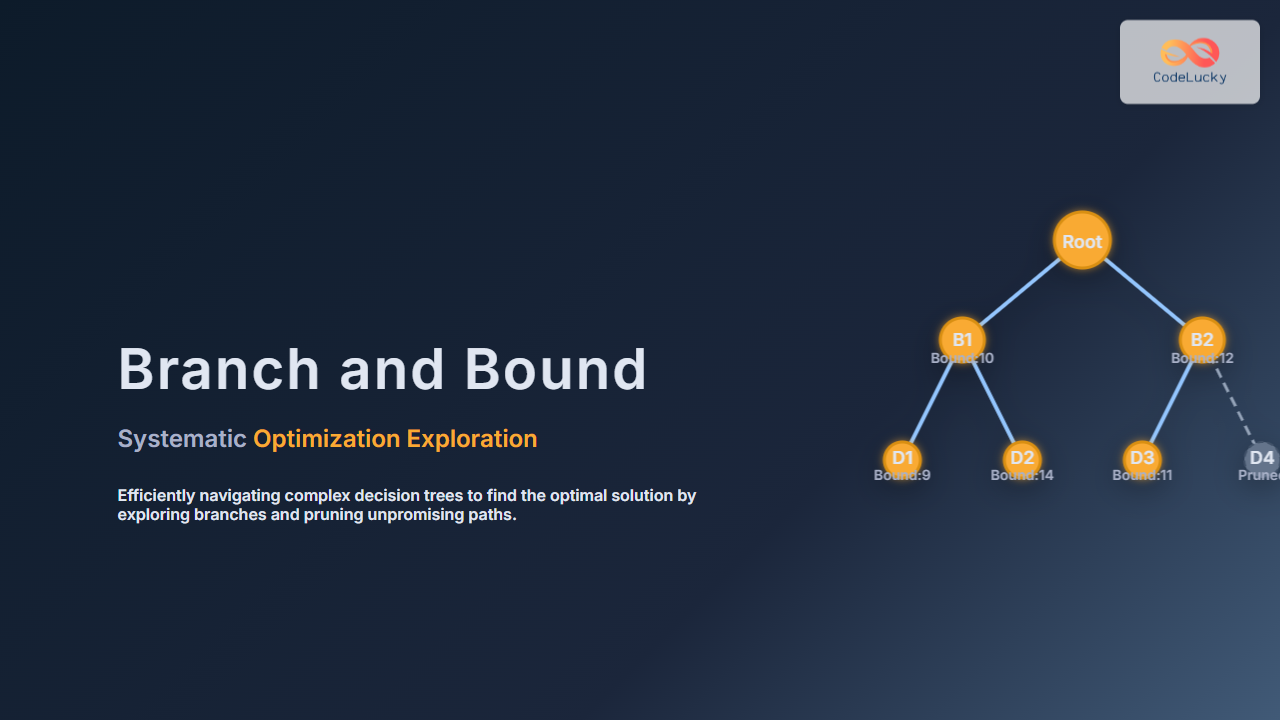
The Branch and Bound algorithm is a powerful and systematic method for solving optimization problems by intelligently exploring solution spaces. Particularly useful in combinatorial optimization, it prunes non-promising subproblems based on bounds, drastically reducing the search effort compared to exhaustive search methods.
This article dives deep into the concept, mechanism, and practical examples of Branch and Bound, enriched with mermaid diagrams for visual clarity and step-by-step interactive walkthroughs that enhance understanding. By the end, you will appreciate how this algorithm efficiently navigates complex decision trees to find global optima.

What is Branch and Bound Algorithm?
The Branch and Bound algorithm is an optimization technique that systematically enumerates candidate solutions by means of a tree structure. It branches the problem into smaller subproblems and uses bounds to prune subproblems that cannot yield better solutions than the current best.
This approach avoids exploring all solution permutations and uses two key ideas:
- Branching: Divide the problem into subproblems (smaller parts).
- Bounding: Calculate bounds (limits) on the best possible solution for a subproblem to discard it early if it’s not promising.
Key Components of Branch and Bound
- State Space Tree: Represents all possible solutions as nodes, branching into subproblems.
- Upper Bound: The best (lowest or highest) solution found so far.
- Lower Bound: Estimated minimum (or maximum) achievable cost in subproblems.
- Pruning: Eliminate subproblems with bounds worse than the current best solution.
- Search Strategy: Depth-first, breadth-first, or best-first exploration of the tree.
Example: Branch and Bound for the Traveling Salesman Problem (TSP)
The Traveling Salesman Problem asks: Given a list of cities and distances between each pair, what is the shortest possible route visiting each city exactly once and returning to the origin?
Here’s how Branch and Bound can solve this:
- Initial Step: Start with the root node representing the start city with an empty route.
- Branches: Create child nodes by choosing the next city to visit.
- Bounds: Calculate lower bound cost for partial routes using methods like reduced cost matrices.
- Prune: If a subtree’s lower bound exceeds the best known tour cost, prune it.
- Explore: Continue expanding and pruning until all promising routes are explored.

Step-by-step Walkthrough of a Simple TSP Instance
Consider 3 cities with distances:
| From \ To | City 1 | City 2 | City 3 |
|---|---|---|---|
| City 1 | 0 | 10 | 15 |
| City 2 | 10 | 0 | 20 |
| City 3 | 15 | 20 | 0 |
Using Branch and Bound:
- Start from City 1.
- Branch to City 2 (cost 10), then City 3 (cost 20), total route cost 30 + back to City 1 (15) = 45.
- Branch to City 3 (cost 15), then City 2 (cost 20), total 35 + back to City 1 (10) = 45.
- Prune any route where partial cost plus optimistic estimate exceeds current best (45).
Mermaid Diagram: Basic Branch and Bound Tree Traversal

Interactive Visualization Concept
Consider an interactive tree where nodes expand on click, showing partial routes and their bounds. Users can see pruning decisions and trace the best solution path dynamically. Due to environment limitations, here’s a conceptual HTML snippet snippet you might embed for interaction:
<div id="bnb-tree">
  <button onclick="expandNode('root')">Start Problem</button>
  <div id="root" style="display:none; margin-left:20px;">
    <button onclick="expandNode('A')">Choose City 2</button>
    <button onclick="expandNode('B')">Choose City 3</button>
  </div>
  <div id="A" style="display:none; margin-left:40px;">Go to City 3 next - Cost=30</div>
  <div id="B" style="display:none; margin-left:40px;">Go to City 2 next - Cost=35</div>
</div>
<script>
function expandNode(id) {
  const el = document.getElementById(id);
  if (el.style.display === 'none') el.style.display = 'block';
  else el.style.display = 'none';
}
</script>
Advantages and Limitations
- Advantages: Efficient pruning, guarantees optimal solution, widely applicable to combinatorial and integer problems.
- Limitations: May still face exponential time complexity in worst cases, careful bounding and heuristics needed for performance.
Variants and Enhancements
- Best-First Search: Explore branches with best promising bound first, often implemented with priority queues.
- Depth-First Search with Backtracking: Uses less memory and often finds good solutions early.
- Heuristics and Relaxations: Used to compute tighter bounds and improve pruning.
Common Applications
- Traveling Salesman Problem (TSP)
- Integer Linear Programming (ILP)
- Knapsack Problem
- Job Scheduling
- Graph Coloring
Summary
The Branch and Bound algorithm is an essential systematic approach for solving complex optimization problems by constructing a search tree, computing bounds to prune suboptimal paths, and thus reducing computational overhead significantly compared to brute-force methods. Its ability to combine branching strategies with effective bounding techniques makes it indispensable in various fields requiring exact optimization.
Understanding its core mechanism, practical applications, and how to visualize its search progression will empower developers and researchers to implement it effectively and optimize their combinatorial problem-solving tasks.