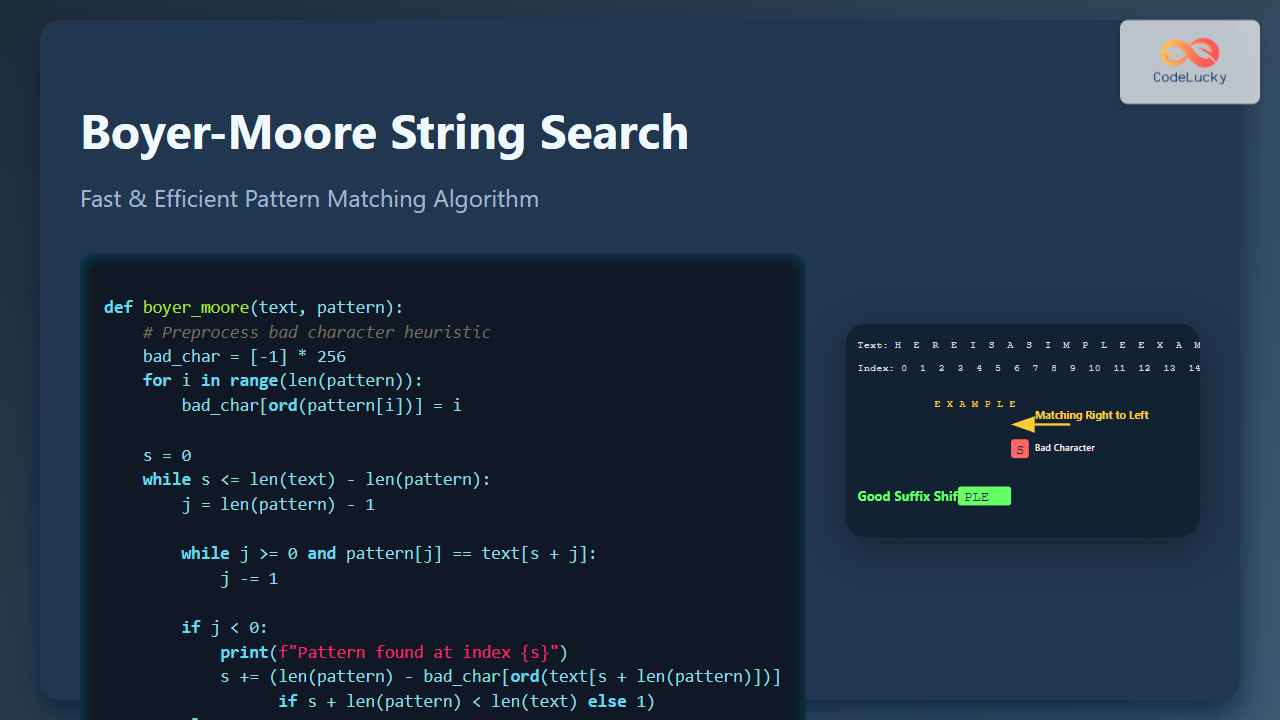
The Boyer-Moore string search algorithm is one of the most efficient and widely used algorithms for pattern matching in strings. It significantly reduces the number of character comparisons when searching for a substring (pattern) within a larger string (text). This article dives deep into the algorithm, its components, and how it achieves fast string matching, illustrated with clear examples and visual diagrams.
Introduction to Boyer-Moore String Search
Developed by Robert S. Boyer and J Strother Moore in 1977, the Boyer-Moore algorithm scans the pattern from right to left instead of left to right, unlike naive search techniques. This reversal helps it skip sections of text, making it faster, especially on large texts and complex patterns.
The algorithm is based on two main heuristics that allow skipping characters in the text:
- Bad Character Heuristic
- Good Suffix Heuristic
Core Concepts of Boyer-Moore Algorithm
Bad Character Heuristic
When a mismatch occurs, the “bad” character in the text is used to shift the pattern to the right, aligning the mismatched character with its last occurrence in the pattern. If the bad character is not found in the pattern, the pattern skips completely past the character.

Good Suffix Heuristic
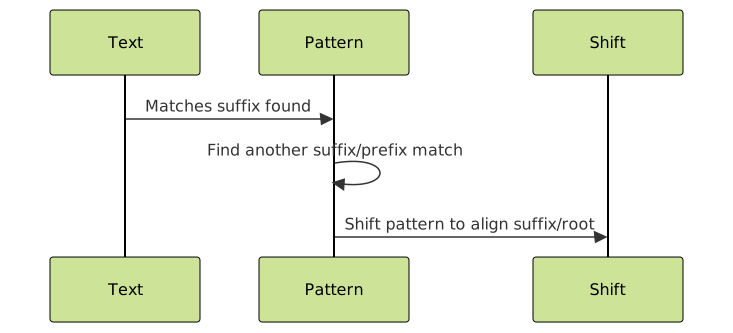
This heuristic handles cases where a substring (suffix) of the pattern matches the text, but a mismatch occurs before this suffix. The pattern shifts so that another occurrence of this suffix (or a matching prefix) in the pattern aligns with the text.
Algorithm Steps
- Align the pattern with the beginning of the text.
- Start matching characters from the rightmost end of the pattern going leftward.
- On mismatch, apply the bad character heuristic to shift the pattern.
- If the bad character heuristic doesn’t provide a suitable shift, apply the good suffix heuristic.
- Repeat until the pattern goes beyond the text length.
Detailed Example with Step-by-Step Search
Consider the text HERE IS A SIMPLE EXAMPLE and the pattern EXAMPLE.
Initial alignment:
HERE IS A SIMPLE EXAMPLE
              EXAMPLE
We compare from right to left of pattern “EXAMPLE”:
- The first mismatch is processed by the bad character heuristic, shifting pattern right to align next potential match.
- Character comparisons are reduced drastically compared to naive search.

Visualizing the Shifts
Below is a visualization of how the pattern shifts along the text during the search process:
Text:   H  E  R  E     I  S     A     S  I  M  P  L  E     E  X  A  M  P  L  E
Index:  0  1  2  3     4  5     6     7  8  9  10 11 12    13 14 15 16 17 18 19

Shift 1:
          E  X  A  M  P  L  E
          |  |  |  |  |  |  |    (Compare right to left)

Shift 2:
                 E  X  A  M  P  L  E

Shift 3:
                      E  X  A  M  P  L  E
Python Code Example
Here is a simplified Python implementation of Boyer-Moore to demonstrate its mechanics:
def boyer_moore(text, pattern):
    m = len(pattern)
    n = len(text)

    # Preprocessing bad character shift
    bad_char = [-1] * 256
    for i in range(m):
        bad_char[ord(pattern[i])] = i

    s = 0
    while s <= n - m:
        j = m - 1

        while j >= 0 and pattern[j] == text[s + j]:
            j -= 1

        if j < 0:
            print(f"Pattern found at index {s}")
            s += (m - bad_char[ord(text[s + m])] if s + m < n else 1)
        else:
            s += max(1, j - bad_char[ord(text[s + j])])

text = "HERE IS A SIMPLE EXAMPLE"
pattern = "EXAMPLE"
boyer_moore(text, pattern)
Advantages of Boyer-Moore Algorithm
- Usually faster than naive search for most practical inputs.
- Efficient for large texts and patterns due to its skip heuristics.
- Good suffix and bad character heuristics minimize unnecessary comparisons.
Limitations
- More complex to implement and understand compared to simple algorithms.
- Preprocessing cost can be high for very short patterns or when only few searches are done.
Conclusion
The Boyer-Moore string search algorithm is a powerful and efficient technique for pattern matching tasks in computing. Its unique approach of scanning from right to left combined with its heuristics dramatically reduces unnecessary comparisons, making it a preferred choice in many software systems and libraries.
Understanding Boyer-Moore helps deepen knowledge about string algorithms and optimization techniques that are essential in text processing, search engines, and bioinformatics.