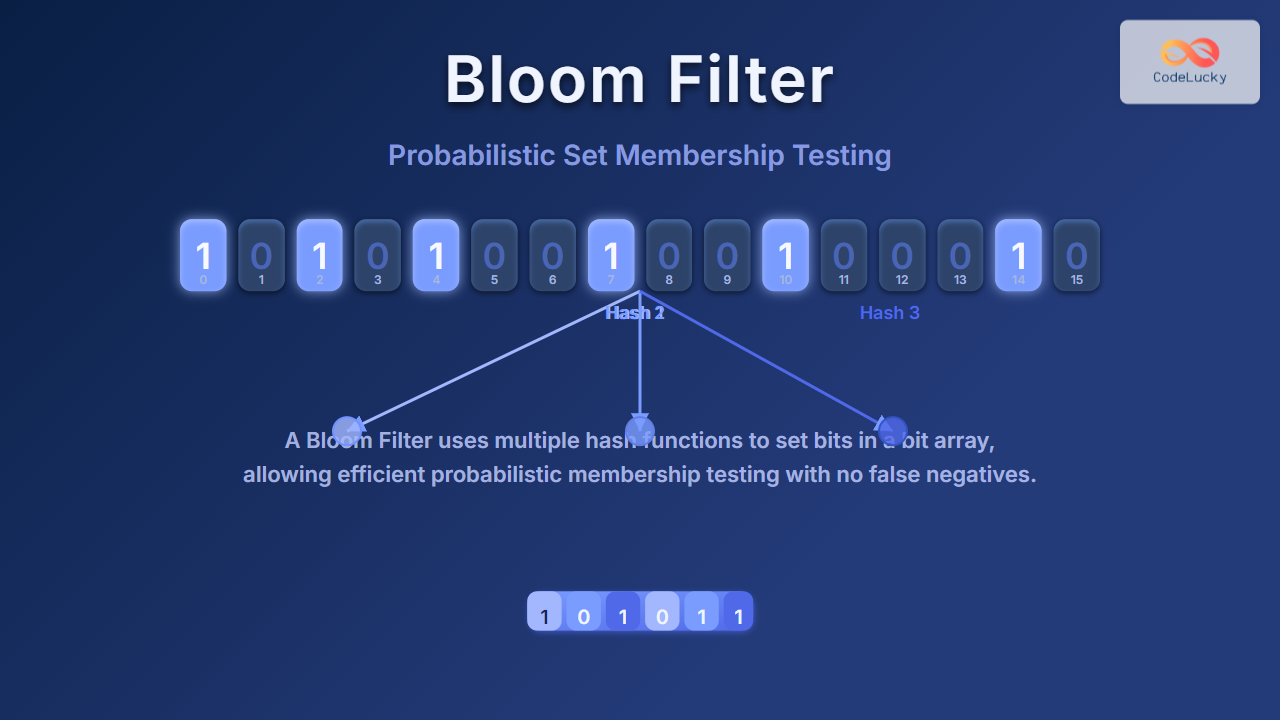
Bloom Filter is a powerful probabilistic data structure designed for set membership testing. It efficiently answers the question: Is this element possibly in the set? with a controlled chance of false positives but zero false negatives. It is widely used in databases, caches, network security, and distributed systems where memory efficiency and speed are critical.
What is a Bloom Filter?
A Bloom Filter is a space-efficient, probabilistic structure that can quickly test whether an element is definitely not in a set or possibly in the set. Conceptually, it is a bit array of m bits, initially all set to zero, coupled with k independent hash functions.
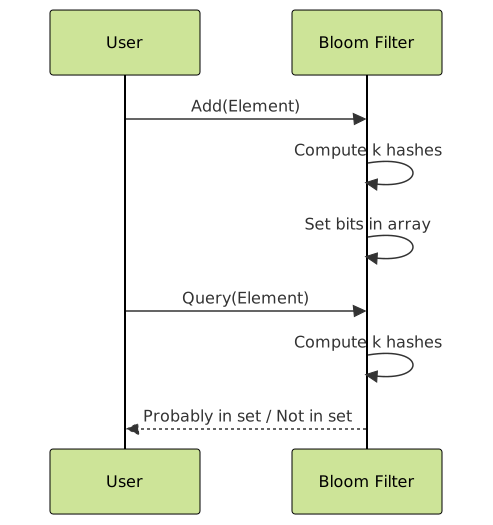
When an element is added, each of the k hash functions maps it to one of the m bit positions and sets those bits to 1. To check membership, the element is hashed with the same k hash functions, and the relevant bits are checked. If any bit is 0, the element is definitely not in the set. If all bits are 1, the element might be in the set — hence the probability of false positives.

Key Characteristics
- False positives: Can incorrectly report “present” for an element not in the set.
- No false negatives: If it says “not present,” the element is definitely not in the set.
- Space efficient: Requires much less memory than storing elements explicitly.
- Fast insertion and query: Time complexity is O(k), where k is the number of hash functions.
- Cannot delete elements: No direct removal of items unless using variants like Counting Bloom Filters.
How Does a Bloom Filter Work?
Suppose you want to add elements to a Bloom Filter:
- Start with a bit array of size m, all zeros.
- Choose k independent hash functions, each maps an input to a bit position.
- For each element to add, compute the k hashes, set bits at those indices to 1.
To check membership:
- Hash the element with the same k functions.
- If any bit at the hash indices is 0, return not present.
- If all bits at the hash indices are 1, return possibly present.
Example: Simple Bloom Filter in Action
Consider a Bloom Filter with m = 10 bits and k = 3 hash functions.
| Step | Action | Bit Array State (Indices 0 to 9) |
|---|---|---|
| 1 | Initialize | 0000000000 |
| 2 | Add “apple” hashed to bits 1, 4, 7 | 0 1 0 0 1 0 0 1 0 0 |
| 3 | Add “banana” hashed to bits 2, 4, 9 | 0 1 1 0 1 0 0 1 0 1 |
| 4 | Query “apple”: bits 1, 4, 7 all 1 → Possibly present | 0 1 1 0 1 0 0 1 0 1 |
| 5 | Query “grape”: bits 0, 1, 6, bits 0 or 6 = 0 → Definitely not present | 0 1 1 0 1 0 0 1 0 1 |
Visualizing Bloom Filter Operations
Probability of False Positives
The false positive rate depends on m (bit array size), k (hash functions), and n (number of inserted elements). The probability that a bit is still 0 after all insertions is approximately:
p = (1 – 1/m)^(k*n) ≈ e^(-k*n/m)
Thus, the probability of a false positive is:
f = (1 – p)^k ≈ (1 – e^(-k*n/m))^k
Tuning k for a fixed m and n minimizes false positive rate:
k = (m/n) * ln(2)
Use Cases of Bloom Filters
- Web caching: Quickly check if an item is cached without accessing slower storage.
- Databases: Speed up existence checks in large datasets.
- Network security: Detect spam or malicious IP quickly.
- Distributed systems: Avoid costly remote queries by approximate membership tests.
Interactive Example (JavaScript)
Below is a simplified interactive Bloom Filter implementation to try adding and querying elements in a 20-bit array using 3 hash functions.
00000000000000000000
Advantages and Limitations
| Advantages | Limitations |
|---|---|
|
|
Conclusion
Bloom Filters provide a unique balance between memory efficiency and query speed for set membership testing with a tolerable trade-off: false positives but no false negatives. Their mathematical foundation and wide applicability make them essential in modern computing scenarios involving large data sets and distributed systems.
Understanding how to implement and tune Bloom Filters can greatly optimize applications where space and performance are critical.