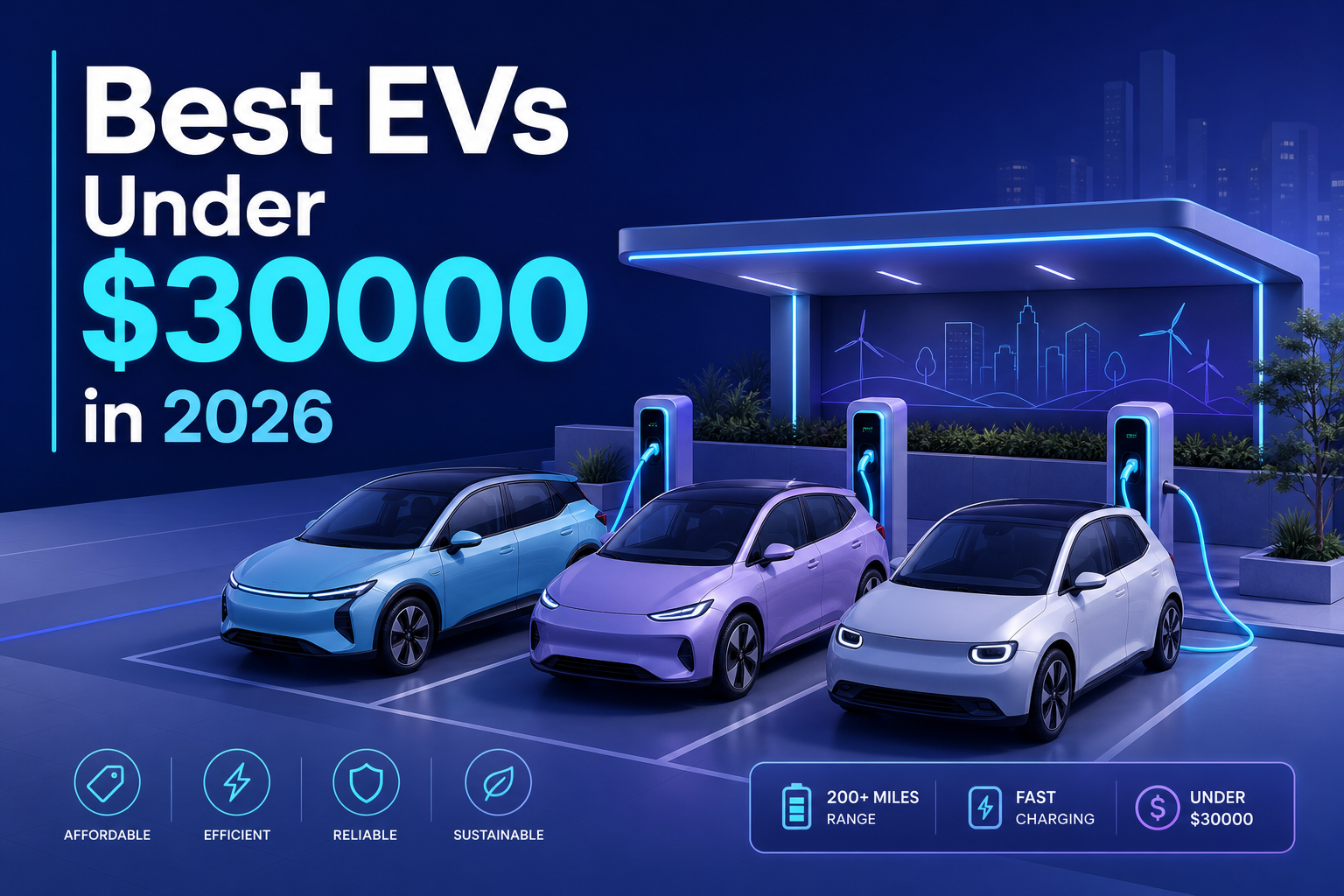
Five years ago, “affordable electric car” usually meant a stripped-down hatchback with a range so short you planned trips around charging stations. That math has flipped. In 2026, three very different automakers are racing to put a genuinely good EV in your driveway for less than the price of a mid-trim gas crossover.
If you have been waiting for the best electric vehicles under $30000 to finally arrive, this is the year the waiting pays off. The Tesla Model 2, the BYD Seagull, and the Rivian R3 each attack the budget segment from a different angle: software-first efficiency, ruthless cost engineering, and rugged adventure styling. This guide breaks down what you actually get for your money, where each one cuts corners, and how to choose without buyer’s remorse.
What Counts as an Affordable EV in 2026?
An affordable EV is a battery-electric vehicle with a starting MSRP at or below roughly $30,000 before incentives, offering enough usable range, charging speed, and safety equipment for daily commuting and occasional longer trips. The category excludes lease-only compliance cars and heavily optioned trims that quietly cross the price line.
That definition matters because sticker prices can be slippery. A headline figure of “$25,000” often refers to a base trim with the smaller battery, steel wheels, and no driver-assist package. Once you add the features most buyers actually want, the real-world price can climb $4,000 to $6,000. Throughout this comparison, you should mentally separate the advertised price from the as-you-want-it price.
Quick rule of thumb: budget the advertised base price plus 15-20% for the trim and options that turn a basic EV into a car you genuinely enjoy living with.
Tesla Model 2: The Software-First Commuter
The Tesla Model 2 is the company’s long-promised mass-market hatchback, built on a next-generation manufacturing platform designed to slash production cost. Its pitch is simple: take the Tesla software experience, supercharging network access, and efficiency leadership, then shrink the package to hit a sub-$30,000 price.
Where the Model 2 shines
Efficiency is the headline. Tesla’s drivetrains have consistently delivered more miles per kilowatt-hour than most rivals, which means a smaller, cheaper battery can still return competitive range. For you, that translates to lower running costs and faster charging sessions, because there are fewer kilowatt-hours to refill.
The second advantage is the charging network. Access to a dense, reliable fast-charging network removes the single biggest source of EV anxiety. Pair that with over-the-air updates that add features after purchase, and the Model 2 behaves more like a smartphone than a traditional car.
Where it asks for compromises
Tesla’s minimalist interior pushes nearly every control onto a central touchscreen. Some drivers love the clean look; others miss physical buttons for climate and wipers. Build quality has historically been variable, so inspecting panel gaps and paint on delivery is worth your time.
BYD Seagull: The Value Champion From China
If raw value is your priority, the BYD Seagull is the car that rewrote the rulebook. BYD builds its own batteries, motors, and even the semiconductors that control them, and that vertical integration shows up directly on the price tag. In several markets the Seagull undercuts every competitor on this list.
The Seagull uses BYD’s Blade battery, a lithium-iron-phosphate (LFP) design known for thermal stability and long cycle life. LFP chemistry trades a little energy density for durability and safety, which is a smart compromise in a budget commuter where you care more about a battery that lasts a decade than one that squeezes out maximum range. You can read more about how these cell chemistries differ on the lithium iron phosphate battery overview.
What you give up for the low price
The Seagull is a small city car. Interior space, highway refinement, and crash-test standards calibrated for other regions are the usual concerns when a model designed for one market is adapted for another. Availability is also uneven; depending on where you live, import tariffs and certification can push the price up or keep the car off your local lot entirely.
Rivian R3: Adventure Styling Goes Affordable
The Rivian R3 takes the brand’s outdoorsy, retro-futuristic design language and shrinks it into a compact crossover aimed at buyers who want personality without a luxury price. Where the Model 2 chases efficiency and the Seagull chases cost, the R3 chases desirability in the affordable segment.
Rivian’s strength is its software and hardware integration plus genuine off-pavement capability in its larger models. The R3 is expected to inherit a slimmed-down version of that engineering. For buyers who want an EV that looks distinctive and handles a dirt road to the trailhead, it occupies a niche the other two largely ignore.
The trade-off is price discipline. Adventure styling, larger wheels, and richer materials cost money, so the R3 is the most likely of the three to drift above $30,000 once you add the trims that make it special. Treat its base price as a starting point, not a final number.
Head-to-Head Comparison Table
The table below summarizes how the three contenders stack up across the factors that matter most when you shop the best electric vehicles under $30000. Figures reflect manufacturer targets and early reporting for the 2026 model year; always confirm final specs with the dealer before you buy.
| Factor | Tesla Model 2 | BYD Seagull | Rivian R3 |
|---|---|---|---|
| Body style | Compact hatchback | City hatchback | Compact crossover |
| Core strength | Efficiency & charging network | Lowest price | Styling & capability |
| Battery chemistry | LFP / NMC options | LFP Blade | LFP (expected) |
| Best for | Tech-focused commuters | Budget city drivers | Lifestyle & light off-road |
| Main compromise | Few physical controls | Size & availability | Price creep with options |
How to Choose the Right EV for Your Budget
The best electric vehicles under $30000 are not interchangeable. The right choice depends less on which car wins a spec sheet and more on how you actually drive. Work through these questions before you commit.
- Map your real range needs. Track your longest regular trip for two weeks. If your daily driving stays under 60 miles, even a smaller-battery trim will serve you with room to spare.
- Audit your charging. Home charging changes the entire ownership equation. If you can plug in overnight, a modest battery is plenty; if you rely on public chargers, prioritize fast-charging speed and network access.
- Calculate total cost, not sticker price. Factor in incentives, insurance, and electricity. A slightly pricier car with a cheaper-to-insure record can win over five years.
- Match the body to your life. A city hatchback is perfect for tight urban parking and painful on a road trip with three passengers and luggage.
A simple cost-per-mile calculation
EV running costs are easy to estimate once you know your local electricity rate and the car’s efficiency. Here is a small Python snippet you can adapt to compare any two cars.
# Estimate electricity cost per mile for an EV
# efficiency is in miles per kWh; rate is your cost per kWh in dollars

def cost_per_mile(efficiency_mi_per_kwh, electricity_rate):
    # Lower kWh used per mile means lower cost
    kwh_per_mile = 1 / efficiency_mi_per_kwh
    return kwh_per_mile * electricity_rate

# Example: a 4.0 mi/kWh EV at $0.15 per kWh
model2 = cost_per_mile(4.0, 0.15)   # efficient drivetrain
seagull = cost_per_mile(3.6, 0.15)  # small but slightly less efficient

print(f"Model 2: ${model2:.3f} per mile")
print(f"Seagull: ${seagull:.3f} per mile")
This function divides 1 by the car’s efficiency to find kilowatt-hours used per mile, then multiplies by your electricity rate. Swap in your own numbers and you will see how even a small efficiency gap compounds over 12,000 miles a year, often outweighing a few hundred dollars of difference at purchase.
Common Pitfalls When Buying a Budget EV
A low price hides a few traps. Avoid these mistakes and you will get far more car for your money.
- Chasing the headline price. The advertised figure is almost always the stripped base trim. Price the version you would actually drive.
- Ignoring charging speed. Two cars with identical range can charge at very different rates. A slow peak charging speed turns a road trip into a chore.
- Overlooking battery warranty. The battery is the most expensive component. Compare the years and mileage of coverage, and the guaranteed capacity retention.
- Forgetting depreciation. Brand reputation and resale demand vary widely. A cheaper car that loses value faster can cost more to own.
- Skipping the test drive. Cabin noise, seat comfort, and visibility never show up on a spec sheet but shape every commute.
For an independent reference on safety ratings before you sign anything, the NHTSA vehicle safety ratings database is a reliable place to verify crash performance.
Frequently Asked Questions
Are electric vehicles under $30000 worth buying in 2026?
Yes, for most commuters. Lower fuel and maintenance costs, combined with maturing battery technology, mean a sub-$30,000 EV can be cheaper to own over five years than a comparable gas car, especially if you charge at home and drive average mileage.
Which is the cheapest of the Model 2, Seagull, and R3?
The BYD Seagull is consistently the lowest-priced of the three thanks to BYD’s vertical integration. The Tesla Model 2 targets a competitive middle, while the Rivian R3 is the most likely to exceed $30,000 once you add desirable options.
How much range do I really need from a budget EV?
Most drivers cover under 40 miles a day. A real-world range of 150 to 200 miles comfortably handles daily commuting plus a buffer for errands and cold-weather efficiency loss. You only need more if you frequently drive long distances without charging access.
Is the BYD Seagull available everywhere?
No. Availability depends heavily on your region’s import rules, tariffs, and certification requirements. In some markets it is a runaway bestseller; in others it is unavailable or significantly more expensive than its home-market price.
Do these EVs qualify for tax incentives?
It varies by country, state, and the vehicle’s assembly location and battery sourcing. Incentive rules change often, so confirm current eligibility with an official government source before assuming a discount applies to your purchase.
What battery type lasts longest in an affordable EV?
LFP (lithium iron phosphate) batteries, used in the Seagull and many base trims, tolerate frequent full charging and typically offer excellent cycle life. They trade some energy density for durability, which is an ideal balance in a budget commuter you plan to keep for years.
Conclusion
The arrival of the Tesla Model 2, BYD Seagull, and Rivian R3 marks the moment the best electric vehicles under $30000 stopped being a compromise and started being a smart default. Each wins a different buyer: the Model 2 for efficiency and charging confidence, the Seagull for unbeatable value, and the R3 for character and capability.
Your job is to match the car to your actual driving rather than the loudest marketing claim. Map your range, audit your charging, calculate cost per mile, and price the trim you would really drive. Do that, and one of these affordable EVs will deliver years of low-cost, low-stress driving, proof that going electric no longer requires a premium budget.