In the realm of computer science, many problems are classified as NP-hard, meaning that finding an exact optimal solution efficiently is often impossible for large instances. Approximation algorithms offer a practical compromise — they deliver solutions close to optimal within a guaranteed bound, and run in polynomial time. This article dives deep into approximation algorithms, their significance, design principles, and examples of how they solve hard problems near-optimally.
What Are Approximation Algorithms?
Approximation algorithms are specialized algorithms designed for NP-hard optimization problems. Instead of aiming for the exact best solution, which may take exponential time, they provide mathematically bounded near-optimal solutions much faster. The key idea is to guarantee a solution within a specific factor of the optimum value.
For a minimization problem, an approximation algorithm with ratio ρ ensures:
\[ \text{Algorithm Solution} \leq ρ \times \text{Optimal Solution} \]
For maximization problems, the inequality direction flips accordingly.
Why Use Approximation Algorithms?
- Scalability: Enables handling very large problem sizes where exact methods are infeasible.
- Bounded performance: Users can predict how far off the solution might be, giving reliability.
- Practicality: Vital in fields like scheduling, network design, resource allocation, where near-optimal is good enough.
Classic Examples of Approximation Algorithms
1. Vertex Cover Problem
The vertex cover problem asks to select the minimum number of vertices in a graph such that every edge has at least one endpoint selected. Finding the minimum vertex cover is NP-hard.
The popular 2-approximation algorithm works as:

This greedy approach ensures the cover size is at most twice the optimal, because every chosen edge leads to adding two vertices, whereas the optimal must cover it with at least one.
2. The Traveling Salesman Problem (TSP) — Metric Case
For metric TSP (where edge weights satisfy the triangle inequality), the Christofides’ algorithm finds a tour at most 1.5 times the length of an optimal tour.
This method cleverly marries MST and matching to guarantee a good approximation for this notoriously hard problem.
Design Techniques Used in Approximation Algorithms
- Greedy algorithms: Build solutions incrementally picking the best immediate choice (e.g., vertex cover).
- Local search: Start with a feasible solution and try local improvements iteratively.
- Primal-dual method: Simultaneously build primal and dual solutions to guarantee performance bounds.
- Linear programming relaxation: Relax integer constraints to solve a linear program efficiently, then round fractional solutions.
Interactive Example: Approximation of the Vertex Cover
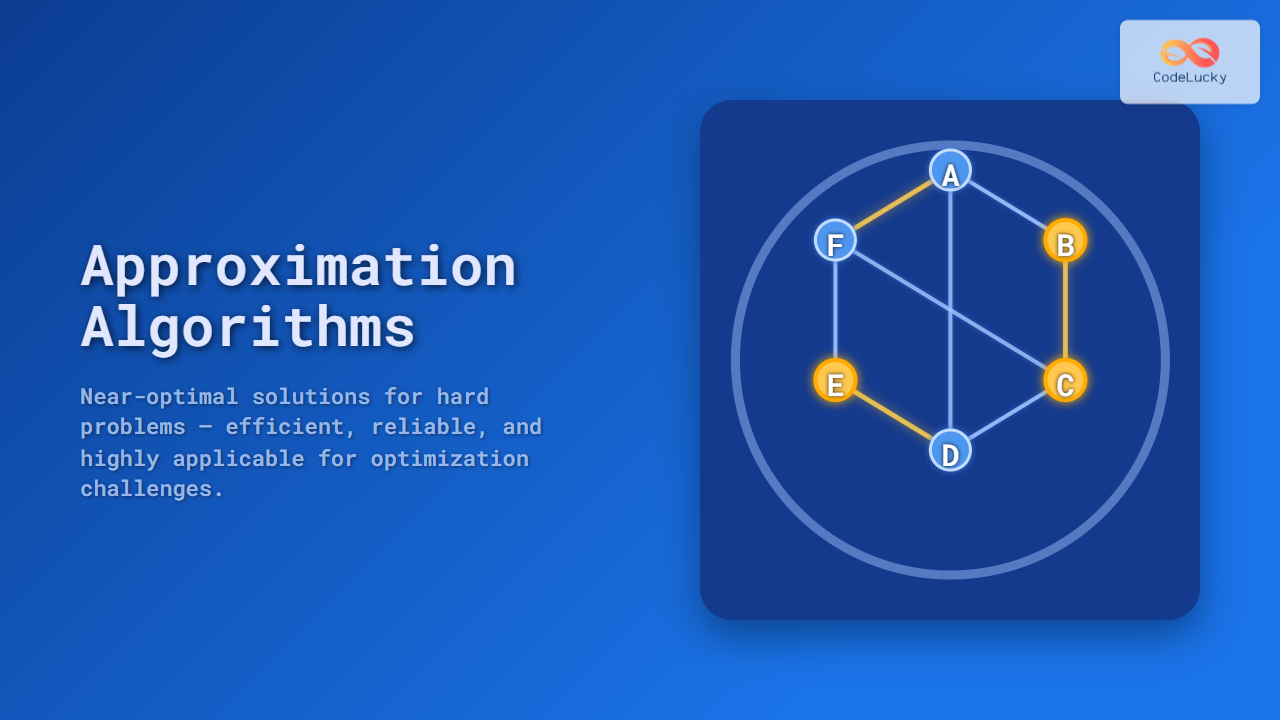
Here is a simple illustration of how the 2-approximation vertex cover algorithm selects vertices:
Challenges and Limitations
- Approximation ratios vary widely; some problems have no known good approximations.
- Guarantees depend on problem properties like metric constraints or problem structure.
- May still produce solutions far from optimal for certain inputs.
Conclusion
Approximation algorithms form a cornerstone technique in tackling NP-hard problems by trading off exactness for efficiency and bounded performance. They empower practical solutions in computationally complex domains and continue to be a rich research area for algorithm designers. Understanding these algorithms, their principles, and examples prepares programmers and computer scientists to better approach difficult optimization challenges in real-world scenarios.