Apostrophes are among the most frequently misused punctuation marks in English. While small, they carry heavy meaning—indicating ownership or possession in writing. Whether you’re crafting a blog post, business email, or academic essay, mastering apostrophe rules ensures your writing looks professional and polished.
Why Apostrophes Matter
The apostrophe clarifies who or what owns something. A single misplaced mark can completely change meaning:
Incorrect: The teachers lounge is over there.
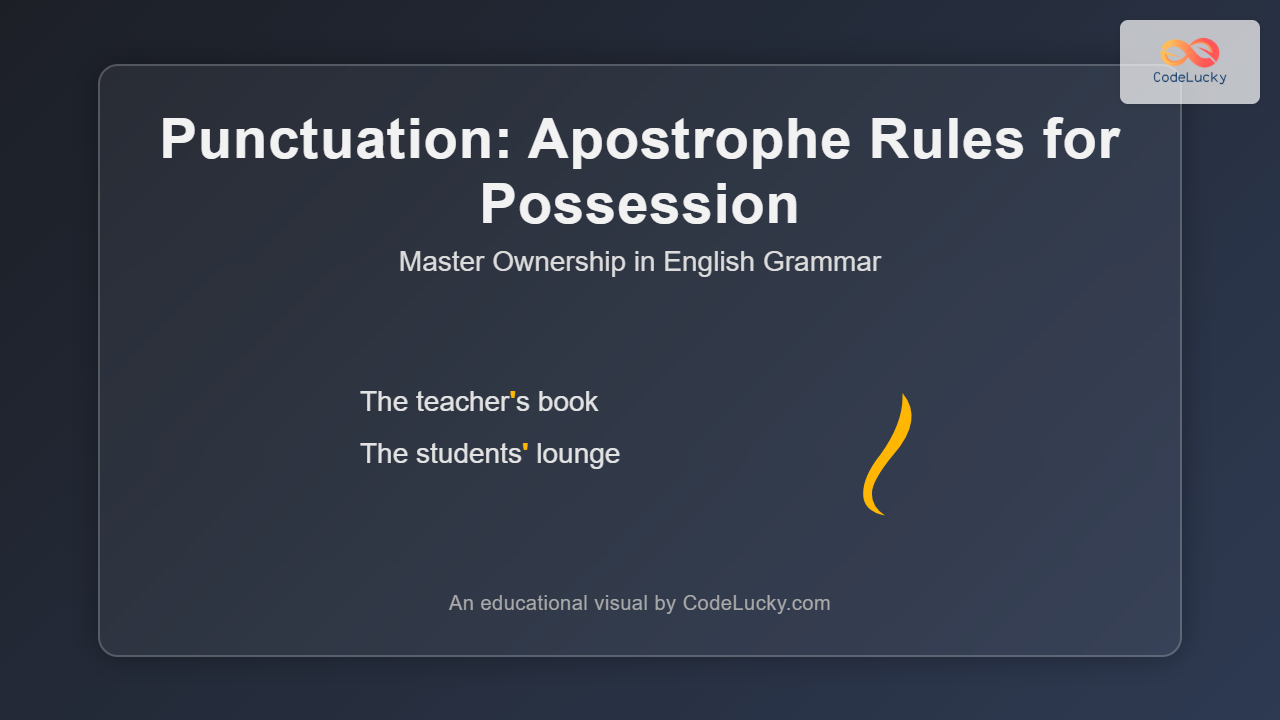
Correct: The teacher's lounge is over there. (belongs to one teacher)
Correct: The teachers' lounge is over there. (belongs to multiple teachers)
As you can see, apostrophe placement determines ownership. Let’s explore every scenario step by step.
1. Singular Possession
Use an apostrophe followed by s ('s) when showing possession for a singular noun, even if the noun ends in “s”.
John's car is parked outside.
The boss's office is on the top floor.
The cat's tail is fluffy.
In modern English, adding 's to singular nouns ending in s (like boss or James) is accepted and clearer to read.

2. Plural Possession
If the plural noun already ends with “s”, simply add an apostrophe (') after it. If the plural noun doesn’t end in “s”, add 's.
The dogs' collars are new.   (dogs = plural)
The children's toys are broken.  (children = irregular plural)
The women's restroom is on the left.
Many learners confuse this rule, so remember: location of the apostrophe depends on whether the plural ends with “s”.

3. Joint vs. Separate Possession
When two people or things share ownership, use 's only after the second noun. But if they own things separately, add 's to each.
Joint: Tom and Jerry's apartment (they share one apartment)
Separate: Tom's and Jerry's apartments (they have their own apartments)
4. Possessive Pronouns Never Take Apostrophes
This is a common trap. Pronouns that already show possession—like its, yours, hers, ours, theirs—never take apostrophes.
Incorrect: The cat lost it's toy.
Correct: The cat lost its toy.
An apostrophe in pronouns usually signals a contraction, not possession:
It’s = It is / It has
5. Apostrophes with Compound Nouns
When using compound nouns like mother-in-law or editor-in-chief, place the apostrophe on the main noun (the one showing ownership).
My mother-in-law's recipe is famous.
The editor-in-chief's decision was final.
The apostrophe helps locate ownership inside complex noun structures.
6. Descriptive vs. Possessive Forms
Sometimes nouns describe rather than possess. Do not use apostrophes for descriptive phrases like:
a teachers college (a college for teachers, not owned by them)
a writers conference (a conference for writers)
Ask yourself—does the first noun own the second? If not, skip the apostrophe.

7. Apostrophes with Names Ending in S
Both styles are accepted in modern English, but consistency is key:
- Add ’s: Chris’s bike, James’s guitar (preferred in American English)
- Only add ’: Chris’ bike, James’ guitar (used in journalism or British English)
Pick one method and apply it consistently across your writing.
8. Decades, Abbreviations, and Time Expressions
Be cautious using apostrophes for plurals of numbers or letters. Apostrophes show possession, not pluralization—unless clarity demands it.
Correct: CDs, 1990s, VIPs
Acceptable (rare): Mind your p’s and q’s.
9. Interactive Check: Find the Correct Form
Try this quick exercise: choose the sentence with correct apostrophe use.
- The dogs bone is missing. ✅ or ❌
- The dog’s bone is missing. ✅
- The dogs’ bone is missing. ❌ (unless multiple dogs share one bone)
When in doubt, ask: “Who owns what?” That simple question reveals the correct structure.
Key Takeaways
- Use
'sfor singular possession. - Use
s'for plural nouns ending withs. - Never use apostrophes in possessive pronouns.
- Place the apostrophe on the owner, not the object.
- Stay consistent with naming style (Chris’s vs Chris’).
Summary Table: Apostrophes for Possession
| Ownership Type | Correct Form | Example |
|---|---|---|
| Singular | ‘s | The cat’s whiskers |
| Plural ending in s | s’ | The students’ books |
| Irregular plural | ‘s | The children’s playground |
| Joint Ownership | Second noun gets ‘s | Jack and Jill’s project |
| Separate Ownership | Each name gets ‘s | Jack’s and Jill’s cars |
Final Thoughts
Mastering apostrophe usage for possession strengthens clarity and professionalism in writing. This single punctuation mark distinguishes readable prose from confusing text. Keep these rules handy, and soon they’ll become second nature in your daily writing.
Now that you’ve mastered apostrophes for possession, check out the next lesson in our English Learning Series — “Punctuation: Apostrophes in Contractions.”