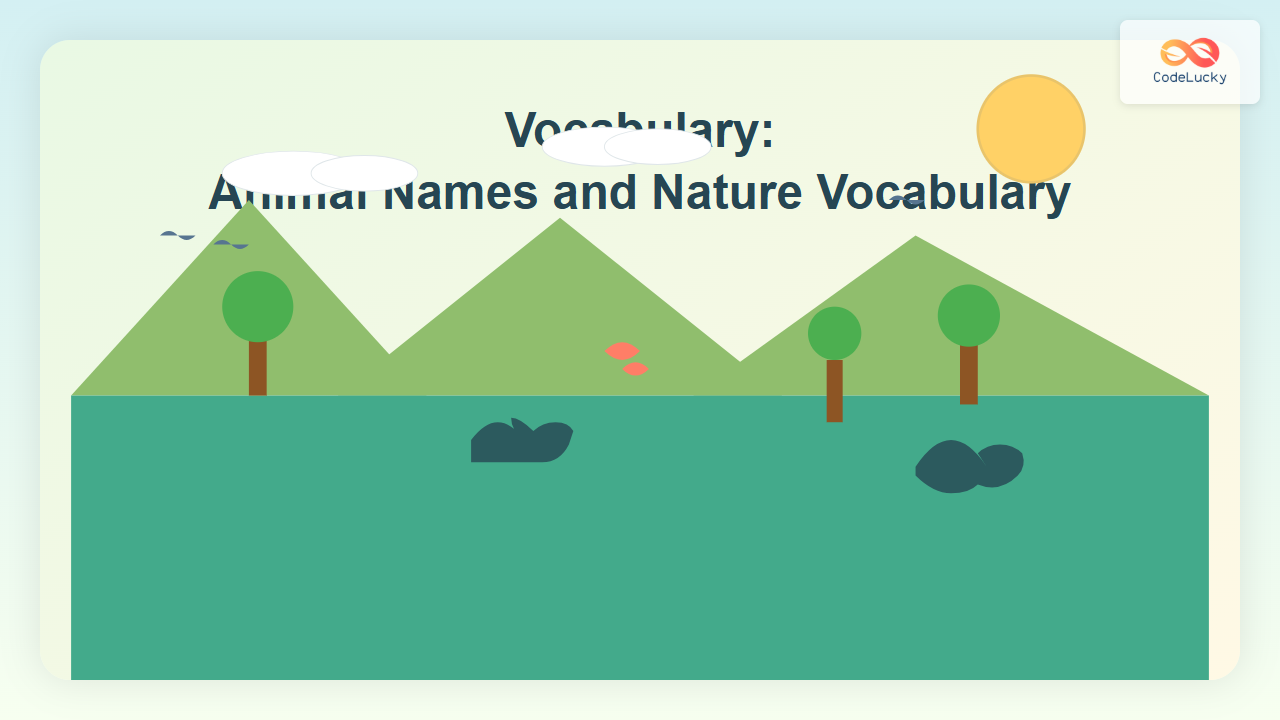
Understanding animal names and nature vocabulary forms a crucial foundation for English language learners. This comprehensive guide explores the rich terminology used to describe wildlife, habitats, and natural environments, enabling you to communicate effectively about the natural world.
Understanding Animal Classification
Animals are categorized into different groups based on their characteristics, habitats, and behaviors. Learning these classifications helps organize vocabulary and makes memorization more effective.

Mammals
Mammals are warm-blooded animals that typically have fur or hair and feed their young with milk. This category includes some of the most familiar animals in English vocabulary.
Common Domestic Mammals
- Dog – The loyal companion often called “man’s best friend”
- Cat – Independent household pet known for hunting mice
- Horse – Large animal used for riding and farm work
- Cow – Farm animal that provides milk and beef
- Pig – Farm animal raised for pork products
- Sheep – Woolly farm animal kept for wool and meat
- Goat – Sure-footed animal known for climbing and producing milk
Example Sentences:
- The dog barked loudly when strangers approached the house.
- Farmers raise cows for dairy production and meat.
- The children rode horses along the mountain trail.
Wild Mammals
- Lion – “King of the jungle,” large carnivorous cat
- Tiger – Striped big cat, largest of all cat species
- Elephant – Largest land animal with a trunk and tusks
- Bear – Large omnivore found in forests and mountains
- Wolf – Wild canine that hunts in packs
- Fox – Cunning, small wild canine with a bushy tail
- Deer – Graceful animal with antlers (males)
- Monkey – Primate known for intelligence and agility
- Gorilla – Largest primate, powerful but gentle
- Giraffe – Tallest animal with a long neck
- Zebra – Horse-like animal with black and white stripes
- Rhinoceros – Large animal with one or two horns
- Hippopotamus – Large semi-aquatic mammal
Example Sentences:
- The elephant used its trunk to spray water on its back.
- A pack of wolves howled at the full moon.
- The giraffe’s long neck helps it reach leaves high in trees.
Birds
Birds are feathered, winged animals that typically fly, though some species are flightless. They lay eggs and have beaks instead of teeth.
Common Birds
- Eagle – Large bird of prey with excellent vision
- Hawk – Medium-sized bird of prey
- Owl – Nocturnal bird known for wisdom symbolism
- Sparrow – Small, common urban bird
- Crow – Intelligent black bird
- Parrot – Colorful bird that can mimic speech
- Peacock – Bird famous for its colorful tail feathers
- Duck – Waterbird with webbed feet
- Swan – Graceful white waterbird
- Chicken – Common farm bird raised for eggs and meat
- Penguin – Flightless bird that swims, found in cold climates
- Flamingo – Pink wading bird with long legs
Example Sentences:
- The eagle soared high above the mountains searching for prey.
- Children fed breadcrumbs to the ducks at the pond.
- The parrot repeated everything its owner said.
Reptiles and Amphibians
Reptiles are cold-blooded animals with scales, while amphibians can live both in water and on land.
Reptiles
- Snake – Legless reptile, some species are venomous
- Lizard – Small to medium reptile with four legs
- Crocodile – Large aquatic reptile with powerful jaws
- Alligator – Similar to crocodile but with broader snout
- Turtle – Reptile with protective shell
- Tortoise – Land-dwelling turtle
- Chameleon – Lizard that changes color
Amphibians
- Frog – Jumping amphibian, often green
- Toad – Similar to frog but with dry, bumpy skin
- Salamander – Lizard-like amphibian
Example Sentences:
- The snake slithered silently through the grass.
- A frog leaped from the lily pad into the water.
- The turtle retreated into its shell when threatened.
Aquatic Animals
These animals live primarily in water, including oceans, rivers, and lakes.
Fish and Marine Animals
- Shark – Large predatory fish
- Whale – Largest marine mammal
- Dolphin – Intelligent marine mammal
- Octopus – Eight-armed sea creature
- Jellyfish – Transparent sea creature with stinging tentacles
- Starfish – Star-shaped sea creature
- Crab – Crustacean with claws and hard shell
- Lobster – Large marine crustacean
- Seal – Marine mammal with flippers
- Salmon – Fish that swims upstream to spawn
- Goldfish – Small ornamental fish
Example Sentences:
- The dolphin performed tricks for the delighted audience.
- Scientists study whale migration patterns across oceans.
- The octopus used its tentacles to open the jar.
Insects and Small Creatures
Insects are the most diverse group of animals, with millions of species worldwide.
- Butterfly – Colorful flying insect with large wings
- Bee – Flying insect that produces honey
- Ant – Small social insect living in colonies
- Spider – Eight-legged creature that spins webs
- Mosquito – Small flying insect that bites
- Fly – Common winged insect
- Beetle– Insect with hard wing covers
- Grasshopper – Jumping insect found in fields
- Dragonfly – Large flying insect with transparent wings
- Ladybug – Small red beetle with black spots
- Caterpillar – Larval stage of butterfly or moth
- Worm – Long, soft-bodied invertebrate
- Snail – Slow-moving creature with spiral shell
Example Sentences:
- A colorful butterfly landed gently on the flower.
- The ants worked together to carry food to their nest.
- Bees collect nectar from flowers to make honey.
Animal Habitats and Environments

Forest and Woodland Vocabulary
- Forest – Large area densely covered with trees
- Jungle – Dense tropical forest
- Woods – Smaller forested area
- Grove – Small group of trees
- Canopy – Upper layer of forest formed by tree crowns
- Undergrowth – Dense vegetation beneath trees
- Clearing – Open space in a forest
- Trail – Path through woodland
Example Sentences:
- The dense jungle is home to thousands of species.
- Sunlight filtered through the forest canopy onto the ground below.
- We followed a narrow trail deep into the woods.
Water Bodies and Marine Environments
- Ocean – Vast body of salt water
- Sea – Large body of salt water, smaller than ocean
- Lake – Large body of fresh water surrounded by land
- River – Flowing body of fresh water
- Stream – Small flowing body of water
- Pond – Small body of still water
- Swamp – Wetland with trees and standing water
- Marsh – Wetland with grasses and reeds
- Coral reef – Underwater ecosystem formed by coral
- Shore – Land along the edge of water
- Beach – Sandy or pebbly shore
- Coast – Land along the ocean
Example Sentences:
- The river flows from the mountains to the sea.
- Colorful fish inhabit the coral reef.
- Children built sandcastles on the beach.
Mountains and Hills
- Mountain – Large natural elevation of earth’s surface
- Hill – Smaller elevated landform
- Peak – Top of a mountain
- Summit – Highest point of a mountain
- Valley – Low area between mountains
- Cliff – Steep rock face
- Canyon – Deep valley with steep sides
- Cave – Natural underground hollow
- Slope – Inclined surface of mountain
Example Sentences:
- Climbers reached the mountain summit at sunrise.
- A small village nestled in the valley between two mountains.
- Water carved the deep canyon over millions of years.
Plains and Grasslands
- Plain – Large flat area of land
- Prairie – Grassland with few trees (North America)
- Savanna – Tropical grassland with scattered trees
- Meadow – Grassy field
- Field – Open land area
- Pasture – Grassland for grazing animals
Example Sentences:
- Buffalo once roamed freely across the prairie.
- Lions hunt zebras on the African savanna.
- Wildflowers bloomed in the spring meadow.
Desert Environments
- Desert – Dry, barren area with little rainfall
- Dune – Hill of sand shaped by wind
- Oasis – Fertile spot in desert with water
- Cactus – Desert plant adapted to dry conditions
Example Sentences:
- The desert receives less than 10 inches of rain yearly.
- Travelers found relief at the oasis after crossing the desert.
- Sand dunes shifted with the desert winds.
Natural Elements and Weather Vocabulary
Weather Phenomena
- Rain – Water falling from clouds
- Snow – Frozen precipitation
- Hail – Balls of ice falling from sky
- Wind – Moving air
- Storm – Violent weather disturbance
- Thunder – Sound from lightning
- Lightning – Electric discharge in atmosphere
- Fog – Thick cloud at ground level
- Mist – Light fog
- Dew – Water droplets on surfaces in morning
- Frost – Ice crystals formed on cold surfaces
- Rainbow – Arc of colors after rain
Example Sentences:
- Heavy rain poured down throughout the night.
- A beautiful rainbow appeared after the storm passed.
- Morning dew glistened on the grass.
Natural Phenomena
- Sunrise – Sun appearing in morning
- Sunset – Sun disappearing in evening
- Dawn – First light of day
- Dusk – Time between sunset and night
- Eclipse – Blocking of sun or moon
- Aurora – Natural light display in polar regions
- Tide – Rising and falling of sea level
- Wave – Moving ridge of water
Example Sentences:
- We watched the breathtaking sunset from the hilltop.
- Large waves crashed against the rocky shore.
- The total solar eclipse darkened the sky temporarily.
Trees and Plants
Types of Trees
- Oak – Large hardwood tree with acorns
- Pine – Evergreen conifer with needles
- Maple – Tree known for colorful autumn leaves
- Willow – Tree with drooping branches
- Palm – Tropical tree with large leaves
- Birch – Tree with white bark
- Cedar – Aromatic evergreen tree
- Redwood – Tall evergreen tree
Plant Parts and Features
- Root – Underground plant part
- Stem – Main stalk of plant
- Branch – Division of tree trunk
- Leaf – Flat green plant part
- Flower – Reproductive part of plant
- Petal – Colored part of flower
- Seed – Plant embryo
- Fruit – Seed-bearing part
- Bark – Outer covering of tree trunk
- Thorn – Sharp pointed growth
Example Sentences:
- The ancient oak tree provided shade for centuries.
- Colorful petals fell from the cherry blossoms.
- Strong roots anchor the tree firmly in the ground.
Flowers and Gardens
- Rose – Popular flowering plant with thorns
- Tulip – Spring bulb flower
- Sunflower – Tall flower that faces the sun
- Daisy – Simple white-petaled flower
- Lily – Elegant trumpet-shaped flower
- Orchid – Exotic tropical flower
- Lavender – Purple aromatic flower
- Jasmine – Fragrant white flower
Example Sentences:
- Red roses symbolize love and romance.
- Tall sunflowers grew along the garden fence.
- The lavender field filled the air with pleasant fragrance.
Animal Behaviors and Actions
Movement Verbs for Animals
- Fly – Birds and insects move through air
- Swim – Fish and aquatic animals move in water
- Crawl – Snakes and insects move on belly
- Slither – Snake’s sliding movement
- Hop – Rabbit and frog jumping movement
- Gallop – Horse’s fast running gait
- Prowl – Cat’s stealthy movement
- Waddle – Duck’s side-to-side walk
- Scurry – Mouse’s quick running
- Soar – Bird’s gliding flight
- Pounce – Cat’s sudden jump on prey
- Migrate – Seasonal movement to different regions
Example Sentences:
- Eagles soar high above the mountains on thermal currents.
- The rabbit hopped quickly across the lawn.
- Salmon migrate upstream to spawn every year.
Animal Sounds
- Bark – Dog’s sound
- Meow – Cat’s sound
- Roar – Lion’s sound
- Howl – Wolf’s sound
- Chirp – Bird’s short sound
- Tweet – Small bird’s sound
- Hoot – Owl’s sound
- Buzz – Bee’s sound
- Hiss – Snake’s sound
- Croak – Frog’s sound
- Neigh – Horse’s sound
- Moo – Cow’s sound
- Quack – Duck’s sound
Example Sentences:
- The lion roared loudly to mark its territory.
- Frogs croaked throughout the night near the pond.
- Birds chirped cheerfully at dawn.
Animal Groups and Collective Nouns

English uses specific collective nouns for different animal groups. Learning these terms enriches your vocabulary and makes descriptions more precise.
Common Collective Nouns
- Flock – Group of birds or sheep
- Herd – Group of cattle, elephants, or deer
- Pack – Group of wolves or dogs
- Pride – Group of lions
- School – Group of fish
- Pod – Group of whales or dolphins
- Swarm – Group of insects
- Colony – Group of ants or bees
- Gaggle – Group of geese on ground
- Troop – Group of monkeys
- Litter – Group of puppies or kittens born together
Example Sentences:
- A flock of birds flew south for the winter.
- The pride of lions rested under the acacia tree.
- A school of fish swam past the coral reef.
Nature Conservation Vocabulary
Environmental Terms
- Ecosystem – Community of living organisms and environment
- Habitat – Natural home of an animal or plant
- Biodiversity – Variety of life in an area
- Species – Group of similar organisms
- Endangered – At risk of extinction
- Extinct – No longer existing
- Conservation – Protection of nature
- Wildlife – Animals living in natural conditions
- Pollution – Contamination of environment
- Deforestation – Clearing of forests
- Climate – Long-term weather patterns
Example Sentences:
- Scientists work to protect endangered species from extinction.
- The rainforest ecosystem supports incredible biodiversity.
- Conservation efforts help preserve natural habitats.
Descriptive Adjectives for Nature
Describing Animals
- Wild – Living in natural state
- Domestic – Tamed and kept by humans
- Fierce – Aggressive and violent
- Gentle – Mild and kind
- Nocturnal – Active at night
- Diurnal – Active during day
- Carnivorous – Meat-eating
- Herbivorous – Plant-eating
- Omnivorous – Eating both plants and meat
- Agile – Moving quickly and easily
- Graceful – Moving elegantly
Describing Natural Environments
- Dense – Thick and crowded
- Lush – Rich and abundant vegetation
- Barren – Unable to support life
- Pristine – Unspoiled and pure
- Rugged – Rough and uneven
- Serene – Calm and peaceful
- Remote – Far from civilization
- Verdant – Green with vegetation
Example Sentences:
- Owls are nocturnal hunters with excellent night vision.
- The lush rainforest teemed with life.
- Mountain goats navigate rugged terrain with ease.
Practical Usage in Context
Describing a Forest Scene
“The dense forest stretched endlessly before us. Tall oak and pine trees formed a thick canopy overhead, filtering the sunlight into dancing patterns on the forest floor. Birds chirped melodiously from the branches while squirrels scurried up tree trunks. In a small clearing, a deer cautiously approached a stream, its ears alert for any danger. The undergrowth rustled as smaller creatures moved through the fallen leaves.”
Describing an Ocean Environment
“The vast ocean sparkled under the bright sun. Waves crashed rhythmically against the sandy beach, leaving behind white foam. A pod of dolphins leaped gracefully through the water, their sleek bodies glistening. Seagulls circled overhead, calling out to each other. Beneath the surface, colorful fish darted among the coral reefs while a sea turtle glided slowly past.”
Describing a Savanna
“The African savanna stretched to the horizon, golden grasslands dotted with acacia trees. A herd of elephants moved slowly across the plain, their trunks swaying. Nearby, a pride of lions rested in the shade, conserving energy for the evening hunt. Zebras grazed peacefully while giraffes used their long necks to reach the highest leaves.”
Idioms and Expressions with Animals
English uses many animal-related idioms in everyday conversation. Understanding these expressions enhances language fluency.
- As busy as a bee – Very busy and hardworking
- Let the cat out of the bag – Reveal a secret
- Raining cats and dogs – Heavy rain
- A fish out of water – Uncomfortable in surroundings
- Hold your horses – Wait patiently
- The early bird catches the worm – Success comes to those who act early
- Kill two birds with one stone – Accomplish two things at once
- A wolf in sheep’s clothing – Dangerous person pretending to be harmless
- Elephant in the room – Obvious problem everyone ignores
- Crocodile tears – Fake sadness
Example Sentences:
- She’s been as busy as a bee preparing for the wedding.
- By starting early, we can kill two birds with one stone.
- Don’t trust him—he’s a wolf in sheep’s clothing.
Baby Animal Names
Many animals have unique names for their young. Learning these terms adds precision to your vocabulary.
- Cub – Baby bear, lion, or tiger
- Puppy – Baby dog
- Kitten – Baby cat
- Calf – Baby cow, elephant, or whale
- Foal – Baby horse
- Lamb – Baby sheep
- Kid – Baby goat
- Chick – Baby bird
- Duckling – Baby duck
- Fawn – Baby deer
- Joey – Baby kangaroo
- Tadpole – Baby frog (larval stage)
Example Sentences:
- The lioness protected her cubs fiercely.
- A tiny yellow duckling waddled behind its mother.
- The elephant calf stayed close to the herd.
Practice Exercises
Exercise 1: Match Animals to Habitats
Match each animal with its typical habitat:
- Penguin – Ocean/Ice
- Camel – Desert
- Monkey – Jungle
- Salmon – River
- Eagle – Mountain
- Lion – Savanna
Exercise 2: Fill in the Blank
Complete these sentences with appropriate animal vocabulary:
- A group of fish swimming together is called a _____. (school)
- Animals that eat only plants are called _____. (herbivores)
- The _____ is known as the king of the jungle. (lion)
- Birds use their _____ to catch and eat food. (beak)
- A baby dog is called a _____. (puppy)
Exercise 3: Identify the Sound
Match the animal to its sound:
- Dog – Bark
- Lion – Roar
- Bee – Buzz
- Owl – Hoot
- Frog – Croak
Tips for Learning Animal and Nature Vocabulary
Visual Learning
Associate words with pictures or real-life observations. When you see an animal or natural feature, practice naming it in English. Create flashcards with images on one side and English names on the other.
Categorization
Group related words together by habitat, classification, or characteristics. This makes memorization more efficient and helps build connections between words.
Contextual Practice
Use new vocabulary in complete sentences and stories rather than memorizing isolated words. Describe scenes from nature documentaries or write about visits to parks or zoos.
Regular Exposure
Watch nature documentaries in English, read wildlife articles, or follow nature photography accounts. Regular exposure reinforces learning and introduces words in context.
Active Usage
Practice speaking about nature and animals in conversations. Describe your surroundings, discuss environmental topics, or share observations about wildlife.
Conclusion
Mastering animal names and nature vocabulary significantly expands English communication abilities. From describing simple observations to discussing complex environmental topics, these terms form an essential part of everyday language. Regular practice through reading, writing, and conversation helps consolidate this vocabulary into active usage.
Continue building your knowledge by observing nature, engaging with wildlife content, and using these words in practical contexts. The natural world provides endless opportunities for vocabulary practice and language development.