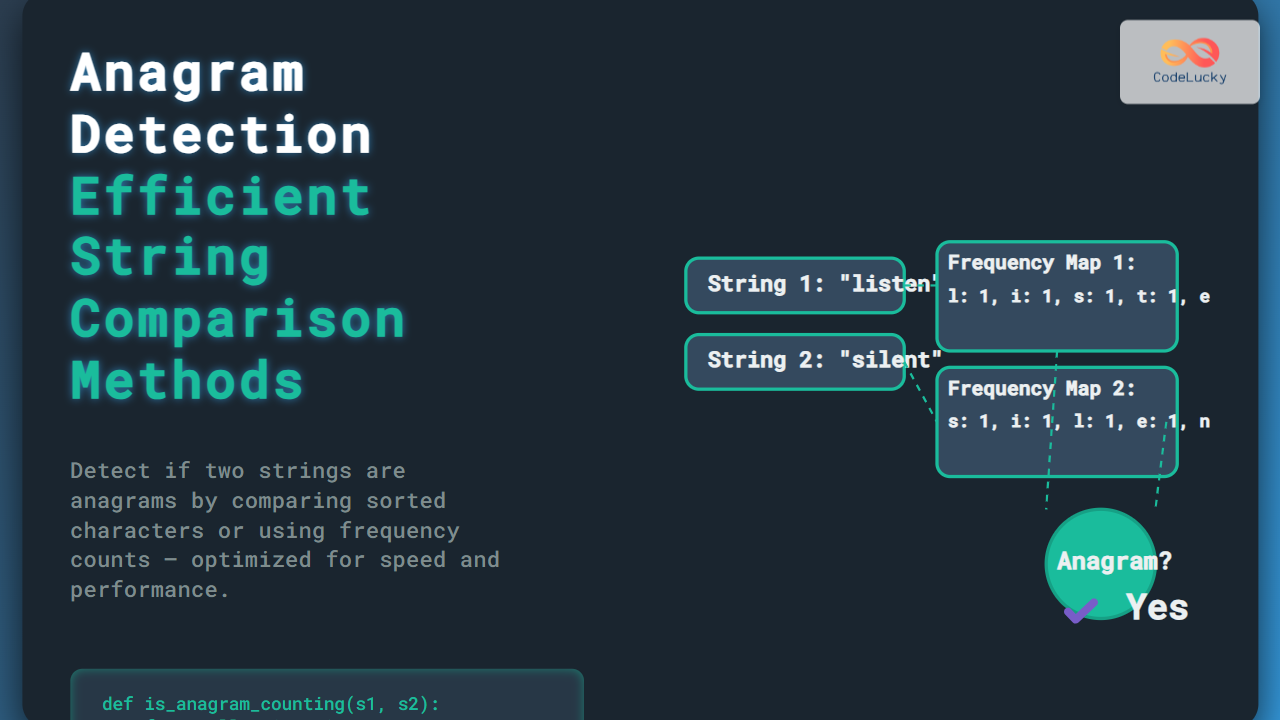
Anagram Detection is a common problem in computer science, competitive programming, and real-world applications such as search optimization, spell-checking, and plagiarism detection. At its core, the problem asks: are two strings made up of the same set of characters, just arranged differently? For example, "listen" and "silent" are anagrams. Detecting anagrams efficiently requires a solid understanding of algorithm design and string manipulation techniques.
What is an Anagram?
An anagram of a word is another word or phrase formed by rearranging its letters. For example:
evil→viledusty→studybinary→brainy
Anagram detection is important in text analysis, natural language processing (NLP), and dictionary-based algorithms.
Brute Force Method
The most straightforward approach is to generate all permutations of one string and check if the other exists. However, this is highly inefficient.
from itertools import permutations

def is_anagram_bruteforce(s1, s2):
    return s2 in [''.join(p) for p in permutations(s1)]

print(is_anagram_bruteforce("listen", "silent"))
Time Complexity: O(n!) — impractical for long strings.

Efficient Method 1: Sorting
A far more efficient technique is to sort both strings and compare them:
def is_anagram_sorting(s1, s2):
    return sorted(s1) == sorted(s2)

print(is_anagram_sorting("listen", "silent"))  # True
Time Complexity: O(n log n) because of sorting.
Space Complexity: O(n).

Efficient Method 2: Frequency Counting
Counting character frequencies is even more optimized. If both strings have exactly the same frequency counts for each character, they are anagrams.
from collections import Counter

def is_anagram_counting(s1, s2):
    return Counter(s1) == Counter(s2)

print(is_anagram_counting("listen", "silent"))  # True
Time Complexity: O(n)
Space Complexity: O(1) if limited to fixed character set like ASCII (constant space).

Efficient Method 3: Hashing Technique
Another approach is computing a hash (e.g., sum of prime numbers assigned to characters). Though not always collision-free, it can be efficient for restricted cases.
def is_anagram_hashing(s1, s2):
    if len(s1) != len(s2):
        return False

    def hash_string(s):
        primes = {
            'a': 2, 'b': 3, 'c': 5, 'd': 7, 'e': 11, 'f': 13,
            'g': 17, 'h': 19, 'i': 23, 'j': 29, 'k': 31, 'l': 37,
            'm': 41, 'n': 43, 'o': 47, 'p': 53, 'q': 59, 'r': 61,
            's': 67, 't': 71, 'u': 73, 'v': 79, 'w': 83, 'x': 89,
            'y': 97, 'z': 101
        }
        val = 1
        for char in s:
            val *= primes[char.lower()]
        return val

    return hash_string(s1) == hash_string(s2)

print(is_anagram_hashing("listen", "silent"))  # True
This approach is clever but limited by integer overflow on large strings.
Interactive Example: Anagram Checker
Below is a minimal interactive Python-based example for running directly or embedding on a website:
def interactive_anagram_checker():
    while True:
        s1 = input("Enter first string: ")
        s2 = input("Enter second string: ")
        print("Are they anagrams? ", is_anagram_counting(s1, s2))
        cont = input("Check again? (y/n): ")
        if cont.lower() != "y":
            break

# Uncomment to run interactively
# interactive_anagram_checker()
Comparison of Methods
| Method | Time Complexity | Space Complexity | Practical Use |
|---|---|---|---|
| Brute Force | O(n!) | O(n!) | Never practical except for educational demos |
| Sorting | O(n log n) | O(n) | Good for moderate string sizes |
| Counting Frequency | O(n) | O(1) for fixed alphabets | Best for large text processing |
| Hashing (Primes) | O(n) | O(1) | Useful for small strings with clever hash functions |
Conclusion
Anagram detection is a fundamental problem in computer algorithms with applications ranging from word games to large-scale text analysis. While brute-force approaches are theoretically interesting, efficient solutions like frequency counting or sorting dominate in practice. For real-world systems where performance matters, counting character frequencies is the recommended approach due to its linear time efficiency and minimal space requirements.
By understanding these methods, you can sharpen your algorithmic problem-solving skills and optimize applications that rely on efficient string comparison.