Understanding when to use uppercase and lowercase letters is a fundamental part of mastering English writing. Correct capitalization ensures clarity, professionalism, and grammatical accuracy. This detailed guide from CodeLucky.com explains every rule, including examples, diagrams, and interactive tips so learners can apply the knowledge instantly.
Introduction to Alphabets and Letter Case
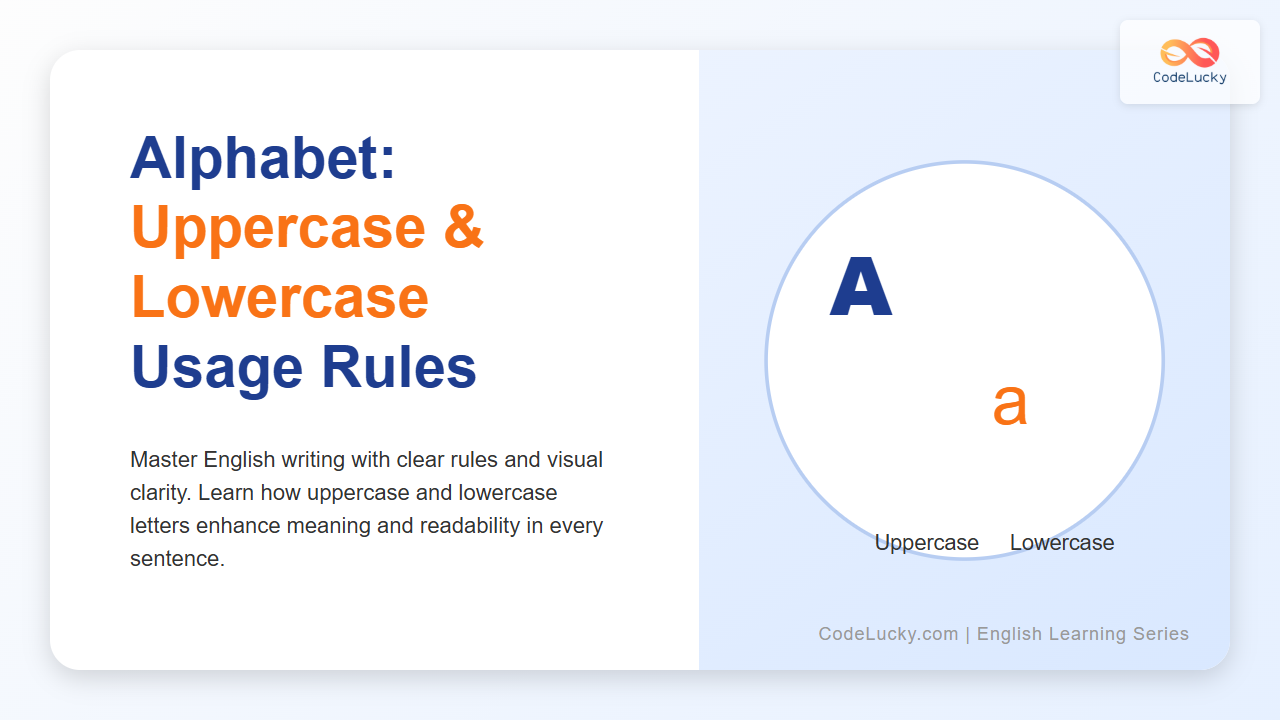
The English alphabet consists of 26 letters. Each letter has two forms — uppercase (capital) and lowercase (small). For example: A / a, B / b, C / c.

Uppercase letters are used at the beginning of sentences, names, and proper nouns, while lowercase letters appear in most other parts of writing. Let’s look at the rules in detail.
1. Capitalization Rules You Must Know
1.1 Start of a Sentence
Always capitalize the first word of a sentence:
✅ Correct: The sky is blue.
❌ Incorrect: the sky is blue.
1.2 Proper Nouns
Proper nouns name specific people, places, or things and always begin with an uppercase letter:
✅ Correct: I met John in Paris.
❌ Incorrect: I met john in paris.
Examples of proper nouns include:
- Names of people: Emma, Robert, Ali
- Geographical names: India, Mount Everest, the Pacific Ocean
- Brand names: Apple, Google, Nike
1.3 Days, Months, and Holidays
Capitalize the names of days, months, and holidays but not seasons:
✅ Correct: Monday, August, Christmas
❌ Incorrect: monday, august, christmas
Note: Seasons like winter, summer, and autumn are lowercase unless they begin a sentence.
1.4 Pronoun “I”
The personal pronoun I is always capitalized, no matter where it appears:
✅ Correct: I am learning English.
❌ Incorrect: i am learning English.
1.5 Titles and Headings
In titles or headings, use title case — capitalize major words, not short articles or prepositions unless they start or end the title:
✅ Correct: The Lion and the Mouse
❌ Incorrect: The lion and the mouse
1.6 Acronyms and Initialisms
Write acronyms in uppercase since they represent condensed forms of proper names:
💡 Examples: NASA, WHO, HTML, BBC
2. Lowercase Usage Rules
Lowercase letters are the default form for most text. They dominate continuous writing because they enhance readability and flow.
2.1 Common Nouns
Common nouns refer to general items or people and begin with lowercase letters unless at the start of a sentence:
✅ Correct: A cat is sleeping.
✅ Correct: The cat loves milk.
❌ Incorrect: The Cat loves milk.
2.2 Articles, Conjunctions, and Prepositions
Words like a, an, the, and, but, for, in, on usually stay lowercase unless they start or end a sentence or title.
2.3 Sentence Continuity
Within sentences, lowercase maintains flow and harmony. For example:
✅ Correct: My brother and I play chess every Sunday.3. Mixed Case and Style Usage
Writers sometimes combine upper and lowercase creatively — for emphasis or stylistic writing — especially in branding and modern digital communication.
- Title Case: Each major word is capitalized. Example:
Learning English Made Easy - Sentence Case: Only the first word and proper nouns are capitalized. Example:
Learning English made easy - All Caps: Every letter is uppercase. Example:
LEARNING ENGLISH MADE EASY

4. Common Mistakes to Avoid
- Capitalizing every word unnecessarily: ❌ This Is Not Correct Grammar.
- Forgetting to capitalize the pronoun “I”.
- Using uppercase for emotional emphasis (e.g., “STOP!!!”) — seen as shouting online.
5. Interactive Practice Example
Try identifying the correct form below. Select which version follows the rules:
1️⃣ the sun rises in the east.
2️⃣ The sun rises in the east. ✅
3️⃣ The Sun rises in The East. ❌
Practicing capitalization in short sentences helps English learners develop habit memory.
6. Summary Table of Capitalization Rules
| Rule | Use Uppercase | Example |
|---|---|---|
| Sentence beginning | Yes | The car is fast. |
| Proper noun | Yes | John visited India. |
| Common noun | No | The dog barked. |
| Pronoun “I” | Yes | I am happy. |
| Season names | No | I love spring. |
7. Visualization of Sentence Structure

Final Thoughts
Using uppercase and lowercase correctly shows linguistic discipline. It not only improves your grammar but also enhances readability and credibility in every form of writing. With consistent practice and awareness of these rules, your English writing will become clearer, more professional, and error-free.
🔤 Continue exploring other topics in the English Learning Series on CodeLucky.com to strengthen your foundation one topic at a time.