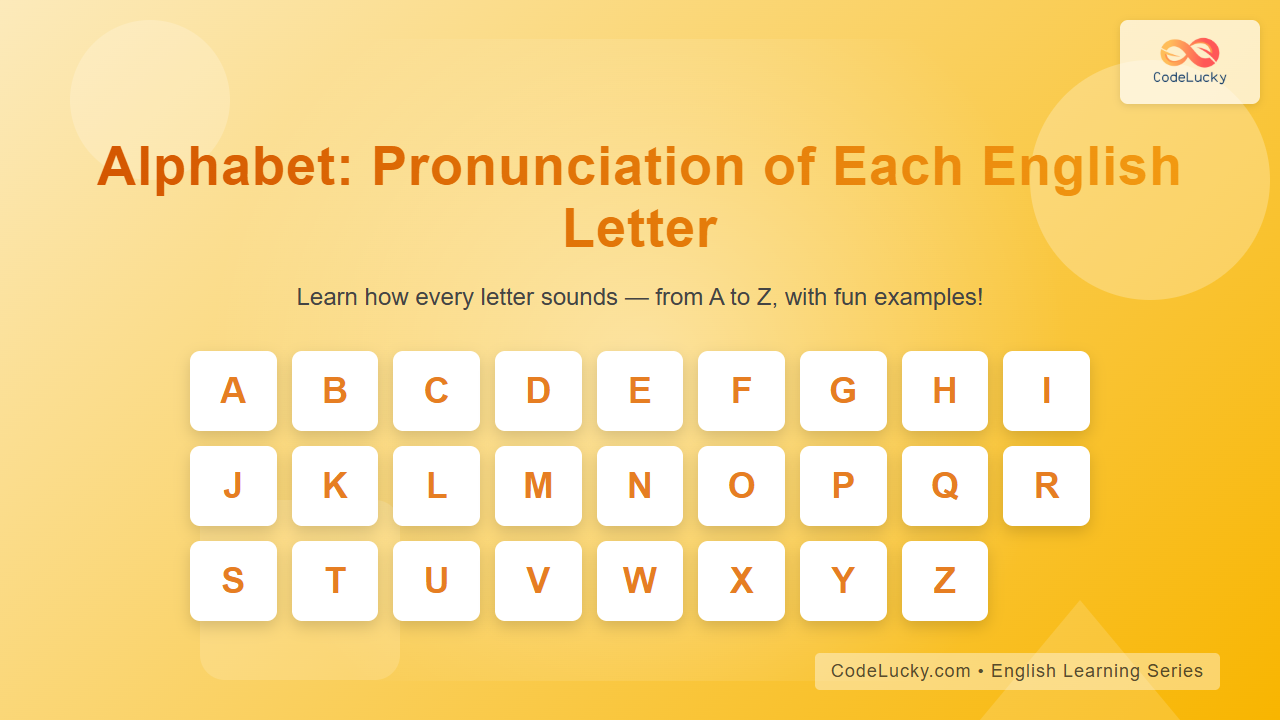
The English alphabet is the foundation of written and spoken English. It contains 26 letters, each with a specific pronunciation that may vary slightly between British and American English. Understanding how to pronounce each letter correctly is the first step toward speaking fluent English.
Overview of the English Alphabet
Before diving into pronunciations, let’s see how the alphabet is categorized into vowels and consonants:

Vowels and Consonants in English
There are 5 vowels and 21 consonants in the English alphabet. Each vowel can make short or long sounds, and consonants mostly have fixed sound patterns depending on their position in a word.
Vowel Letters
- A – pronounced /eɪ/ as in apple (short: /æ/ in cat)
- E – pronounced /iː/ as in elephant (short: /e/ in bed)
- I – pronounced /aɪ/ as in icecream (short: /ɪ/ in sit)
- O – pronounced /oʊ/ as in open (short: /ɒ/ or /ɑ/ in dog)
- U – pronounced /juː/ as in unicorn (short: /ʌ/ in cut)
Consonant Letters
Consonants mostly represent fixed sounds but may vary with context. Let’s explore each one.
Complete Pronunciation Chart of All 26 Letters
| Letter | Phonetic (IPA) | How to Say It | Example Word |
|---|---|---|---|
| A | /eɪ/ | Say “ay” | Apple, Age |
| B | /biː/ | Say “bee” | Ball, Baby |
| C | /siː/ | Say “see” | Cat, City |
| D | /diː/ | Say “dee” | Dog, Day |
| E | /iː/ | Say “ee” | Egg, Elephant |
| F | /ɛf/ | Say “ef” | Fan, Fish |
| G | /dʒiː/ | Say “gee” | Goat, Giant |
| H | /eɪtʃ/ | Say “aitch” | Hat, House |
| I | /aɪ/ | Say “eye” | Ice, Ink |
| J | /dʒeɪ/ | Say “jay” | Jungle, Jump |
| K | /keɪ/ | Say “kay” | Kite, King |
| L | /ɛl/ | Say “el” | Lion, Lamp |
| M | /ɛm/ | Say “em” | Monkey, Moon |
| N | /ɛn/ | Say “en” | Net, Nose |
| O | /oʊ/ | Say “oh” | Orange, Owl |
| P | /piː/ | Say “pee” | Pen, Pig |
| Q | /kjuː/ | Say “cue” | Queen, Quick |
| R | /ɑːr/ | Say “ar” | Rat, Rose |
| S | /ɛs/ | Say “es” | Sun, Snake |
| T | /tiː/ | Say “tee” | Tree, Tiger |
| U | /juː/ | Say “you” | Umbrella, Unicorn |
| V | /viː/ | Say “vee” | Van, Vase |
| W | /ˈdʌbljuː/ | Say “double-you” | Water, Window |
| X | /ɛks/ | Say “ex” | X-ray, Box |
| Y | /waɪ/ | Say “why” | Yellow, You |
| Z | /ziː/ (US) /zɛd/ (UK) |
Say “zee” or “zed” | Zoo, Zebra |
Interactive Pronunciation Practice
Try reading each letter aloud, following this rhythm:
- Say the letter name — e.g., “B”
- Say the sound it makes — e.g., “/b/ as in Ball”
- Use it in a short example — e.g., “B is for Ball.”
You can also make flashcards: one side with the letter name, the other with an image or word example.
Tips for Improving Alphabet Pronunciation
- Practice speaking aloud every day for at least 10 minutes.
- Record your voice and compare it with native pronunciations on YouTube or dictionary websites.
- Focus on tricky letters like R, V, W, and Z — these often differ between accents.
- Associate each letter with a visual image or motion to improve memory.
British vs. American Pronunciation Differences
Most letters sound the same in both accents except a few:
- Z: “Zed” (UK) vs “Zee” (US)
- R: Lightly pronounced or silent in British English, strong in American.
- A: Slightly flatter in British accent (as in “cat”).
Quick Recap
- English alphabet = 26 letters (5 vowels + 21 consonants).
- Each letter has a standard pronunciation.
- Practice makes recognition and pronunciation natural.
- Differences exist between British and American English but they share the same alphabet base.
With regular speaking and listening practice, you’ll soon pronounce each English letter like a fluent speaker!