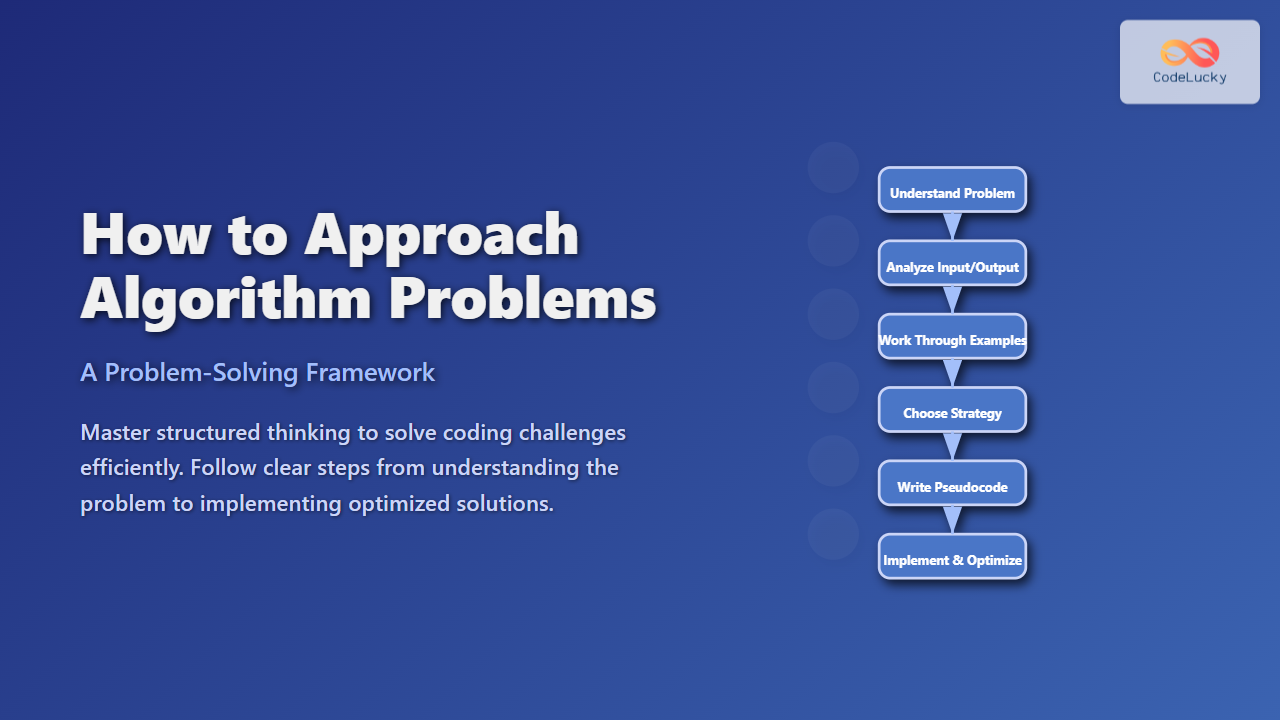
In computer science and competitive programming, the way you approach an algorithm problem often matters more than the final code itself. Many beginners jump straight into coding but get stuck halfway. Experienced problem solvers, however, follow a structured problem-solving framework that helps them craft efficient and correct solutions. In this article, we explore a step-by-step methodology to approach algorithm problems, with examples, diagrams, and intuitive explanations.
Why a Framework Matters
When faced with a challenging problem, our brain can become overwhelmed with details. A systematic approach makes problem-solving predictable and manageable. By breaking down the process, you reduce cognitive overload, avoid common pitfalls, and improve time complexity of your solutions.
The Algorithm Problem-Solving Framework
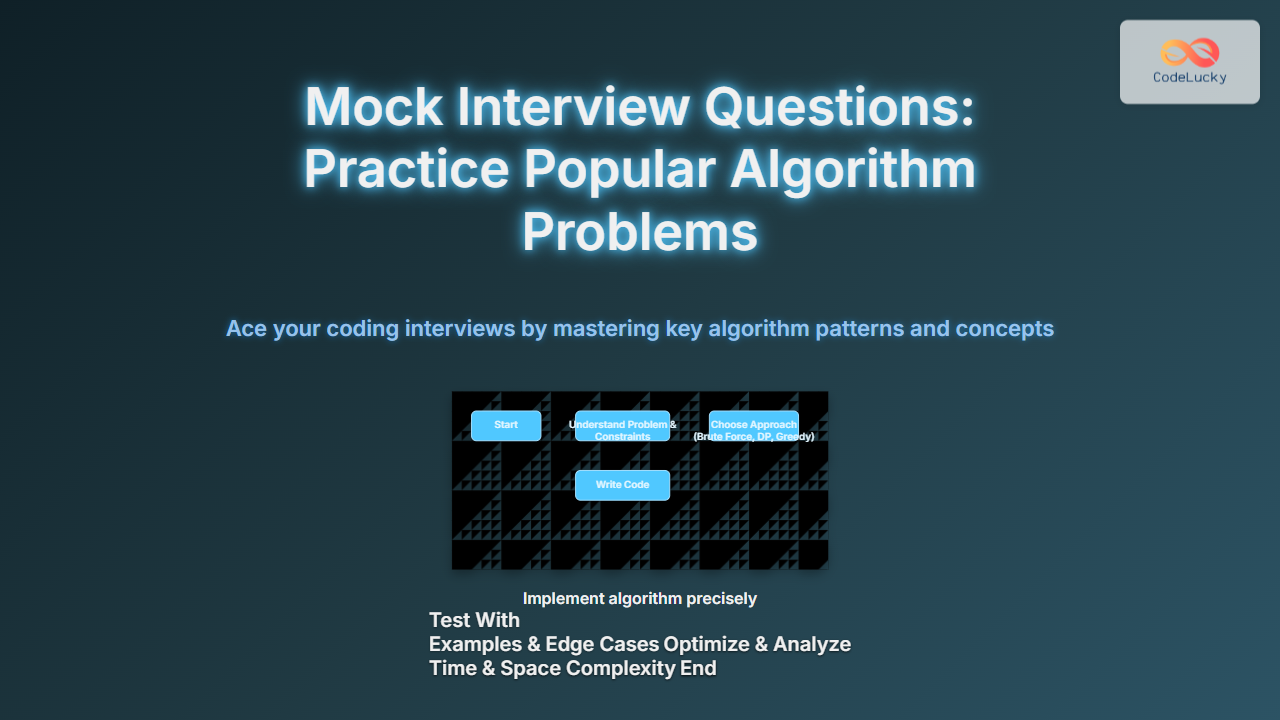
The framework consists of clear steps that guide you from understanding the problem to implementing an optimized solution:
- Step 1: Understand the Problem
- Step 2: Break Down Input and Output
- Step 3: Explore Examples and Edge Cases
- Step 4: Choose the Right Strategy
- Step 5: Visualize the Process
- Step 6: Write Pseudocode
- Step 7: Implement in Code
- Step 8: Optimize and Verify

Step 1: Understand the Problem
Read carefully. Identify what the problem is asking and what constraints exist. For example, in a “maximum subarray sum” problem, ask:
- What does the input represent?
- What is the expected output?
- What are the constraints on input size?
Step 2: Break Down Input and Output
Consider the data types, structure, and scale:
Input:  [-2,1,-3,4,-1,2,1,-5,4]
Output: 6
Reason: Subarray [4,-1,2,1] has the maximum sum = 6.
Step 3: Explore Examples and Edge Cases
Work through small and extreme examples:
- Empty array?
- All negative numbers?
- Single element?
Step 4: Choose the Right Strategy
Select a suitable method: brute force, divide-and-conquer, dynamic programming, greedy algorithms, or graph traversal depending on constraints.
For the maximum subarray problem, brute force has a time complexity of \(O(n^2)\), but Kadane’s Algorithm reduces it to \(O(n)\).

Step 5: Visualize the Process
Building visual models helps clarify the problem. For example, in Kadane’s Algorithm, we track the current sum and maximum sum as we traverse the array.
Array: [-2, 1, -3, 4, -1, 2, 1, -5, 4]
Stepwise max tracking:
- Current maximum resets when sum drops below zero.
- Final maximum = 6.
Step 6: Write Pseudocode
Before coding, write plain language pseudocode:
function maxSubArray(arr):
    max_sum = -infinity
    current_sum = 0
    for num in arr:
        current_sum = max(num, current_sum + num)
        max_sum = max(max_sum, current_sum)
    return max_sum
Step 7: Implement in Code
A Python implementation:
def maxSubArray(nums):
    max_sum = float('-inf')
    current_sum = 0
    for n in nums:
        current_sum = max(n, current_sum + n)
        max_sum = max(max_sum, current_sum)
    return max_sum

print(maxSubArray([-2,1,-3,4,-1,2,1,-5,4]))  # Output: 6
Step 8: Optimize and Verify
Always verify time and space complexity. Consider constraints like \(n \leq 10^5\). For example:
- Brute Force: \(O(n^2)\)
- Kadane’s Algorithm: \(O(n)\)
Common Strategies for Algorithm Problems
The following are commonly used strategies:
- Greedy Algorithms: Making local optimal choices.
- Dynamic Programming: Breaking problems into subproblems with overlapping results.
- Divide and Conquer: Solving smaller parts recursively.
- Graph Algorithms: Traversing paths and networks.
- Backtracking: Systematically exploring all solutions.

Interactive Example: Try it Yourself
Here’s a simple interactive JavaScript snippet for finding maximum subarray sum (Kadane’s Algorithm). You can paste it in a browser console:
function maxSubArray(nums) {
    let max_sum = -Infinity;
    let current_sum = 0;
    for (let n of nums) {
        current_sum = Math.max(n, current_sum + n);
        max_sum = Math.max(max_sum, current_sum);
    }
    return max_sum;
}

console.log(maxSubArray([-2,1,-3,4,-1,2,1,-5,4])); // Output: 6
Conclusion
Instead of diving headfirst into code, following a structured algorithm problem-solving framework ensures accuracy, strengthens your logical reasoning, and allows you to pick the most efficient technique for the problem at hand. By practicing with examples and applying visualization and pseudocode, you will become a more effective problem solver in both coding interviews and real-world programming.