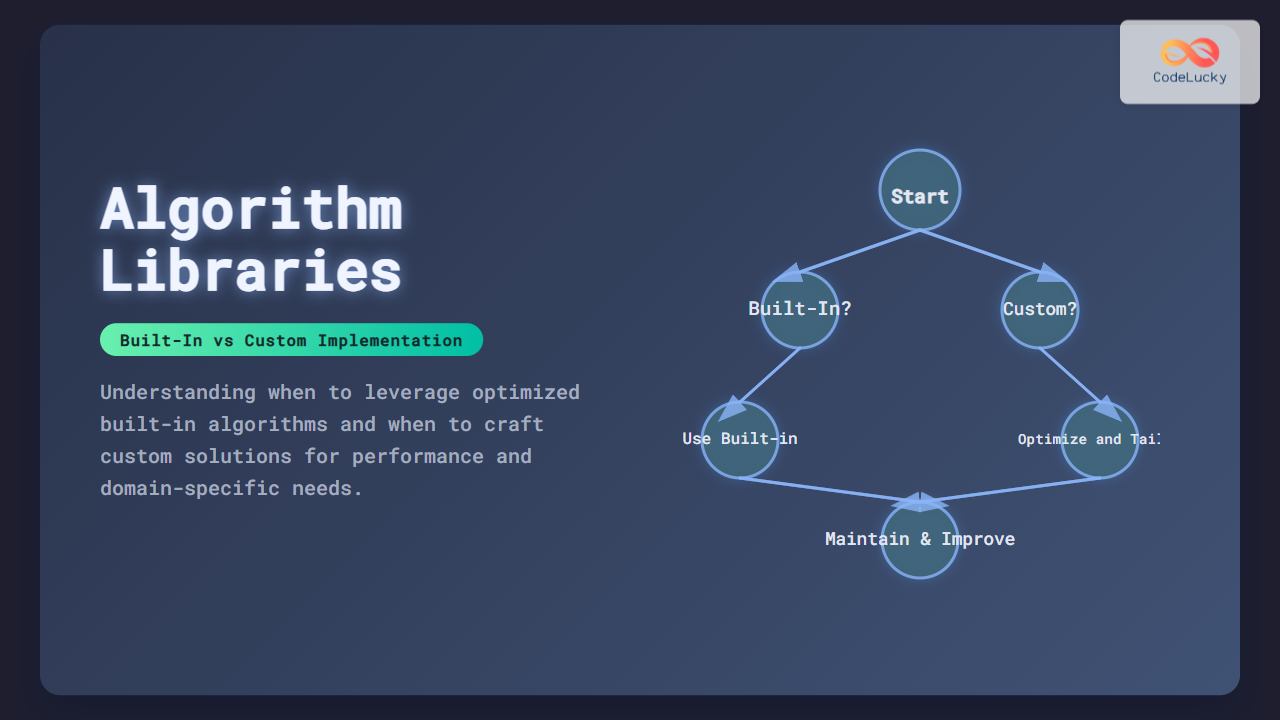
In the world of software development, algorithm libraries play a crucial role in accelerating development, improving reliability, and ensuring scalability. However, developers often face a common question: should you use built-in algorithm libraries provided by the programming language, or craft a custom implementation tailored to your specific use case?
This article breaks down the factors that influence this decision, compares trade-offs, and provides examples from languages like Python, Go, and Rust. By the end, you will know exactly when to rely on built-in features and when investing in custom code makes sense.
Why Algorithm Libraries Exist
Most modern programming languages come with robust algorithm libraries that include data structures (arrays, trees, heaps), sorting techniques, searching utilities, and mathematical functions. These implementations are:
- Highly optimized at the compiler or interpreter level.
- Tested extensively for edge cases and correctness.
- Maintained by communities of experts.
For instance, Python ships with sort() based on Timsort, Rust provides zero-cost abstractions for iterators and collections, and Go’s standard library implements efficient searching and sorting mechanisms.
When to Use Built-In Algorithm Libraries
Relying on built-in functions is generally the best starting point. You should use built-in libraries when:
- Performance is already optimal: Built-in functions are usually written in low-level languages like C for maximum efficiency.
- Reliability is critical: Standard libraries are well tested and less prone to hidden bugs.
- Maintainability matters: Other developers can immediately recognize and understand standard library usage.
- Security is a factor: Custom algorithms may introduce vulnerabilities if not rigorously tested.
For example, in Python:
# Using built-in sort
numbers = [42, 7, 19, 3, 56]
numbers.sort()
print(numbers)  # Output: [3, 7, 19, 42, 56]
This sort is faster and more memory-efficient than most naive custom approaches.

When to Write a Custom Algorithm
Despite the power of built-in libraries, there are cases where custom implementations are necessary:
- Specialized domain problems: When your use case doesn’t align with standard algorithms, such as highly specific graph traversal requirements.
- Optimized for constraints: You may need algorithms optimized for memory usage, concurrency, or hardware-specific performance.
- Educational purposes: Implementing algorithms from scratch strengthens understanding and prepares for technical interviews.
- Extended features: Sometimes a built-in is close but needs extra features like hybrid data structures or non-standard sorting orders.
Consider a custom implementation of breadth-first search (BFS) in Python:
from collections import deque

def bfs(graph, start):
    visited = set()
    queue = deque([start])
    while queue:
        node = queue.popleft()
        if node not in visited:
            print(node, end=" ")
            visited.add(node)
            queue.extend(neighbor for neighbor in graph[node] if neighbor not in visited)

graph = {
    'A': ['B', 'C'],
    'B': ['D', 'E'],
    'C': ['F'],
    'D': [],
    'E': ['F'],
    'F': []
}
bfs(graph, 'A')  # Output: A B C D E F
While Python’s collections.deque supports a queue structure, the traversal order here is specific to BFS requirements—something no single built-in function covers completely.
Performance Trade-Offs
The choice between built-in and custom algorithms can be visualized as a trade-off graph:

Developers must balance time-to-market with long-term scalability when making this decision.
Interactive Example: Sorting Benchmark
Try out this small Python benchmark comparing built-in sorting vs a naive bubble sort:
import random, time

def bubble_sort(arr):
    n = len(arr)
    for i in range(n):
        for j in range(0, n-i-1):
            if arr[j] > arr[j+1]:
                arr[j], arr[j+1] = arr[j+1], arr[j]
    return arr

# Generate random list
arr = [random.randint(1, 10000) for _ in range(2000)]

# Built-in sort
start = time.time()
sorted_builtin = sorted(arr)
print("Built-in sort:", time.time() - start)

# Custom bubble sort (naive)
start = time.time()
sorted_custom = bubble_sort(arr.copy())
print("Bubble sort:", time.time() - start)
Running this shows built-in sorting outperforms custom naive implementations by orders of magnitude. Custom implementations should only rival built-ins in very specialized cases.
Guidelines for Deciding
To simplify the decision process, follow these guidelines:
- If the problem matches a standard algorithm → use the built-in version.
- If performance bottlenecks appear in profiling → consider custom optimization.
- If domain-specific constraints apply → implement a targeted solution.
- For learning or interview prep → practice with custom versions.

Conclusion
Algorithm libraries are powerful tools that save time, reduce bugs, and offer optimized performance across use cases. However, knowing when to step outside the built-in toolbox and implement a custom algorithm is an equally vital skill in computer science. Develop a mindset of profiling first, analyzing constraints, and then deciding between built-in convenience and custom precision—as this balance often defines the efficiency and maintainability of large-scale systems.