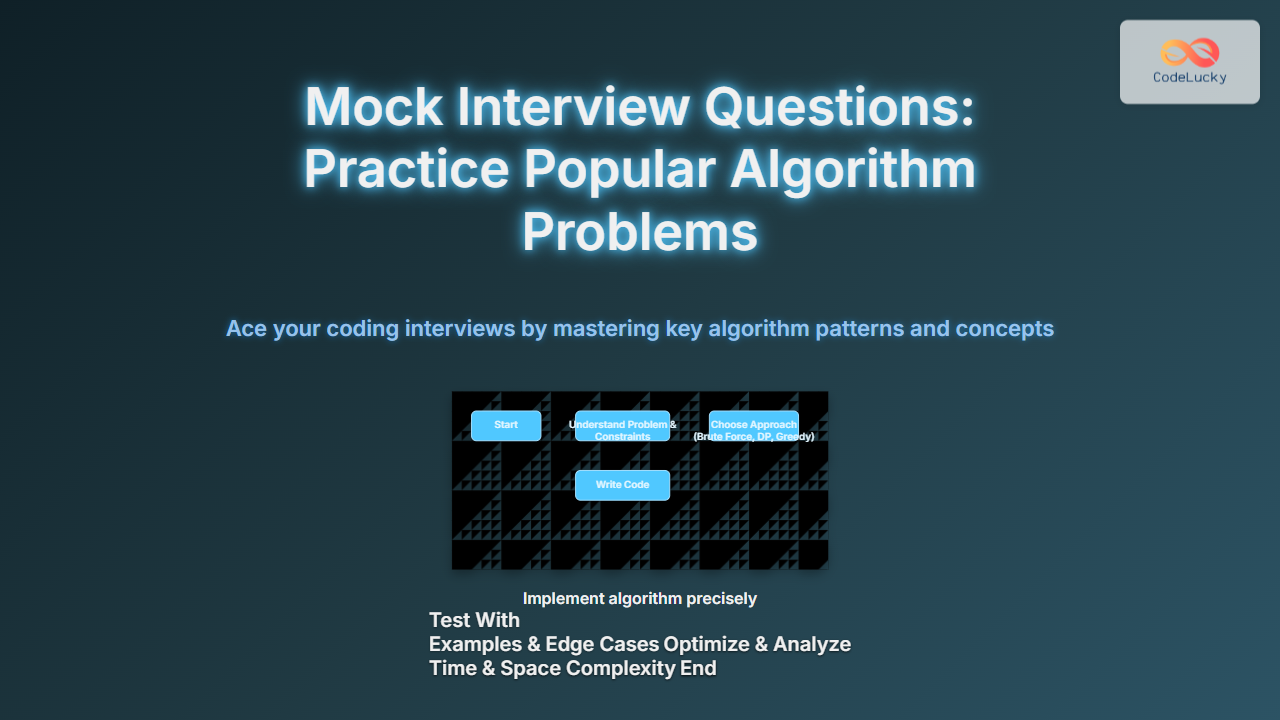
Cracking a coding interview requires more than just knowing the syntax of a programming language. Employers at top tech firms such as Google, Microsoft, and Amazon expect candidates to demonstrate their ability to solve complex problems efficiently. Algorithm interview preparation is the process of mastering core computer science concepts and practicing them with systematic strategies.
This article provides a detailed roadmap to prepare for algorithm-based coding interviews. It includes practical strategies, examples with outputs, and even visual explanations with mermaid diagrams to help you develop an intuitive problem-solving mindset.
Why Algorithm Interview Preparation Matters
Coding interviews emphasize problem-solving, optimization, and analytical thinking. Without strong algorithmic knowledge, it’s difficult to stand out. Key reasons preparation is essential include:
- Algorithm questions test your ability to think critically and optimize solutions.
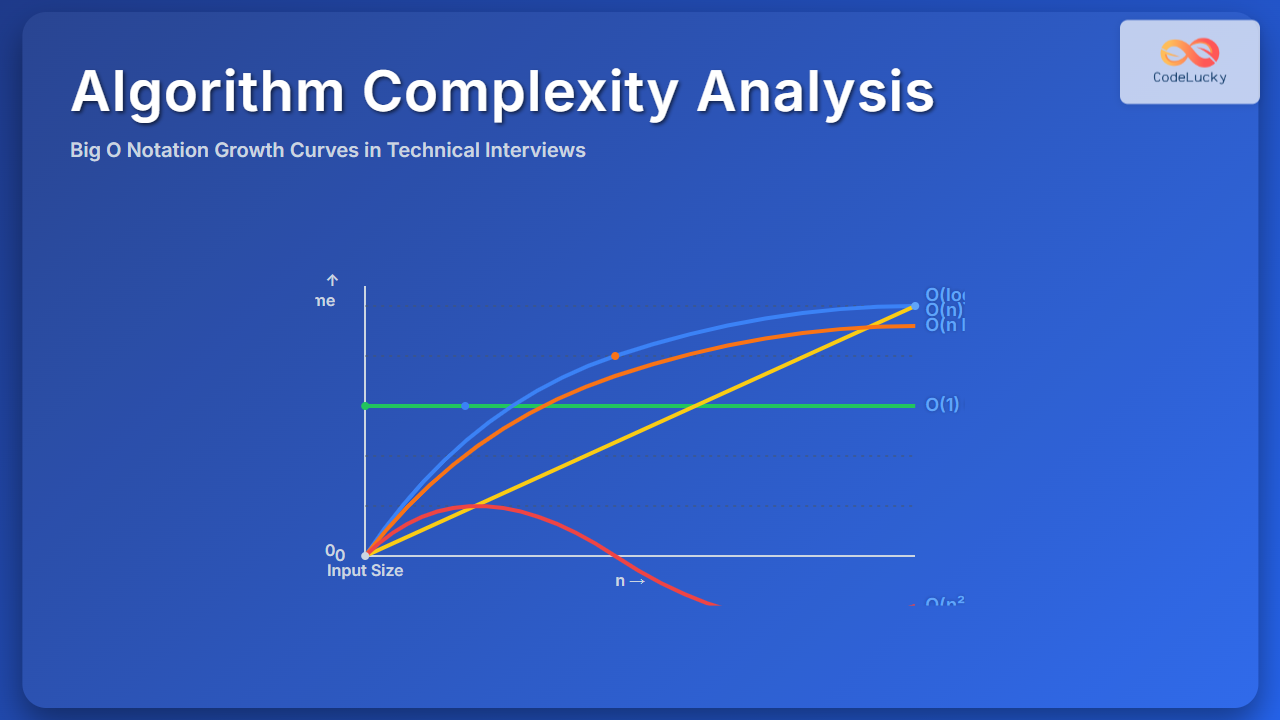
- They evaluate time and space complexity analysis using Big-O notation.
- Companies use algorithms as an equalizer to filter the best candidates globally.
Core Topics You Must Master
Here are the fundamental areas you should focus on for algorithm interview preparation:
- Data Structures: Arrays, Linked Lists, Stacks, Queues, Trees, Heaps, Hash Tables, Graphs
- Sorting & Searching Algorithms: QuickSort, MergeSort, Binary Search
- Recursion & Backtracking: Problems involving DFS, N-Queens, Sudoku Solvers
- Dynamic Programming: Knapsack, Longest Common Subsequence, Fibonacci Variants
- Graph Algorithms: Dijkstra’s Algorithm, BFS, DFS, Topological Sort
- Greedy Algorithms: Interval Scheduling, Huffman Coding
- Mathematical & Number Theory: GCD, Modular Arithmetic, Prime Factorization
Visualizing an Interview Problem
Consider the classic algorithm question: “Find the shortest path in a weighted graph.” To explain Dijkstra’s Algorithm visually, let’s use a diagram:

Here, Dijkstra’s algorithm helps compute the shortest path from node A to all other nodes efficiently.
Step-by-Step Example: Binary Search
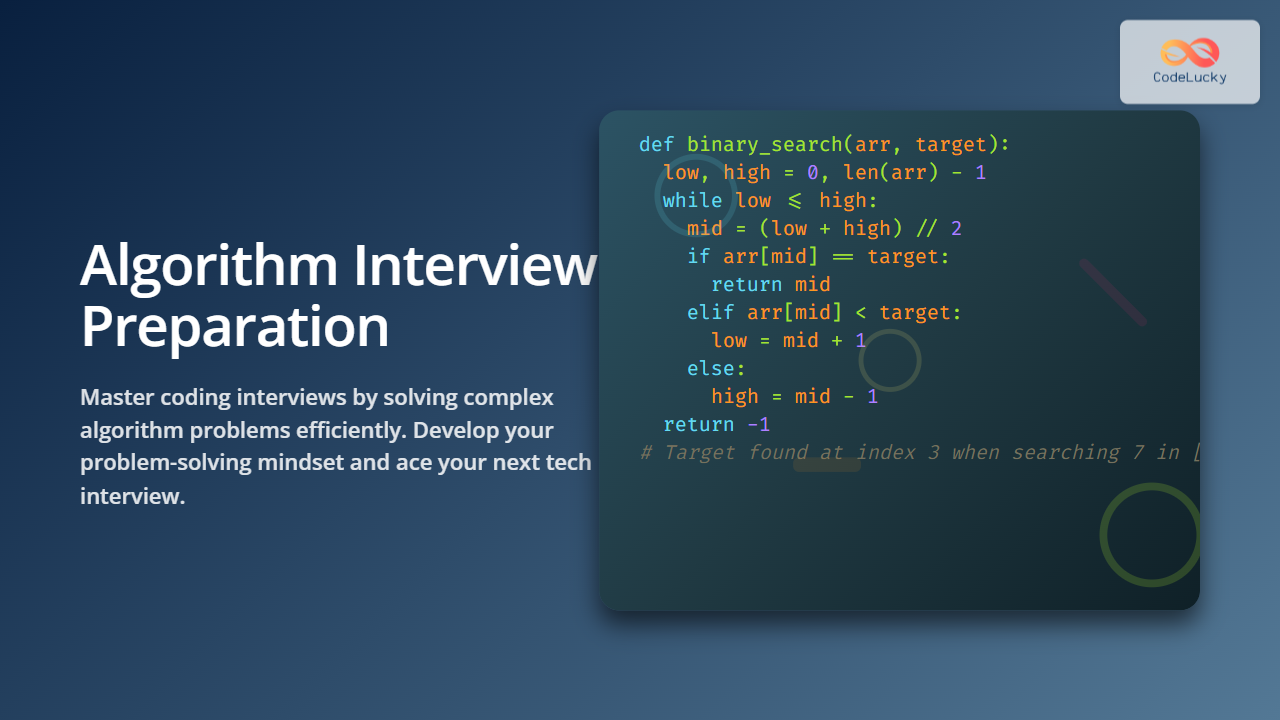
Binary search is a fundamental interview algorithm. Below is Python example with output:
def binary_search(arr, target):
    low, high = 0, len(arr)-1
    while low <= high:
        mid = (low + high) // 2
        if arr[mid] == target:
            return mid
        elif arr[mid] < target:
            low = mid + 1
        else:
            high = mid - 1
    return -1

# Example usage
arr = [1, 3, 5, 7, 9, 11]
target = 7
result = binary_search(arr, target)
print("Target found at index:", result)
Output:
Target found at index: 3
Interactive Problem: Reverse a Linked List
Another common interview problem is reversing a linked list. Visualizing it helps:

After reversal:

By iteratively changing the pointers, you can reverse a linked list in O(n) time.
Dynamic Programming Example: Fibonacci Sequence
Dynamic Programming optimizes recursive problems by storing intermediate results.
def fib(n, memo={}):
    if n in memo:
        return memo[n]
    if n <= 2:
        return 1
    memo[n] = fib(n-1, memo) + fib(n-2, memo)
    return memo[n]

print(fib(10))
Output:
55
This avoids exponential recursive calls by using memoization.
Strategies to Crack Coding Interviews
- Practice Consistently: Solve problems daily on a variety of topics.
- Master Complexity Analysis: Always explain your Big-O complexity.
- Think Aloud: Communicate your approach clearly during interviews.
- Dry Run: Simulate your solution on paper before coding.
- Optimize Iteratively: Start with correct but not optimal solutions, then refine.
Mindset and Final Tips
Preparing for algorithm interviews is not just about knowledge—it’s about problem-solving confidence, speed, and clarity of thought. Treat each problem as a puzzle and practice approaching it systematically. With focused preparation, you will be ready to impress interviewers and secure your next role.