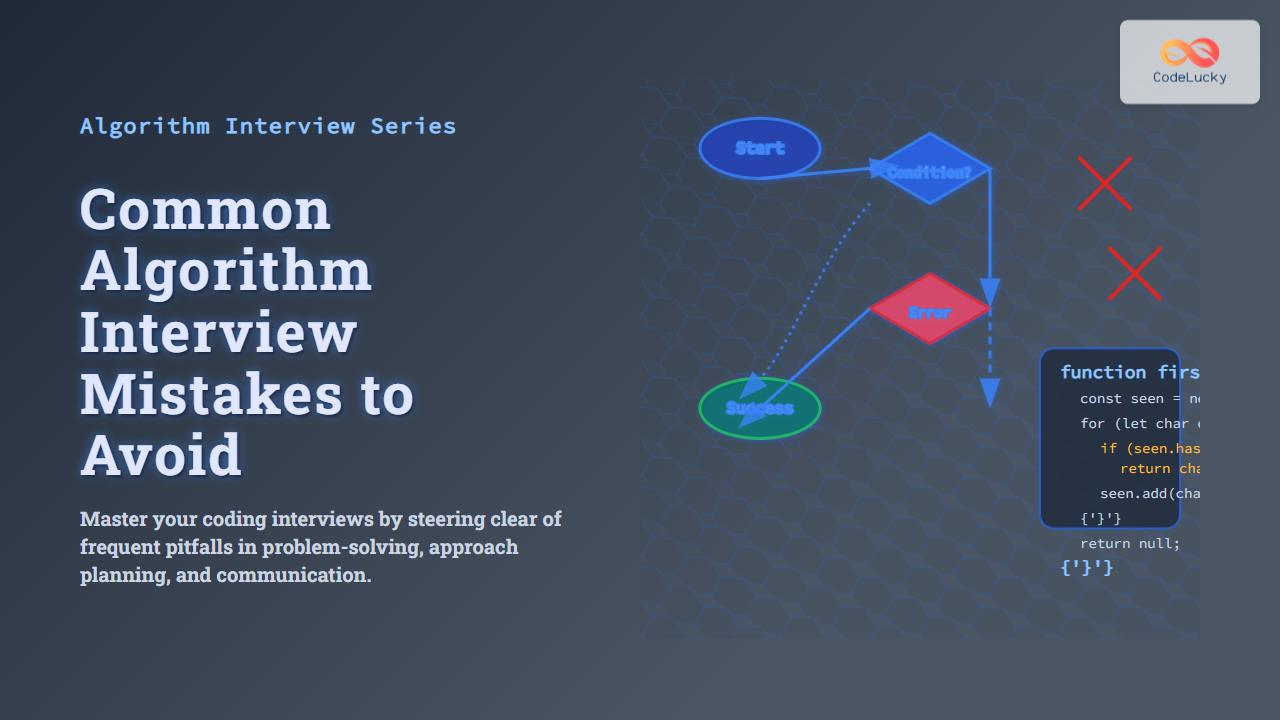
Introduction to Algorithm Interview Mistakes
Algorithm interviews can be daunting even for experienced programmers. Many candidates make crucial mistakes that cost them the opportunity to move forward. Understanding these common pitfalls is key to optimizing preparation and succeeding in technical interviews.
This article explores the frequent algorithm interview mistakes, why they happen, and practical tips to avoid them, supplemented with examples, visual explanations, and interactive concepts.
Common Algorithm Interview Mistakes
1. Poor Problem Understanding
Jumping into coding without fully grasping the problem requirements is a classic mistake. It often leads to incorrect assumptions and wasted effort.
- Not clarifying edge cases or input constraints
- Ignoring problem examples or test cases
Tip: Always restate the problem in your own words and confirm constraints before coding.
2. Lack of a Clear Plan Before Coding
Writing code without outlining the approach is inefficient and error-prone.
- Skipping pseudocode or algorithm strategy
- Missing an optimal or feasible approach
Tip: Spend time designing a high-level plan, choose data structures, and discuss trade-offs before implementation.
3. Ignoring Edge Cases and Testing
Many fail to consider special or border cases, leading to hidden bugs.
- Empty inputs, very large or small inputs
- Duplication and ordering problems
Tip: Conceptually check for edge cases, then validate your code with diverse test inputs.
4. Inefficient Solutions
Naive or brute force approaches are common but often unacceptable in interviews.
Example: Using nested loops for searching instead of advanced data structures or algorithms.
Tip: Prioritize time and space complexity optimization and explain your reasoning.
5. Poor Communication
Effective communication with the interviewer about your thought process is critical.
- Not verbalizing your approach and decisions
- Ignoring interviewer hints or feedback
Tip: Narrate your thoughts clearly and engage actively with your interviewer.
Detailed Example: Common Mistake and Fix
Consider the classic problem: Find the first recurring character in a string.
Input: "acbbac"
Output: "b"
Pitfall: A candidate might use a nested loop to compare every character with every other following character, resulting in O(n²) time complexity.
Improved approach: Use a hash set to track seen characters and iterate once, achieving O(n) time.

Code snippet demonstrating the efficient solution:
function firstRecurringChar(str) {
  const seen = new Set();
  for (let char of str) {
    if (seen.has(char)) return char;
    seen.add(char);
  }
  return null; // no recurring char
}
Interactive Tip: Visualizing Algorithm Steps
Understanding algorithm execution visually can mitigate conceptual errors. Here’s a simple framework to walk through sorting algorithms during interviews.

This flowchart represents bubble sort, a common algorithm for demonstrating basic concepts. Candidates often lose points by not explaining such flows clearly.
Additional Pitfalls & How to Avoid Them
6. Overlooking Time Complexity
Missing the opportunity to optimize or analyze complexity can downgrade the solution quality.
Tip: Always analyze and discuss Big O notation after presenting your solution.
7. Overcomplicating Simple Solutions
Some candidates write overly complex code when simple logic suffices, confusing the interviewer.
Tip: Aim for clarity and simplicity, then optimize if needed.
8. Not Refactoring Code
Writing a working solution and stopping there misses the chance to improve readability and performance.
Tip: Use spare interview time to clean and refactor your code with meaningful variable names and comments.
9. Ignoring Space Complexity
High memory use without justification can be a red flag in algorithm design.
Tip: Balance space and time usage; discuss potential trade-offs.
10. Lack of Confidence and Practice
Nervousness and insufficient rehearsal show during interviews, leading to mistakes and omissions.
Tip: Practice regularly with mock interviews, coding platforms, and real-time problem solving.
Summary: Mastering Algorithm Interviews by Avoiding Mistakes
Success in algorithm interviews hinges on thoughtful preparation and mindful avoidance of common pitfalls. Key takeaways include:
- Thoroughly understanding the problem and clarifying requirements
- Planning the solution approach before coding
- Considering edge cases and validating code rigorously
- Balancing clarity, efficiency, and communication
- Practicing consistently to build confidence and fluency
By focusing on these areas, candidates can improve their algorithm interview performance significantly.