Implementing algorithms in different programming languages is a crucial skill for developers, interview candidates, and competitive programming enthusiasts. While algorithmic logic remains the same, language-specific features, syntax, and data structures can significantly affect performance and readability. This article explores how to efficiently implement algorithms in Python, C++, Java, and JavaScript, highlighting best practices, examples, and optimization strategies for each.
Understanding Language-Specific Algorithm Implementation
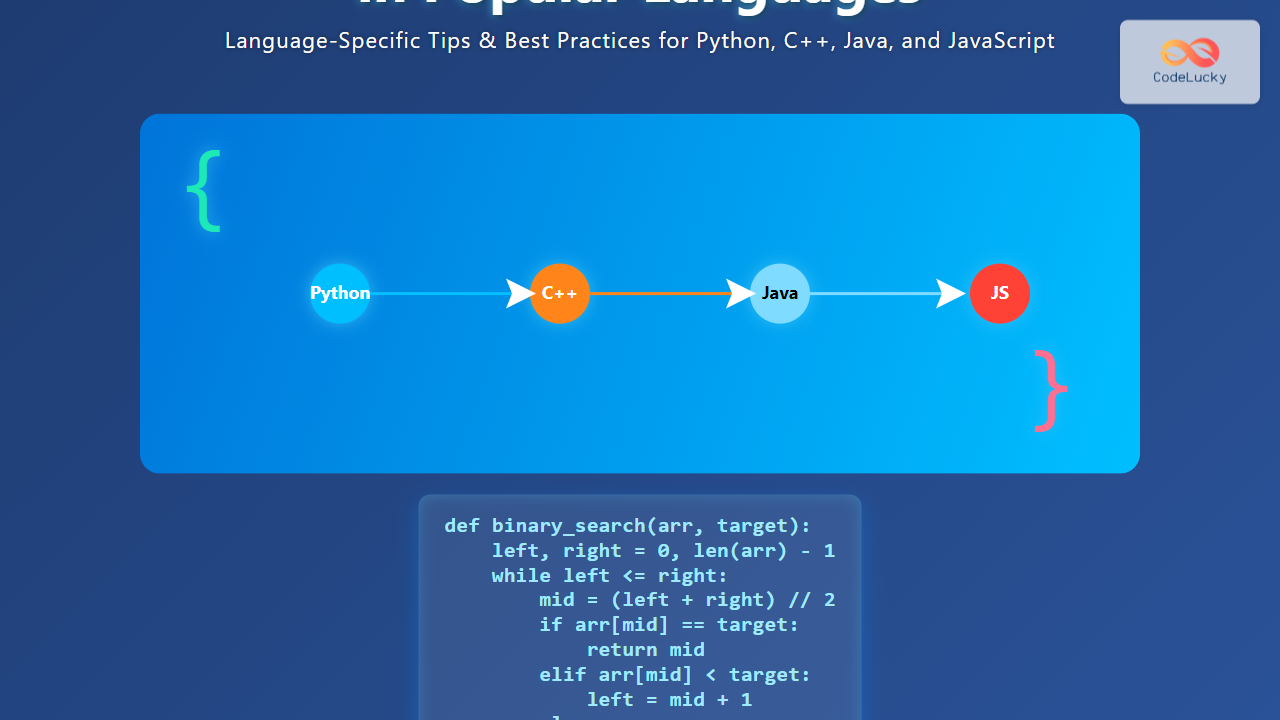
Every programming language offers different tools and paradigms. Choosing the right data structures, built-in functions, and idiomatic constructs ensures better performance and cleaner code. Below is a high-level overview:

Algorithm Implementation in Python
Python is known for simplicity, readability, and its extensive libraries. However, performance can lag due to its dynamic nature. Python is excellent for quick prototyping and algorithm learning.
Example: Binary Search in Python
def binary_search(arr, target):
    left, right = 0, len(arr) - 1
    while left <= right:
        mid = (left + right) // 2
        if arr[mid] == target:
            return mid
        elif arr[mid] < target:
            left = mid + 1
        else:
            right = mid - 1
    return -1

# Example run
nums = [1, 3, 5, 7, 9, 11]
print(binary_search(nums, 7))  # Output: 3
Python Tips:
- Use Python’s built-in modules like
bisectfor optimized searching. - Leverage list comprehensions and generators for concise implementations.
- Avoid nested loops where possible; use built-ins like
sum(),min(), andmax().
Algorithm Implementation in C++
C++ offers speed and memory control, making it a competitive programming favorite. With the Standard Template Library (STL), implementations are efficient and concise.
Example: Dijkstra’s Algorithm in C++
#include <bits/stdc++.h>
using namespace std;

void dijkstra(int source, int V, vector<pair<int, int>> adj[]) {
    vector<int> dist(V, INT_MAX);
    priority_queue<pair<int, int>, vector<pair<int, int>>, greater<>> pq;

    dist[source] = 0;
    pq.push({0, source});

    while (!pq.empty()) {
        int u = pq.top().second;
        pq.pop();
        for (auto &edge : adj[u]) {
            int v = edge.first, w = edge.second;
            if (dist[u] + w < dist[v]) {
                dist[v] = dist[u] + w;
                pq.push({dist[v], v});
            }
        }
    }

    for (int i = 0; i < V; i++)
        cout << "Node " << i << " is at distance " << dist[i] << endl;
}
C++ Tips:
- Use
vector,set,unordered_mapfor efficient memory and time complexity. - Always prefer
priority_queueordequefor graph algorithms. - Take advantage of
<algorithm>functions likesort(),binary_search().
Algorithm Implementation in Java
Java provides robustness, portability, and extensive libraries. It’s widely used in enterprise applications, interview preparation, and big data.
Example: Merge Sort in Java
class MergeSort {
    void merge(int arr[], int l, int m, int r) {
        int n1 = m - l + 1;
        int n2 = r - m;

        int L[] = new int[n1];
        int R[] = new int[n2];

        for (int i = 0; i < n1; ++i)
            L[i] = arr[l + i];
        for (int j = 0; j < n2; ++j)
            R[j] = arr[m + 1 + j];

        int i = 0, j = 0, k = l;
        while (i < n1 && j < n2) {
            if (L[i] <= R[j]) arr[k++] = L[i++];
            else arr[k++] = R[j++];
        }
        while (i < n1) arr[k++] = L[i++];
        while (j < n2) arr[k++] = R[j++];
    }

    void sort(int arr[], int l, int r) {
        if (l < r) {
            int m = (l + r) / 2;
            sort(arr, l, m);
            sort(arr, m + 1, r);
            merge(arr, l, m, r);
        }
    }

    public static void main(String args[]) {
        int arr[] = {12, 11, 13, 5, 6, 7};
        MergeSort ob = new MergeSort();
        ob.sort(arr, 0, arr.length - 1);
        for (int i : arr) System.out.print(i + " ");
    }
}
Java Tips:
- Use Java Collections Framework (
ArrayList,HashMap,PriorityQueue). - Always consider using
ComparableandComparatorfor sorting tasks. - For recursion-heavy code, ensure you handle
StackOverflowErrorrisk.
Algorithm Implementation in JavaScript
JavaScript runs natively in browsers and supports event-driven programming, making it crucial for web-based algorithmic challenges and interactive problem solving.
Example: Quick Sort in JavaScript
function quickSort(arr) {
    if (arr.length <= 1) {
        return arr;
    }
    const pivot = arr[arr.length - 1];
    const left = [];
    const right = [];
    for (let i = 0; i < arr.length - 1; i++) {
        if (arr[i] < pivot) left.push(arr[i]);
        else right.push(arr[i]);
    }
    return [...quickSort(left), pivot, ...quickSort(right)];
}

// Example run
console.log(quickSort([10, 7, 8, 9, 1, 5]));
// Output: [1, 5, 7, 8, 9, 10]
JavaScript Tips:
- Use modern ES6+ features like
map(),reduce(), andfilter(). - Consider asymptotic differences when handling large arrays in the browser.
- JavaScript is single-threaded; for heavy computations, use
Web Workers.
Key Takeaways When Choosing a Language

Each language offers unique strengths:
- Python – Fast prototyping, easier readability.
- C++ – High performance, strong STL support.
- Java – Reliable with versatile libraries.
- JavaScript – Best suited for web applications and front-end algorithms.
Understanding these nuances allows developers to implement algorithms not just correctly, but also optimally based on the context, performance constraints, and application environment.