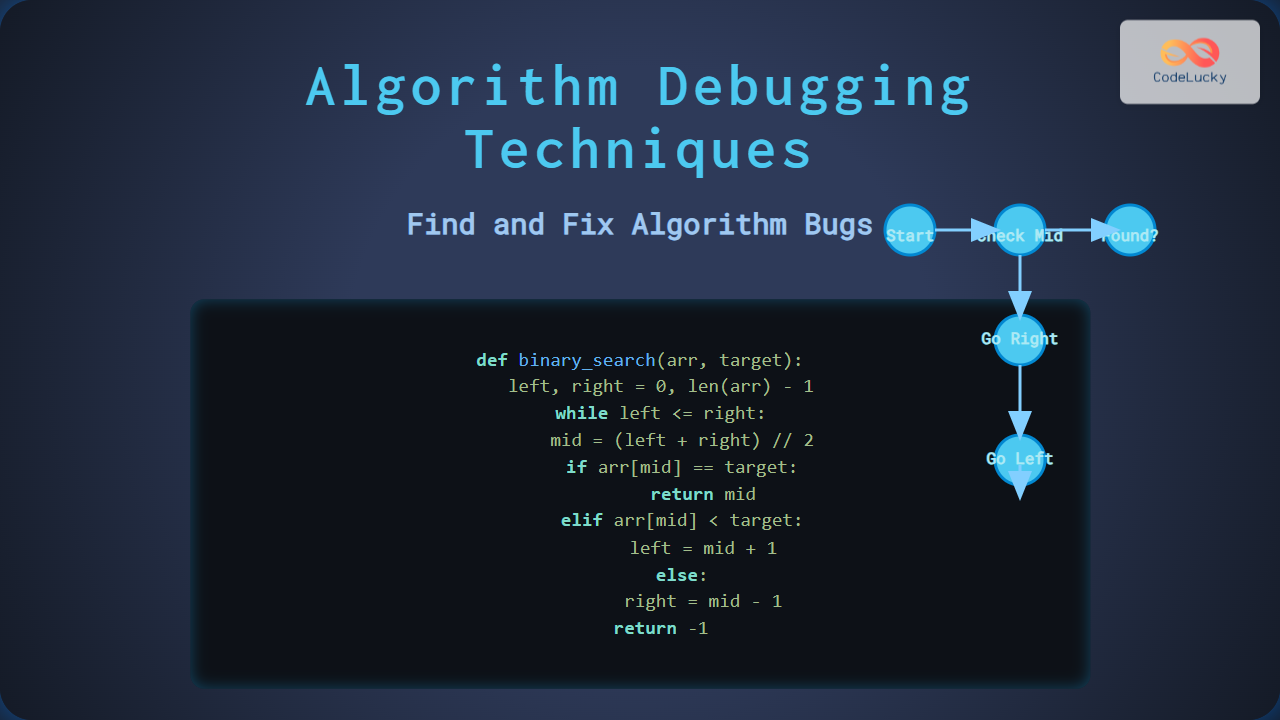
Debugging algorithms is a critical part of programming that ensures the correctness and reliability of solutions. Even well-designed algorithms can produce faulty results due to logic flaws, incorrect assumptions, or implementation errors. By using systematic debugging techniques, you can isolate bugs, trace algorithm behavior, and resolve issues efficiently.
Why Algorithm Debugging Matters
Algorithms are the backbone of computational problem-solving. A small bug in an algorithm can lead to inefficiency, incorrect outputs, or even complete failure of a system. Debugging helps identify logical gaps, prevent wasted computation, and ensures robustness.
Common Types of Algorithm Bugs
- Logic Errors: Incorrect steps or conditions inside the algorithm causing wrong outputs.
- Boundary Errors: Failing at edge cases such as off-by-one errors in loops or incorrect handling of empty inputs.
- Performance Bugs: Algorithms that work correctly but take exponential time due to missing optimizations.
- Incorrect Assumptions: When algorithm design assumes input constraints that are not guaranteed.
- Data Handling Errors: Using wrong data structures or mismanaging memory.
Systematic Debugging Techniques
1. Manual Tracing
Tracing involves simulating your algorithm step-by-step with sample input. This helps verify the logical flow and intermediate outputs.

2. Print Debugging
Insert print statements or logs to track variable changes and decision-making points. For instance, while debugging a sorting algorithm, print the array after each key iteration.
def bubble_sort(arr):
    n = len(arr)
    for i in range(n):
        for j in range(0, n-i-1):
            if arr[j] > arr[j+1]:
                arr[j], arr[j+1] = arr[j+1], arr[j]
        print(f"Pass {i}: {arr}")  # Debug output
3. Unit Testing Edge Cases
Testing edge cases such as empty arrays, very large numbers, or minimal inputs reveals hidden bugs. Always design unit tests that cover:
- Base cases (e.g., smallest input size).
- Boundary extremes (e.g., maximum values within constraints).
- Unexpected inputs (e.g., negative numbers or null values).
4. Using Algorithm Visualization Tools
Visualization tools or custom plots help observe how algorithms behave over time. For example, plotting recursive calls in depth-first search can reveal infinite recursion.

5. Divide and Conquer Debugging
Like the divide-and-conquer strategy in algorithms, debugging can also split the problem space. Isolate different parts of the code and test them independently to find which component introduces errors.
6. Using Assertions
Assertions allow quick sanity checks to ensure algorithm invariants are maintained. For example, during binary search, we can assert that the search interval shrinks each iteration.
def binary_search(arr, target):
    left, right = 0, len(arr) - 1
    while left <= right:
        assert left <= right  # Invariant: interval must shrink properly
        mid = (left + right) // 2
        if arr[mid] == target:
            return mid
        elif arr[mid] < target:
            left = mid + 1
        else:
            right = mid - 1
    return -1
Example: Debugging a Recursive Algorithm
Consider a factorial function. A common mistake is forgetting the base case:
def factorial(n):
    return n * factorial(n-1)  # Bug: no base case!
This causes infinite recursion. Correcting it requires adding a terminating condition:
def factorial(n):
    if n == 0 or n == 1:
        return 1
    return n * factorial(n-1)
Interactive Debugging Example
Run this Python snippet in an interactive environment to observe debugging outputs for a faulty Fibonacci implementation:
def buggy_fibonacci(n):
    if n <= 1:
        return n
    return buggy_fibonacci(n-1) + buggy_fibonacci(n-3)  # Bug: wrong recurrence

for i in range(7):
    print(f"fib({i}) = {buggy_fibonacci(i)}")
Expected outputs will mismatch, helping you notice that the recurrence relation is wrong. Adjusting the second term from n-3 to n-2 resolves the bug.
Best Practices for Algorithm Debugging
- Always start with small input examples before scaling up.
- Use diagrammatic tracing to visualize decision-making paths.
- Add automated test cases covering both normal and edge conditions.
- Apply systematic isolation of code modules when locating bugs.
- Leverage modern debugging tools (IDE debuggers, visualization libraries).
Conclusion
Algorithm debugging is more than fixing errors—it is about strengthening the reliability of solutions. By combining careful tracing, visualization, systematic testing, and intelligent use of debugging techniques, you can not only resolve bugs but also refine your problem-solving skills. Debugging turns mistakes into insights, making you a stronger and more efficient programmer.