When preparing for technical interviews, one of the most critical skills is understanding algorithm complexity analysis. Interviewers often ask you to analyze an algorithm’s performance using Big O notation. This not only demonstrates your coding ability but also your grasp of optimization and scalability—key factors in building efficient software systems.
What is Big O Notation?
Big O notation is a mathematical concept used to describe how the runtime or memory usage of an algorithm grows as the input size increases. Instead of focusing on exact execution time, Big O focuses on growth rate—how your algorithm behaves as the input becomes very large.
For example:
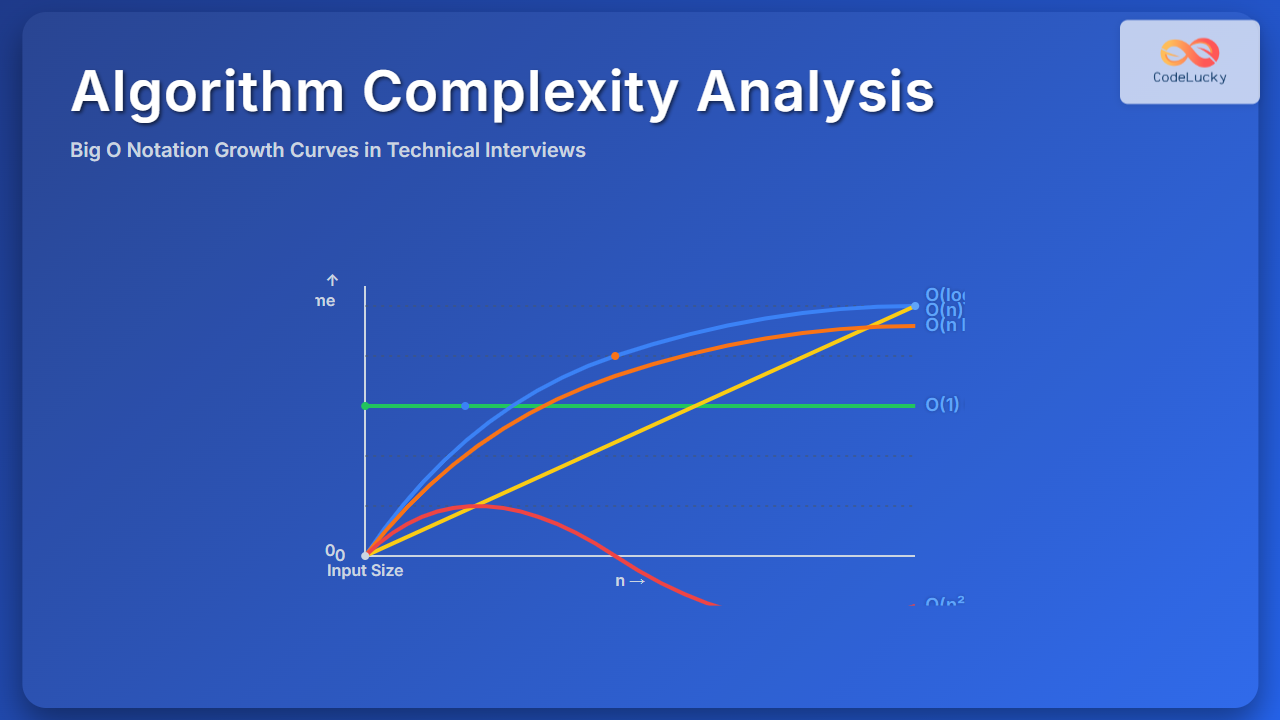
O(1): Constant time – runtime does not depend on input size.O(log n): Logarithmic time – grows slower than input size.O(n): Linear time – directly proportional to input size.O(n log n): Log-linear time – common in efficient sorting algorithms.O(n²),O(n³): Quadratic, cubic – common in nested loops.O(2^n),O(n!): Exponential or factorial – impractical for large inputs.
Visualizing Big O Growth
Why Big O Matters in Interviews
Employers care about scalable solutions. Two algorithms may solve the same problem correctly, but one might scale to millions of users while the other fails quickly. Understanding complexity ensures you can explain trade-offs, pick the right data structures, and discuss optimization strategies confidently.
Real-World Example: Searching
Consider searching for an item in a sorted vs unsorted list:
Linear Search (O(n))
def linear_search(arr, target):
    for i in range(len(arr)):
        if arr[i] == target:
            return i
    return -1
Worst case: checking every element, making it linear time.
Binary Search (O(log n))
def binary_search(arr, target):
    low, high = 0, len(arr) - 1
    while low <= high:
        mid = (low + high) // 2
        if arr[mid] == target:
            return mid
        elif arr[mid] < target:
            low = mid + 1
        else:
            high = mid - 1
    return -1
Binary search eliminates half of the list with each step, making it logarithmic time.

Analyzing Sorting Algorithms
Sorting is a common interview category where complexity analysis is crucial. Here’s a comparison:
| Algorithm | Average Complexity | Worst Case | Space |
|---|---|---|---|
| Bubble Sort | O(n²) | O(n²) | O(1) |
| Merge Sort | O(n log n) | O(n log n) | O(n) |
| Quick Sort | O(n log n) | O(n²) | O(log n) |
Space Complexity in Interviews
Beyond time complexity, interviewers often check for space complexity. For example, recursion may make an algorithm easy to implement but increases memory usage due to function call stack. Being able to analyze both dimensions is essential.
Interactive Thought Exercise
Try to classify the following operations by their complexity:
- Accessing an array element by index – O(?)
- Finding the maximum in an unsorted list – O(?)
- Merging two sorted lists of size n – O(?)
- Checking if a number is prime – O(?)
Answers: O(1), O(n), O(n), O(√n).
Tips to Ace Interview Questions on Complexity
- Always discuss time and space complexity trade-offs explicitly.
- Draw comparison charts or walk through growth examples when possible.
- Don’t just memorize algorithms—practice analyzing new ones.
- Communicate clearly about the best, average, and worst-case runtimes.
Conclusion
Algorithm complexity analysis with Big O notation is a cornerstone of technical interviews. It helps you showcase not only your coding skills but also your ability to design efficient, scalable, and production-ready systems. Train yourself on a variety of classic problems while keeping an eye on efficiency, and you will be better prepared to impress interviewers at top companies.